
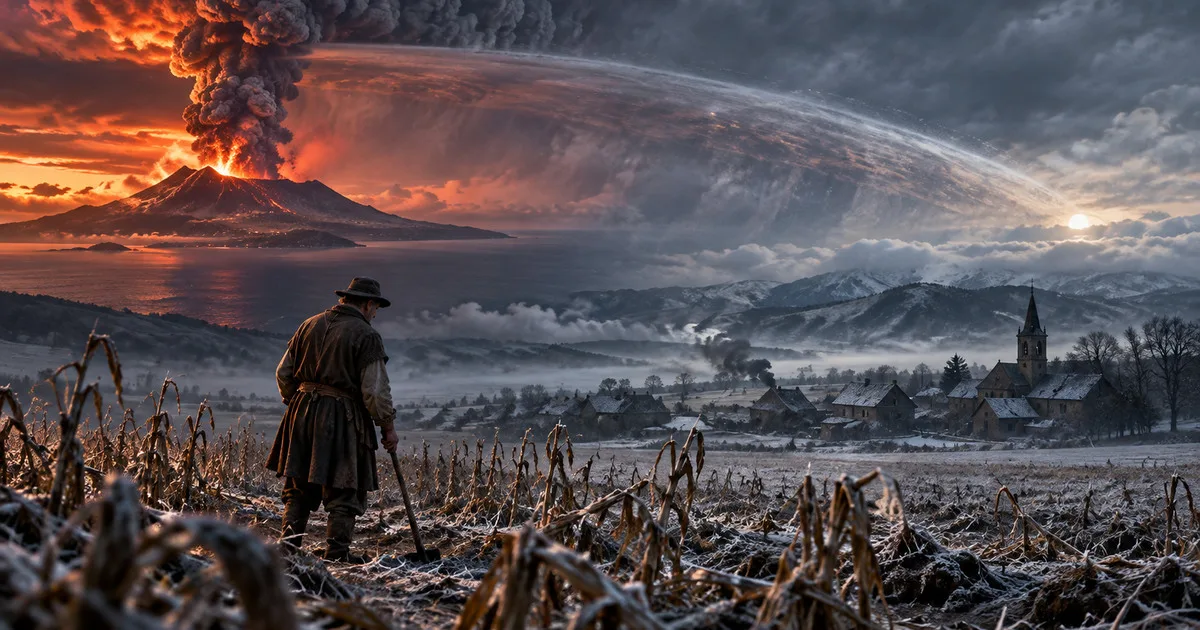
In June 1816, farmers in parts of New England faced a sight that should have belonged to winter: frost and, in some places, snow. Across the Atlantic, an unusually cold, wet European summer threatened harvests. Families watched the sky, worried about food, and struggled to explain why the familiar rhythm of the seasons had broken down.
The answer began more than a year earlier, thousands of miles away, on an Indonesian island. On April 10, 1815, Mount Tambora erupted with such force that it altered the chemistry of the atmosphere. Its most enduring consequence was not the ash that darkened nearby skies, but a thin veil of particles that helped cool the planet.
The result became known as the Year Without a Summer. Yet the phrase can be misleading: summer did not disappear everywhere. What happened was a profound, uneven disruption of climate, agriculture and everyday life — and an extraordinary example of how events in one part of Earth can change life on another continent.
An eruption on an island few Europeans could name
Mount Tambora rises on Sumbawa, in what is now Indonesia. In early April 1815, after years of activity, the volcano entered a devastating explosive phase. Its climax on April 10 produced one of the largest eruptions in recorded history. The Smithsonian Institution’s Global Volcanism Program classifies the eruption as Volcanic Explosivity Index 7, one of the highest categories on the scale.
Explosions, falling ash and fast-moving volcanic flows devastated communities close to the mountain. NASA’s account reports that ash was recognized at least 1,300 kilometers (about 800 miles) away. Scientists’ estimates of the quantity of erupted material vary with the methods and definitions used, but there is no dispute about the eruption’s exceptional size.
It is worth remembering whose disaster this was first. People on Sumbawa and neighboring islands suffered the immediate violence, loss of crops, damaged water supplies and subsequent hunger. The later European weather crisis was global news in retrospect, but the catastrophe began in Southeast Asia.
The invisible ingredient that cooled the world
The common shorthand says Tambora’s ash blocked out the Sun. That is only part of the story, and not the best explanation for why cooling lasted into 1816.
Large ash particles settle out relatively quickly. The longer-lived influence comes from gases, especially sulfur dioxide. When a powerful eruption injects enough of this gas high into the stratosphere, it can react to form tiny sulfate droplets. Those aerosols scatter some incoming sunlight back toward space, reducing the energy reaching Earth’s lower atmosphere.
The U.S. Geological Survey explains this mechanism clearly: sulfate aerosols, not a permanent blanket of falling ash, are central to the cooling produced by major explosive eruptions.
A geochemical study of Tambora estimated that the climactic eruption released roughly 53–58 million metric tons of sulfur dioxide. This is a scientific estimate reconstructed from volcanic deposits, not a direct measurement made in 1815.
Imagine a very thin, worldwide atmospheric sunshade. It does not make every afternoon dark or every location freezing. Instead, it slightly alters Earth’s energy balance — enough that ordinary weather patterns can become unusually damaging when they interact with that cooler background.
Why the worst summer arrived a year later
Tambora’s eruption climaxed in April 1815, but the most famous cold summer came in 1816. That delay was not a mystery in the way it might first appear.
Stratospheric aerosols can spread over large areas and persist for months or longer. Land and ocean respond at different speeds, while atmospheric circulation shapes where the cooling and rainfall anomalies become most pronounced. The effects therefore unfold over seasons rather than appearing everywhere at once on the day of the eruption.
In the northeastern United States, historical observations describe damaging summer frosts and episodes of snow. In parts of Europe, persistent rain and unusual cold combined to create especially difficult agricultural conditions. The University Corporation for Atmospheric Research documents these contrasting experiences.
But the term Year Without a Summer should not be read literally or globally. It is a name for a striking climate anomaly most famously documented in Europe and parts of North America. Not every country had the same weather, and not every bad harvest can be assigned to a single volcano.
The science is stronger — and more nuanced — than the legend
Could the miserable European summer simply have happened because of normal atmospheric variability? Climate scientists have tried to separate the eruption’s influence from the ordinary circulation patterns that also shape weather.
In a 2019 attribution study published in Environmental Research Letters, researchers compared historical conditions with climate-model simulations. The background circulation could explain much of the rainfall anomaly on its own, but only around one quarter of the unusual cold. Including the volcanic influence made a summer as cold as Europe’s 1816 event up to 100 times more likely in the models. For the unusual precipitation, the estimated increase in likelihood was more modest: roughly 1.5 to 3 times.
Those numbers concern modeled likelihoods of an extreme European summer, not the probability that any individual person experienced a frost. They also do not mean Tambora was the sole cause of every storm, crop failure or economic hardship.
And Tambora was not acting in a perfectly stable climate. Ice-core research has identified evidence of another major, still-unidentified eruption around 1809 that contributed to the unusually cold 1810s. The event of 1815 was the crucial additional shock, not the only climate influence of the decade.
When a colder summer became a food crisis
A few unusually cold days can damage an entire growing season. A late frost may kill newly planted crops; persistent wet conditions can make sowing and harvesting difficult; poor yields push prices up precisely when families need supplies most.
Records from the Czech Lands show an extremely cold summer in 1816, followed by poor grain harvests and widespread increases in grain prices in 1817, according to a historical-climate study in Climate of the Past. Similar combinations of unfavorable weather and scarcity affected other European regions and parts of North America.
The consequences fell unevenly. Wealthier households could often absorb higher food prices better than laborers and small farmers. Regions already suffering from war, poverty or fragile supplies were more vulnerable. The human impact depended on local conditions, institutions and access to food as well as temperature.
It is tempting to attach one dramatic worldwide death toll to the Year Without a Summer. That would give an impression of certainty the historical record cannot support. Direct losses from Tambora and later deaths involving hunger and disease are difficult to separate, and published estimates differ widely. The more defensible conclusion is that the eruption contributed to serious human suffering both near the volcano and far beyond it.
A surprising cultural aftershock: Frankenstein
The climatic disruption also left traces in literature.
In the summer of 1816, Mary Godwin (later Mary Shelley) spent time near Lake Geneva with Percy Bysshe Shelley, Lord Byron and their circle. Wet, gloomy weather kept them indoors for part of the visit. A ghost-story challenge helped inspire the story that became Frankenstein, published in 1818.
The weather did not create the novel on its own. Shelley brought her own imagination, reading, experiences and fascination with scientific possibility. But the unusual summer was part of the setting in which the idea emerged — a rare connection between volcanic chemistry, European weather and one of literature’s most enduring stories.
How do scientists know Tambora caused the cooling?
No one in 1816 had a satellite measuring volcanic gases or a modern global temperature network. Today’s evidence combines independent lines of investigation:
- Volcanic deposits tell researchers about the size and timing of Tambora’s eruption.
- Polar ice cores preserve chemical traces from sulfate aerosols transported through the atmosphere.
- Historical weather records, diaries and harvest reports document where unusual conditions occurred.
- Climate models test how much of the observed cooling is consistent with volcanic forcing rather than internal weather variability.
Each type of evidence has limits. Taken together, they support a remarkably coherent explanation without requiring every cold day of 1816 to be blamed on Tambora.
Could another volcano steal a summer today?
A sufficiently powerful eruption injecting substantial sulfur dioxide into the stratosphere could temporarily cool Earth’s surface again. That possibility is not speculation: the physics has been measured after more recent eruptions, including Mount Pinatubo in 1991. The USGS describes how such aerosol clouds influence the amount of sunlight reaching the lower atmosphere.
But a volcanic cooling episode would not be a permanent solution to modern global warming. The sulfate veil fades, whereas long-lived greenhouse gases continue to accumulate unless emissions are reduced. The two mechanisms operate differently and on different timescales.
The central lesson of 1816 is not that Earth suddenly forgot how to make summer. It is that a chain of physical processes — eruption, sulfur gases, stratospheric aerosols, altered energy balance and regional weather — can connect one mountain to distant fields, food prices and even cultural history.
More than two centuries later, Tambora remains one of the clearest reminders that the planet is a connected system, and that understanding the mechanism is often more astonishing than the legend.
Quick answers
Did summer literally vanish everywhere in 1816? No. The phrase refers chiefly to extraordinary cold and poor growing conditions in parts of Europe and North America. Effects varied by region.
Was ash the main reason temperatures stayed low? Sulfate aerosols formed from volcanic sulfur dioxide were a major driver of the sustained cooling. Much of the larger ash fell out much sooner.
Why was 1816 worse than 1815 in many places? The atmospheric aerosol veil spread and affected the climate over subsequent months, interacting with regional weather patterns during the next growing season.
Did Tambora directly cause Frankenstein? No. The wet summer contributed to the circumstances surrounding Mary Shelley’s writing, but the novel’s origin was more complex.
Sources
- Smithsonian Institution — Global Volcanism Program: Tambora. Eruption classification, timing and geological context.
- NASA Earth Observatory — Mount Tambora Volcano. Historical eruption and satellite-image context.
- U.S. Geological Survey — Volcanoes Can Affect Climate. Sulfur dioxide and sulfate-aerosol mechanism.
- Self et al. (2004), Geophysical Research Letters. Sulfur-dioxide emission reconstruction.
- Schurer et al. (2019), Environmental Research Letters. Climate-attribution analysis of the European summer.
- Brázdil et al. (2016), Climate of the Past. Weather, agriculture and prices in the Czech Lands.
- Cole-Dai et al. (2009), Geophysical Research Letters. Ice-core evidence for another major 1809 eruption.
- British Library — Mary Shelley’s Frankenstein. The 1816 Geneva summer and literary context.