
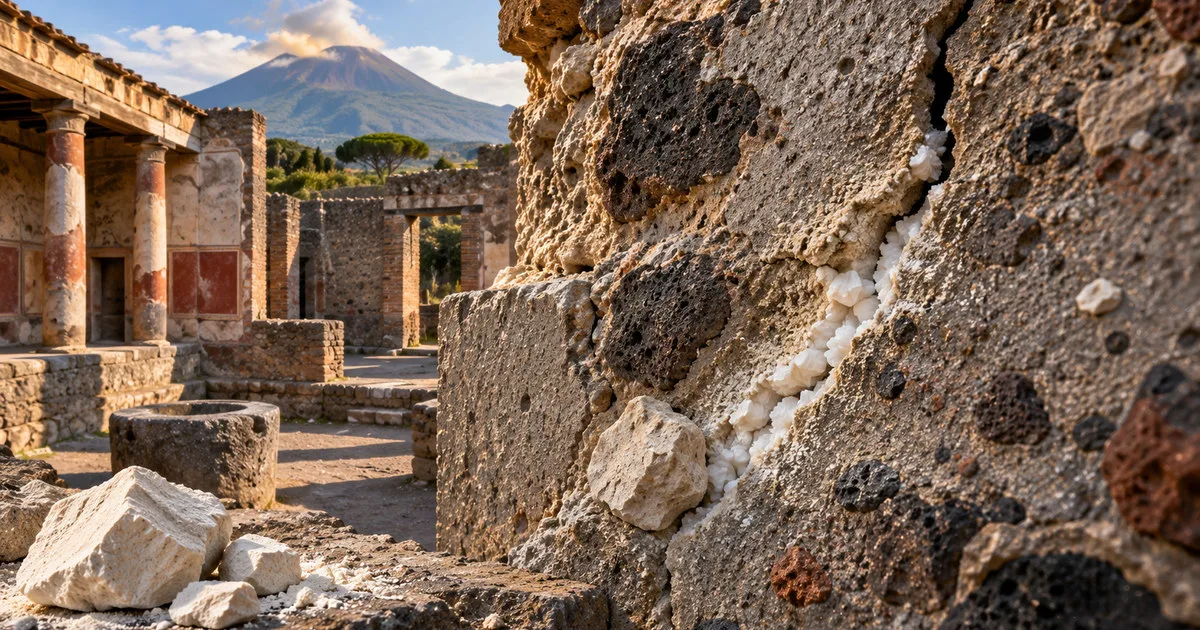
Picture a Roman mason inspecting a wall roughly two thousand years ago. In its mortar are small, pale fragments that might look like evidence of careless mixing. Today, those fragments are central to an intriguing possibility: some Roman concrete could help seal its own cracks.
Not through an ancient chemical miracle, and not by reversing every kind of damage. The proposed mechanism is more elegant. When a small crack admits water, certain calcium-rich particles left inside the mortar can release material that later crystallizes in the gap. Researchers have recreated that process in modern, Roman-inspired mixtures. And an unfinished building site buried by Mount Vesuvius has supplied unusually direct evidence of how Roman workers prepared their materials.
That makes the real question more interesting than the legend: What did Roman builders put into their concrete, and how could it keep reacting long after the wall hardened?
First, Roman concrete was not one universal recipe
Concrete is a composite: particles of stone or other aggregate held together by a binding material. Romans used combinations of lime, volcanic materials, rubble, and aggregates to construct walls, vaulted spaces, harbors, and other infrastructure. Materials and methods varied across locations, projects, and periods.
That variation matters. The concrete in a land-based wall was not necessarily made or exposed to the elements in the same way as concrete in a Mediterranean harbor. Long-term reactions in seawater can create different minerals from those that develop in a building’s mortar.
The much-admired durability of Roman structures is also not evidence that every Roman building survived without repairs. We see a surviving subset of a vast ancient building tradition, shaped by construction quality, exposure, maintenance, and centuries of loss. The 2023 study in Science Advances investigated a specific mechanism that may help explain part of this longevity, rather than claiming to have discovered the only secret to all Roman concrete.
The white fragments that turned out to be clues
In samples of ancient Roman mortar, researchers repeatedly noticed small, bright, lime-rich lumps known as lime clasts. These inclusions had often been treated as signs of poor mixing or inadequate processing.
But Admir Masic and colleagues examined mortar from the ancient city wall at Priverno, Italy, using microscopy and chemical mapping. They studied not only what the clasts contained, but also the different chemical regions around them: their interiors, outer rims, and interfaces with the surrounding mortar.
That microscopic evidence pointed toward a preparation method called hot mixing. Instead of first fully combining lime with water to make a uniform paste, workers could mix quicklime with dry volcanic material and other ingredients, then add water. The process would leave behind some highly reactive calcium-rich fragments. Their irregularity was not necessarily a flaw; it could become a useful feature of the finished material.
The team’s findings appeared in January 2023. At that stage, the inferred ancient mixing technique was supported by material analysis, but the exact workflow of Roman builders still needed better archaeological confirmation. Read the original research.
What makes a concrete mixture ‘hot’?
The chemistry begins with limestone, a rock rich in calcium carbonate. Heating limestone in a kiln produces quicklime, or calcium oxide (CaO), releasing carbon dioxide during that process. When quicklime meets water, it undergoes an exothermic reaction—one that releases heat:
Calcium oxide + water → calcium hydroxide + heat
Or, in chemical notation: CaO + H₂O → Ca(OH)₂.
In the hot-mixing scenario, that heat is generated within a mixture that also contains volcanic ash or other reactive mineral ingredients. The ingredients then participate in cement-forming reactions. Volcanic particles are not merely inert sand; their reactive components can combine with calcium-bearing material to form binding phases.
Crucially, the reaction need not consume every bit of lime in exactly the same way. Some lime-rich clasts remain embedded in the hardened mortar, often with chemically altered outer zones and more reactive interior regions. Under particular conditions, they can act as local reservoirs of calcium.
That is the central distinction between ‘the Romans mixed something badly’ and ‘the material may have been designed, or at least produced, in a way that gave it useful future chemistry.’ The evidence shows a technique and its effects; it does not prove that every ancient mason consciously understood the microscopic mechanism now described by scientists.
How a crack can begin to seal itself
A crack changes the environment inside hardened concrete. Water can enter spaces that were previously enclosed, interact with exposed mineral surfaces, and transport dissolved substances.
In the proposed Roman-concrete mechanism, a crack encounters one or more reactive lime clasts. Contact with water makes calcium-bearing compounds available in solution. As that solution moves through the narrow opening and reacts with dissolved carbon dioxide or carbonate species, calcium carbonate can precipitate.
Calcium carbonate is the mineral family that includes calcite—a major constituent of limestone. Here, newly formed mineral crystals can occupy space inside the crack. In effect, the material uses water, which often contributes to deterioration, as part of a limited repair process.
The reaction is not a living process, and the wall is not rebuilding itself from scratch. Scientists call this form of natural, internally driven repair autogenous healing. Its success depends on conditions such as crack width, available calcium, water movement, and the chemistry of the surrounding material.
The same calcium-rich environment may also support later reactions involving volcanic particles. Such post-setting changes can alter the microstructure over time. These are related phenomena, but a newly mineral-filled hairline crack should not be confused with restoring a collapsed arch or reversing severe structural damage.
The experiment: a crack about half a millimeter wide
An appealing story becomes stronger when researchers test it. In the 2023 Science Advances paper, the team prepared modern Roman-inspired cementitious samples containing quicklime-derived clasts, as well as comparison samples without those clasts.
They deliberately fractured specimens and brought the pieces back together, leaving gaps approximately 0.5 ± 0.1 millimeters wide. Then they ran water through the cracked samples and measured how the flow changed.
In clast-containing samples, flow through the cracks decreased over roughly one to three weeks, ultimately reaching negligible or zero flow during the 30-day monitoring period. The comparison materials lacking the reactive clasts did not show the same effective sealing behavior. Microscopic examination found fresh mineral deposits inside the formerly open gap, and Raman measurements identified calcite.
These observations directly support the claim that this particular material design can seal certain cracks. But three qualifications are essential:
- The tested material was a modern reconstruction, not a two-thousand-year-old wall being deliberately cracked in the laboratory. One formulation used modern Portland cement and fly ash alongside added quicklime.
- Sealing water flow is not identical to recovering original structural strength. The experiment demonstrated crack filling and reduced permeability, not a universal restoration of load-bearing capacity.
- The result is conditional. Larger fractures, different exposure conditions, fewer reactive clasts, or different mixtures may behave differently.
That is why the scientifically defensible headline is that Roman-inspired chemistry can promote self-healing—not that ancient concrete is indestructible.
Pompeii gave researchers an ancient construction site frozen in time
The most compelling historical follow-up came from a place famous for tragedy rather than engineering: Pompeii.
When Mount Vesuvius erupted in 79 CE, it buried rooms that were still being built or repaired. Excavations in Regio IX uncovered a preserved work area, including building materials, partially finished walls, and dry piles prepared for construction.
In a study published on December 9, 2025, in Nature Communications, researchers examined those materials with archaeological and chemical methods. They identified evidence that quicklime had been mixed into dry pozzolanic material before water was added. That sequence matches the central prediction of hot mixing.
The significance is easy to miss. The 2023 investigation had worked backward from hardened mortar to infer its preparation. The Pompeii site offered a view of raw ingredients at an interrupted stage of construction—much closer to seeing the process itself. The team also studied partially completed and finished masonry, tying the dry ingredients to the material’s later chemical structure.
The findings do not mean ancient written instructions were useless or that all Roman recipes were identical. In fact, the research adds nuance to the influential account of Vitruvius, who described preparing lime with water before mixing it with other ingredients. Written recipes may record one method while excavated construction sites preserve evidence for others, and the interpretation of ancient terminology remains a scholarly question.
The MIT account of the Pompeii study describes the site as an important independent check on how the hot-mixing process actually worked.
Volcanoes helped build Rome—but not in only one way
Quicklime is one part of the explanation. Another is the volcanic material that Roman builders incorporated into many mixtures.
A pozzolan is a material containing reactive silica or alumina that can react with calcium-rich compounds in the presence of water, helping form binding products. Volcanic ash from suitable deposits gave Roman builders access to a remarkable set of ingredients. The precise mineral composition and preparation affected how the mortar developed over time.
For Roman marine concrete, prolonged interaction with seawater created another fascinating chemistry. A 2017 study led by Marie Jackson documented mineral growth involving phillipsite and aluminum-rich tobermorite inside ancient harbor concrete. The seawater and volcanic minerals could participate in reactions that refined pore spaces and created additional binding phases. Read the marine-concrete research.
That does not mean seawater makes all concrete stronger, or that every Roman wall contains the same crystals. Marine and land-based recipes and exposure environments differ substantially. The broader lesson is that certain ancient concretes were chemically active systems whose internal minerals could continue changing long after initial setting.
Could modern buildings learn from this?
Concrete remains indispensable to modern infrastructure, but producing cement carries a significant environmental burden, including carbon emissions from fuel use and limestone processing. Durability matters because structures that last longer may require less repair, replacement, and additional material.
The Roman-inspired experiments suggest a design strategy: place suitable reactive mineral reservoirs inside a material so that small cracks can eventually be sealed. That could help control water intrusion, one important pathway for long-term damage.
It would be misleading, however, to declare the ancient recipe automatically greener or stronger. Making quicklime also releases carbon dioxide. Modern concrete must meet demanding standards for strength, predictable setting, reinforcement compatibility, freeze-thaw resistance, long-term performance, and cost. And the durability challenges of reinforced concrete often involve steel corrosion—an issue not addressed simply by copying a Roman mortar formula.
Researchers and manufacturers therefore aim to adapt useful principles, not reproduce a Roman harbor wall as a universal replacement for modern construction. Whether a new formulation cuts lifetime emissions is a question for measured performance and full lifecycle assessment, not a conclusion that follows from its antiquity.
Does Roman concrete actually repair itself?
Sometimes, in a specific and limited sense, it may. Ancient lime-rich mortar contains structures consistent with a proposed calcium-driven healing process. Modern mixtures inspired by those structures have demonstrated mineral filling of experimentally created cracks. The Pompeii construction site has strengthened the case that hot mixing was genuinely practiced by Roman builders.
What remains uncertain is how widely the mechanism operated across different Roman structures, how much it contributed to each survivor’s lifespan, and how reliably it can be engineered into today’s large-scale construction.
The most striking fact is not that Rome possessed a lost magic formula. It is that a rough-looking white fragment, once dismissed as a manufacturing imperfection, may have helped a wall respond to damage long after the workers who built it were gone.
That is a different kind of ancient ingenuity: not a material that never cracks, but one whose chemistry can sometimes make a crack less consequential.
Sources
- Seymour, L. M., Maragh, J., Sabatini, P., Di Tommaso, M., Weaver, J. C., and Masic, A. (2023). Hot mixing: Mechanistic insights into the durability of ancient Roman concrete. Science Advances, 9(1), eadd1602. Original materials analysis and experimental crack-sealing study.
- Vaserman, E., Weaver, J. C., Hayhow, C., et al. (2025). An unfinished Pompeian construction site reveals ancient Roman building technology. Nature Communications, 16, 10847. Evidence from dry material piles, walls, and construction-site tools, published December 9, 2025.
- MIT News (2025). Pompeii offers insights into ancient Roman building technology. Institutional report providing archaeological and historical context.
- Jackson, M. D., Mulcahy, S. R., Chen, H., et al. (2017). Phillipsite and Al-tobermorite mineral cements produced through low-temperature water-rock reactions in Roman marine concrete. American Mineralogist, 102, 1435–1450. Study of long-term reactions in Roman maritime structures.
- Allard, C. (2023). Self-healing Roman concrete. Nature Reviews Materials, 8, 80. Independent research highlight discussing the hot-mixing study.