
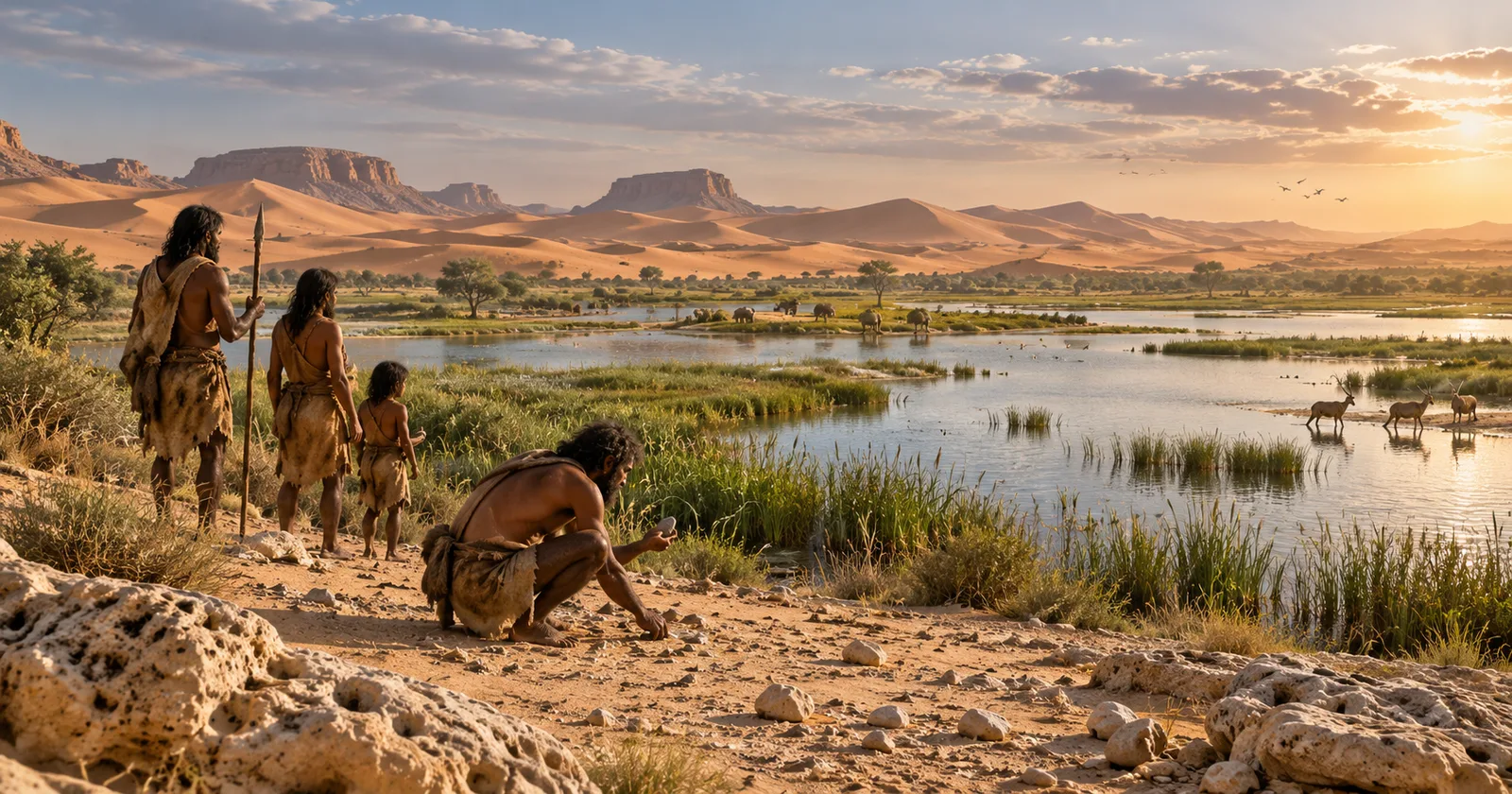
Imagine arriving at a lake in the middle of the Arabian Peninsula tens of thousands of years ago. There is fresh water. The surrounding landscape is greener than the desert we know today. For a group of prehistoric travelers, it sounds like a promising place to stop.
But what if something essential is missing—not food or water, but the right kind of rock?
A study published in Nature on October 28, 2026, proposes that this overlooked resource helps explain a puzzle of ancient Arabia: some places that once had lakes show surprisingly little archaeological evidence of people living there. The answer may lie beneath our feet. Dellmour et al., Nature (2026)
The desert was not always a desert
Today, the Rub’ al Khali—the Empty Quarter—is a vast sand sea across the southern Arabian Peninsula. It is difficult to cross, and much of it is exceptionally dry. But its present appearance is a poor guide to its distant past.
During wetter phases of the Pleistocene, changing rainfall patterns created lakes, wetlands and grassier landscapes in parts of Arabia. Researchers sometimes call these recurring humid episodes Green Arabia. That name does not mean the entire peninsula was continuously lush. It means the environment changed dramatically at particular times and places.
These ancient lakes matter because researchers often use past freshwater locations to predict where people might have traveled or settled. Find the old water, the logic goes, and you may find the archaeological traces of humans who depended on it. Nature: Stone and water governed early human settlement of the desert
But the Empty Quarter did not follow that expectation.
A 1,500-kilometer search—and a striking absence
An international research team conducted a roughly 1,500-kilometer geoarchaeological survey across the Rub’ al Khali. They investigated 125 localities. At 55 of them, they documented deposits left by ancient lakes.
The investigators did not rely on the shape of the dunes alone. Evidence included lake sediments and remains such as freshwater mollusks. Some deposits in the region are associated with wetter periods roughly 122,000 to 67,000 years ago—an interval that overlaps known prehistoric occupation around the desert’s margins.
Yet the survey found no stone-tool artifacts at the investigated localities. This was especially striking because the team reported high visibility of the exposed ground, and archaeological sites from broadly comparable periods are known near the edges of the desert. Original field study, Nature
The result does not mean nobody ever crossed this landscape. Archaeology rarely proves an absolute absence. But the pattern raised a pointed question: if water was available, why was there so little evidence of sustained occupation in the surveyed interior?
The missing ingredient was stone
For people who relied on stone tools, a lake was only one part of a livable landscape. They also needed rock that could be fractured predictably into sharp edges—for cutting, scraping, shaping wood or processing food.
This property is sometimes called knappability. Materials such as flint or chert can break in ways that let an experienced toolmaker control the shape of a cutting edge. Not every stone is suitable. Some rocks are too crumbly, others fracture poorly, and some landscapes simply expose very little usable tool stone.
The central Empty Quarter is one of those landscapes. In the study, rock suitable for toolmaking was found only near the western and eastern ends of the investigated route, not across the long intervening interior. The nearest known suitable outcrops to some surveyed basins were more than 200 kilometers away. Dellmour et al., Nature
That creates a practical problem. A traveler might carry a finished tool across a large distance. A community living in one place for years would need a dependable supply of toolmaking material, replacement pieces and ways to repair worn edges.
The researchers’ argument is not that prehistoric people were incapable of carrying stone. It is that occasional travel and long-term settlement have very different material demands.
Why didn’t rivers bring the stone to the lakes?
This is where the geology becomes especially interesting.
Rivers can carry rock fragments downstream. A river-fed lake might receive gravel that includes useful stone from distant bedrock. But the researchers interpret many of the Empty Quarter’s ancient lakes as groundwater-fed. Water could appear without a river delivering fresh supplies of toolmaking rock.
That combination—water without suitable stone—may have produced oases that looked promising in climate models but were difficult places for stone-tool-dependent groups to occupy for long. Original study: field survey and geological interpretation
In other words, a lake could solve the thirst problem while leaving the tool problem untouched.
A model that changes the map
To test whether this idea went beyond one expedition, the team combined reconstructed water access with geological maps of likely tool-stone availability. They compared the model with known Middle Paleolithic and Middle Stone Age archaeological locations, including evidence from Oman.
Their peninsula-wide analysis estimated that about 57% of water-accessible terrain lay on geological formations classified as lacking suitable stone. Adding the stone layer improved the model’s ability to distinguish known archaeological site locations, compared with using water proximity alone. Dellmour et al., Nature
This percentage is a result of the researchers’ mapping method, not a literal census of every rock on the peninsula. Local exposures can be missed by maps, and different technologies can change how much stone people need.
Still, the broader lesson is powerful: two regions with water may offer very different possibilities for settlement. A useful map of the human past needs to account for resources, not just climate.
What the discovery does—and does not—prove
The study offers an explanation supported by field observations and spatial modeling. It does not establish that the Empty Quarter was never visited, that all ancient Arabians avoided it, or that stone was the only factor affecting where humans lived.
There are other complications. Archaeological traces may be buried or destroyed, some visits leave few visible remains, and evidence from different periods does not always line up perfectly. Future discoveries could change the picture.
The authors explicitly leave room for small, short-lived activity sites to be discovered in the interior. What their evidence weighs against is the expectation of substantial, archaeologically visible settlement in the surveyed lake-rich interior during the periods investigated. Original study and discussion of limitations
An accompanying Nature commentary describes the work as a reminder that freshwater does not, by itself, predict prehistoric occupation. Cancellieri, Nature News & Views (2026)
A different way to think about human migration
We often imagine prehistoric migration as a search for green land and clean water. Both mattered enormously. But human survival also depended on the raw materials that made technology possible.
The new findings invite us to picture ancient Arabia not as one continuous green corridor whenever the rains returned, but as a patchwork of places where several necessities happened to overlap. Some lakes may have been attractive stopping points. Others may have been poor candidates for lasting settlement despite their water.
That is the extraordinary part of this story: a lake could be full, the land could be greener, and yet the missing resource was a rock sharp enough to make a tool.
When you imagine a prehistoric oasis, what would you look for first—water, food, shelter or stone?
Sources
- Dellmour, R. W. et al. (2026). Stone and water governed early human settlement of the desert. Nature. DOI: 10.1038/s41586-026-11180-5
- Cancellieri, E. (2026). Tethered to stone: how rock and water availability shaped early desert occupation. Nature News & Views
- Institute of Archaeology of the Czech Academy of Sciences (2026). Stone and Water Determined Human Settlement of the Desert
- Research data and archaeological records — Open Science Framework