
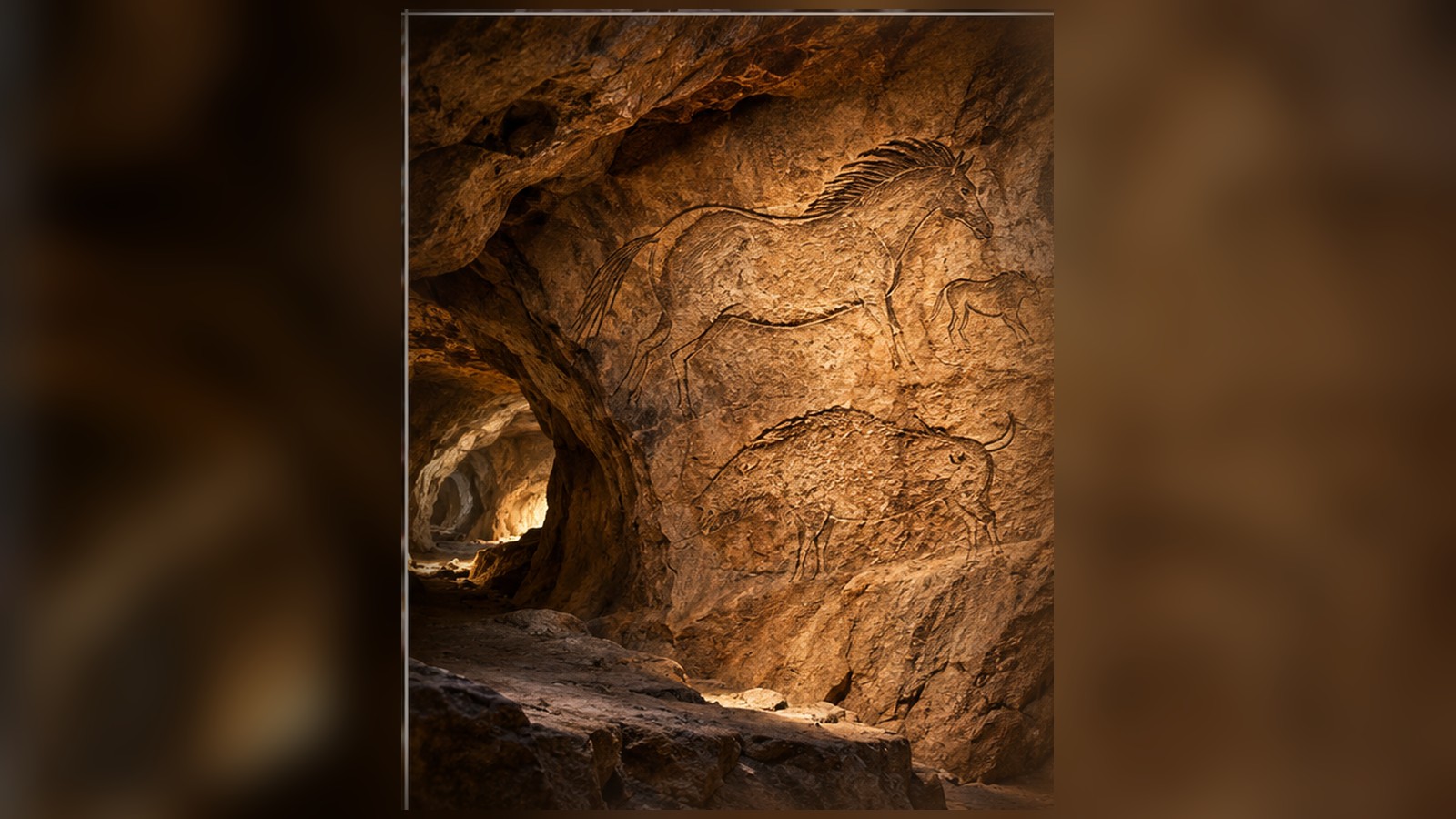
There is something strange about discovering a hidden work of art in a place people have visited for decades. It is not concealed behind a locked door or buried beneath meters of sediment. It is right there on the wall — but almost nobody has known how to see it.
That is part of the story emerging from Cova de la Font Major, a cave system in Catalonia, northeastern Spain. In a study published in the journal Antiquity on November 5, 2026, archaeologists described 280 Palaeolithic engravings, including 55 representations of animals.
Some of this artwork has been estimated to date back roughly 26,000 years, although researchers use archaeological comparison and stylistic evidence to establish broad periods rather than a precise birthday for every line.
The remarkable part is not simply the age. This is a cave system that has been known and visited for many years. The engravings remained easy to miss because they are often shallow, obscured by other markings and visible only under carefully directed light.
A discovery made in 2019 — published in detail in 2026
The new study does not mean that archaeologists first entered the cave this week. The initial recognition of Palaeolithic marks occurred in 2019, when archaeologist Josep Maria Vergès Bosch identified some engravings among later graffiti during work in the cave.
Vergès Bosch and Míriam Salas-Altès subsequently documented and analyzed the wider assemblage. Their 2026 paper, Filling gaps: the Palaeolithic rock art of the Cova de la Font Major on the north-east Iberian Peninsula, presents the collection as one of the largest known Palaeolithic cave-art groups in the Iberian Mediterranean region.
This timeline is important: the news in November 2026 is the published research and its implications, not a claim that 280 marks were suddenly noticed for the first time yesterday.
The cave stretches over kilometers of passages and has a long history of human use. It has also been open to the public for decades, becoming a museum site in the 1990s. That history means the walls contain traces of different eras — and makes separating old engravings from modern markings an unusually demanding task.
Why did nobody notice the pictures?
A carved line does not always look like the dark outline in a museum photograph. In a cave wall, a groove may be only a subtle change in texture. Shine a light directly onto it and the surface can appear almost flat; move the light sideways and the groove casts a shadow that suddenly reveals its shape.
This is one reason archaeologists often document rock art using carefully controlled illumination, photography and detailed tracing. The same wall can reveal very different information depending on viewing angle and technique.
At Font Major, some figures also incorporate natural cracks and irregularities in the stone. The artists did not always start with a blank surface. They could use the existing wall as part of the composition — for example, allowing a crack to stand in for a line in the depicted scene.
The result is an encounter between natural geology and human intention. It asks a difficult question: when does a line in stone become an image, and how can we distinguish deliberate art from weathering or later marks?
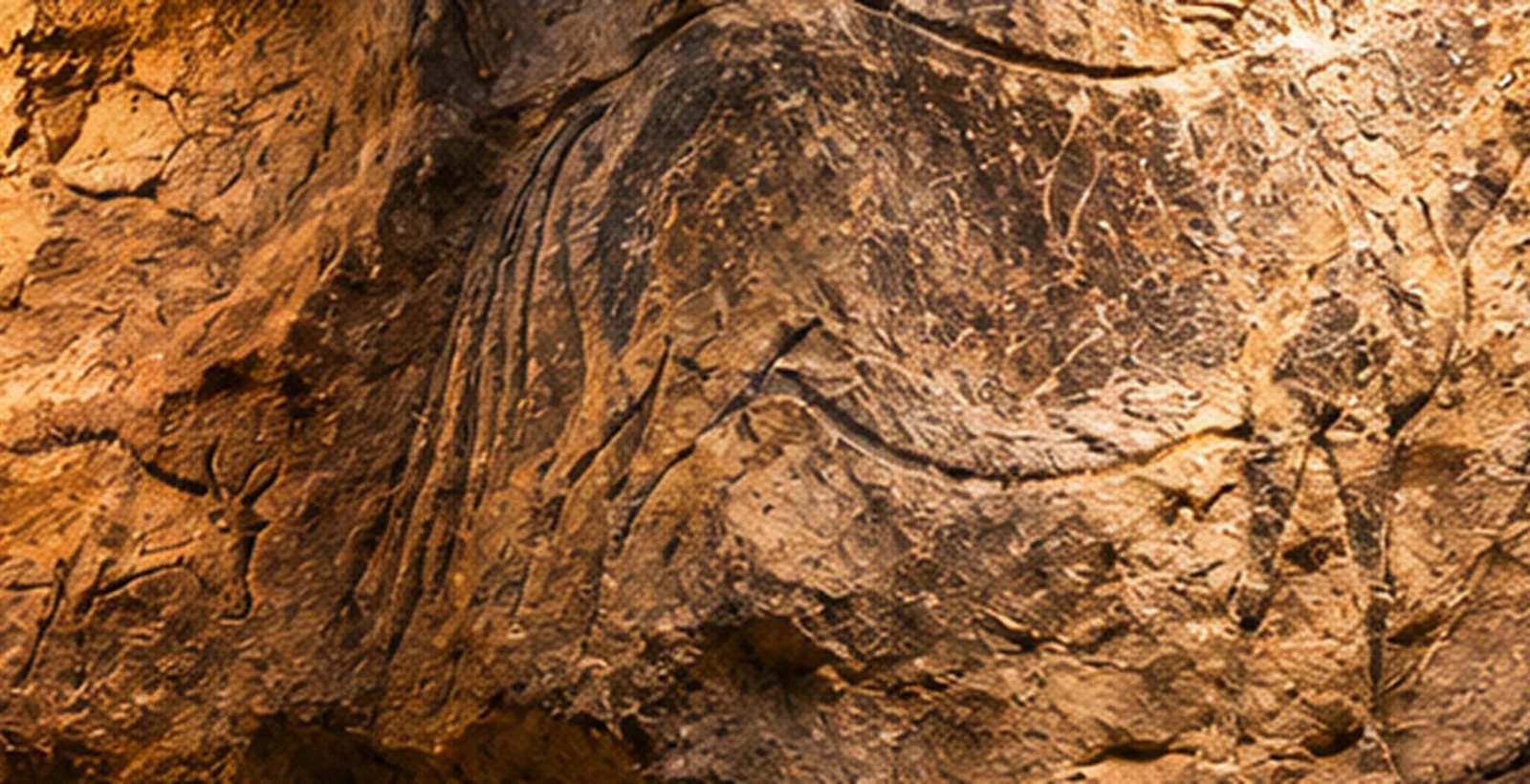
Animals, abstract marks and possible movement
Among the 280 motifs, the researchers identified 55 animal figures. Reports of the study describe depictions that include horses and large mammals, alongside a much broader collection of nonfigurative marks.
Not every engraved line has an obvious modern interpretation. Some are loops, groups of strokes or abstract shapes. It would be a mistake to assume that every mark corresponds to a recognizable animal, a fixed symbol or a message we can now translate.
Particularly intriguing are features that seem to suggest movement. Some figures may have been designed to exploit their position, multiple contours or the lighting of the cave surface, leading scholars to discuss possible visual effects. That is a research interpretation, not proof that people were producing animation in the modern sense of moving pictures.
Instead, the work offers an opportunity to study how Palaeolithic people used space, light and irregular surfaces to communicate visually.
Why the location matters
One of the study’s most significant claims concerns geography, not just artistry. Before this discovery, substantial Palaeolithic cave art was comparatively scarce in the northeastern Iberian Peninsula.
A missing mark on an archaeological map can have at least two interpretations: perhaps ancient people did not make much art there, or perhaps archaeologists have not yet found — or correctly identified — what survives.
Font Major adds a large, complex assemblage to a region previously thought to have little of this kind of art. That challenges assumptions about the distribution of artistic traditions and invites researchers to revisit caves and rock shelters that might have been overlooked.
This is also why claims that ‘prehistoric people were absent from the region’ would be misleading. The paper’s contribution is to the known record of Palaeolithic parietal art — art on cave or rock surfaces — and how researchers interpret its regional distribution.
How old are the engravings, exactly?
The headline figure of approximately 26,000 years is useful as an indication of deep time, but an engraved groove cannot ordinarily be read like a calendar. Dating cave art can depend on the relationship between marks and surrounding deposits, stylistic comparison, archaeological context and, where available, scientific dating techniques.
The Antiquity paper places numerous representations in pre-Magdalenian phases. This is a chronological interpretation of the assemblage, not a claim that all 280 marks were made in a single year or by the same group.
That distinction makes the discovery more interesting, not less: caves can preserve layered human activity across enormous spans of time. The artwork may belong to different moments of use.
What comes next
A collection of this size offers researchers questions about artistic techniques, repeated motifs, how images were arranged across passages and how people interacted with natural rock formations.
It also creates a conservation challenge. Places accessible to visitors need careful management so that modern contact, lighting and environmental changes do not damage fragile traces of the past.
The most immediate lesson is a humbling one. Modern viewers can walk past the same wall for years and miss what is there. Sometimes archaeology does not have to dig deeper to change history. It has to look at an old surface in a new light.