
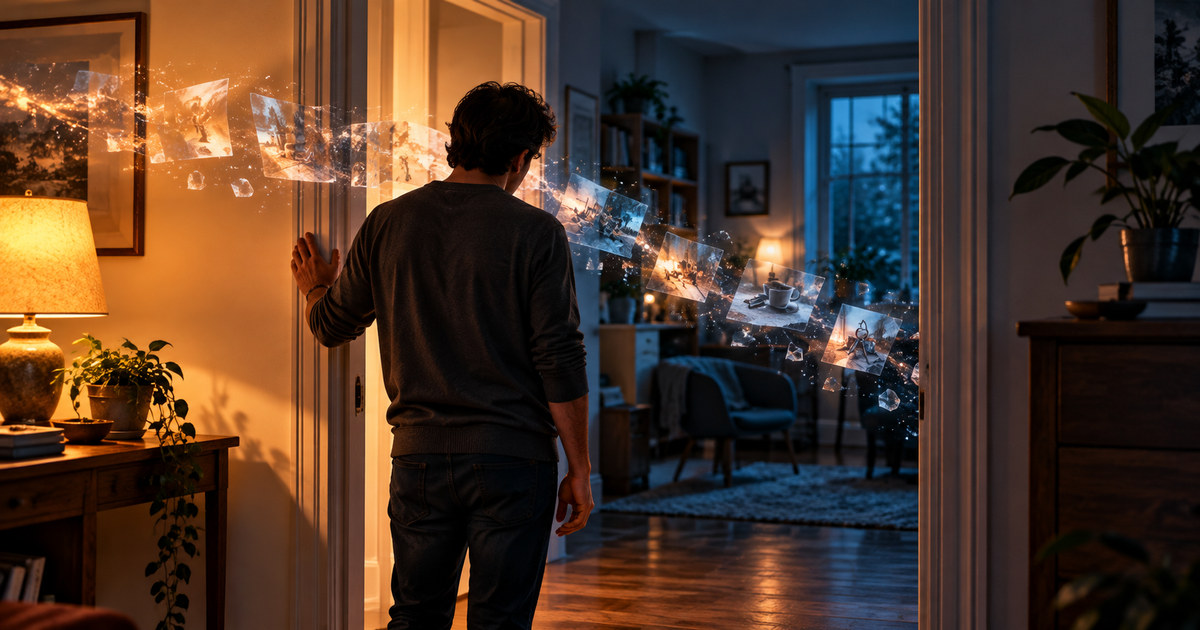
You walk into the kitchen, stop beside the counter, and suddenly wonder what you came for. The reason was perfectly clear ten seconds ago. Now the room looks familiar, but your mission has vanished.
People often blame distractions, tiredness, or age. Yet psychologists have studied a more surprising possibility: the act of moving from one space to another can change how easily we retrieve a recent thought. The phenomenon has a name—the doorway effect—and the research behind it is considerably more interesting, and less absolute, than the popular claim that doors make us forget things.
Why would a doorway affect memory?
Our experience feels continuous. We walk, talk, make plans, and change rooms without noticing any pause in the story. But the mind also has to decide where one meaningful event ends and another begins.
Consider what happens when you leave your desk to get a glass of water. In one room, the important things might be an email, a document, and a phone. In the kitchen, the relevant scene changes to cupboards, taps, and dishes. The transition can signal that the old situation has ended and a new one has started.
Psychologists call such transitions event boundaries. A doorway is an obvious physical boundary, but boundaries can also occur when an activity, goal, or scene changes. One influential explanation is that the brain keeps an active representation of the current situation—sometimes called an event model—and updates it when circumstances shift.
This does not mean memories are erased. It means that information connected with the previous moment may become harder to access right away.
The experiment that gave doorways their reputation
In a 2006 study published in Memory & Cognition, psychologists Gabriel Radvansky and David Copeland asked participants to navigate virtual rooms while keeping track of objects. Researchers tested their ability to identify the recently encountered objects after movement either within a room or between rooms.
People had more trouble accessing information after a spatial shift. Crucially, the task was about memory for specific objects under controlled conditions—not an estimate of how often someone forgets why they entered their own kitchen.
A 2011 follow-up tested the phenomenon further, including movement through actual rooms. It again found poorer memory performance after passing through doorways compared with movement that stayed within one space.
One particularly curious result concerned the familiar trick of retracing your steps. In one experiment, participants eventually returned to the original room. Returning did not restore their performance in that particular test. The findings were not simply explained by being physically back in the same place where the object had been encountered.
That does not establish that retracing your steps never helps in everyday life. It means one laboratory result should not be turned into a universal memory tip.
Your brain may notice the boundary before you cross it
The doorway itself is not necessarily a magic line.
In a 2023 study, researchers used immersive animations of people moving through rooms. Participants tried to remember invented words while watching sequences that either included a doorway or did not. The researchers controlled for distance and time.
Memory performance declined not only after the simulated doorway was crossed but also, in some conditions, when participants were about to cross it.
That is a striking clue. If anticipating a boundary can influence performance, the effect cannot depend solely on the physical act of walking through a frame. The visual system may begin preparing for a new event before the transition occurs.
The idea is that the mind prioritizes what is relevant now. Old details may slip out of the spotlight when a new scene is about to begin. But scientists continue to investigate whether that change reflects event-model updating, attention, interference, or several processes acting together.
Here is the twist: doorways do not always cause forgetting
If you have read that a doorway automatically wipes short-term memory, the evidence does not support such a strong claim.
A 2021 paper in BMC Psychology tested the effect across four experiments using immersive virtual reality, video, and real-world movement. The researchers did not find a consistent, significant doorway-related memory deficit across the experiments.
There was an important exception. In one virtual-reality experiment, participants who were also managing an extra working-memory load made more false alarms in the doorway condition. In other words, mental load appeared to matter.
A separate 2024 study presented at CHI also failed to find the predicted object-recognition difference when researchers varied doorway appearances and ways of moving through virtual reality.
Yet another 2024 study in the Journal of Vision found a memory disadvantage associated with visual event boundaries even when participants were deliberately trying to keep information in mind.
These results are not all the same—and that is exactly why the topic is scientifically interesting. What you are trying to remember, how much else you are holding in mind, how the scene changes, and how memory is tested all seem relevant. The evidence supports context-sensitive effects, not an inevitable memory blackout each time you enter a room.
Why forgetting the task feels so strange
An intention such as “get my charger” is different from recognizing a picture or recalling a made-up word. It involves prospective memory: remembering to do something in the future.
A household trip may require you to keep that intention active while walking, looking around, responding to sounds, and processing a new scene. If your attention switches to another concern—say, a notification or someone speaking—the original goal can become less accessible.
The laboratory doorway studies do not prove that every forgotten errand is caused by event boundaries. They offer one plausible piece of a larger explanation: your immediate goal competes with the information the new environment demands.
A computer analogy can help, with a warning. Imagine an application that updates its active workspace when you switch tasks. The old information has not necessarily been deleted from storage; it may simply be less prominent in the current workspace. Researchers sometimes discuss event-related forgetting in terms of clearing or flushing information, but those are metaphors—not proof that the brain literally deletes a memory when you cross a threshold.
What can you actually do about it?
No method has been proved to cancel the doorway effect in every setting. Still, a few low-effort habits follow sensibly from the idea that your goal can lose priority as the situation changes.
Name the purpose before you move. Instead of a vague feeling that you need something, say to yourself, “I’m going to the kitchen for my water bottle.” That makes your intention specific. Treat this as a practical strategy, not as a clinically validated doorway-effect cure.
Carry a clear cue. If you need to take a document somewhere, holding the document—or writing a short reminder—keeps the task visible. A cue can be useful when you expect interruptions.
Reduce competing tasks when the errand matters. Trying to mentally juggle several instructions can make a simple transition more demanding. The 2021 findings give a reason to take working-memory load seriously, though they do not establish a specific intervention.
If the thought disappears, reconstruct the goal. Ask what you were doing just before you left, rather than staring at the new room and expecting the thought to reappear. Returning to the original place may sometimes provide useful cues, but the 2011 experiment is a reminder that this is not guaranteed.
Occasional lapses of this kind are common experiences. A single forgotten errand cannot diagnose a memory disorder. If memory problems become persistent, worsen, or interfere with daily life, seek advice from a qualified health professional instead of assuming a doorway is responsible.
The bigger idea hidden in a very ordinary mistake
The most fascinating part of the doorway effect is not that doors have mysterious powers. It is that memory is organized around meaningful events, not simply arranged as an uninterrupted recording of everything that happens.
A change of room can become a change of chapter. Sometimes that helps us focus on what comes next. Sometimes a small intention from the previous chapter becomes annoyingly difficult to retrieve.
So the next time you stop in a doorway wondering why you are there, you may be witnessing something subtle: not a broken memory, but a mind trying to keep up with the changing structure of your day.
Sources
- Radvansky, G. A., & Copeland, D. E. (2006). Walking through doorways causes forgetting: Situation models and experienced space. Memory & Cognition, 34, 1150–1156. https://doi.org/10.3758/BF03193261
- Radvansky, G. A., Krawietz, S. A., & Tamplin, A. K. (2011). Walking through doorways causes forgetting: Further explorations. The Quarterly Journal of Experimental Psychology, 64, 1632–1645. https://doi.org/10.1080/17470218.2011.571267
- Wang and colleagues (2023). Here it comes: Active forgetting triggered even just by anticipation of an impending event boundary. Psychonomic Bulletin & Review.
- McFadyen, J., et al. (2021). Doorways do not always cause forgetting: A multimodal investigation. BMC Psychology, 9, 41. https://doi.org/10.1186/s40359-021-00536-3
- Ongchoco, J. D. K., & Xu, Y. (2024). Visual event boundaries trigger forgetting despite active maintenance in visual working memory. Journal of Vision, 24(9), 9. https://doi.org/10.1167/jov.24.9.9
- van Gemert, T., et al. (2024). Doorways do not always cause forgetting: Studying the effect of locomotion technique and doorway visualization in virtual reality. CHI ‘24. https://doi.org/10.1145/3613904.3642879