
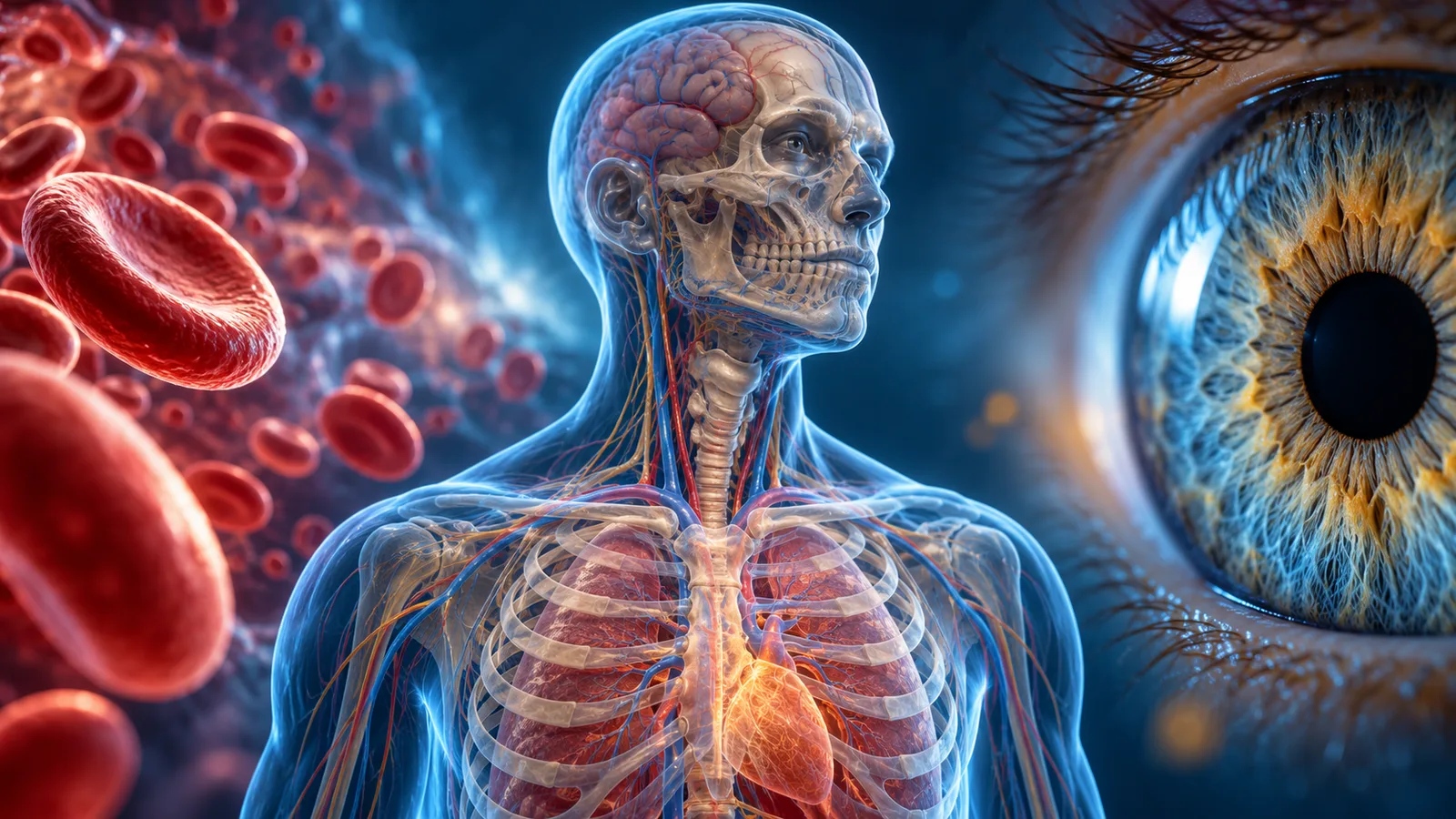
These five questions connect body structure, protection, oxygen transport, vision and a familiar involuntary movement. Try choosing an answer before reading each explanation.
1. Which science studies the structure of the human body?
A. Anatomy — B. Astronomy — C. Geology
The answer is A: anatomy. Human anatomy describes the body’s structures, from cells and tissues to organs and their arrangement. It asks what the parts are and how they fit together. Naming a bone is one anatomical task; describing where it sits relative to another structure is another.
This helps explain why an anatomical model can show several layers of the same body. The skeleton and surrounding tissues are different structures occupying related positions, rather than unrelated objects sharing a space. The word applies beyond humans, too: anatomy also concerns the structures of other animals and plants. National Cancer Institute: anatomy
2. What is your body’s largest organ?
A. Your liver — B. Your skin — C. Your brain
The answer is B: your skin. It is easy to picture an organ as something hidden inside your chest or abdomen. Skin challenges that picture because it forms the body’s external covering.
Its protective role is more than a matter of appearance. Skin provides a barrier between your tissues and the surrounding environment. It helps shield you from injury and infection, contributes to temperature regulation and gathers sensory information.
The liver and brain are important organs, but neither covers the body’s entire outer surface. A small block of skin in a teaching model represents a section of that much larger organ; the block’s displayed size is not its total size in a person. NCI SEER Training: Anatomy of the Skin
3. What carries most of the oxygen in your blood?
A. White blood cells — B. Platelets — C. Red blood cells
The answer is C: red blood cells. They contain hemoglobin, the protein that binds oxygen. When you breathe, oxygen crosses from the tiny air sacs in the lungs into nearby blood vessels, where red blood cells pick it up.
The important distinction is between carrying a substance and merely being present alongside it. Blood contains several components, but the oxygen-carrying role in this question belongs to hemoglobin inside red blood cells. The video says “most” because some oxygen also travels dissolved in the blood. NHLBI: What Breathing Does for the Body
4. What normally happens to your pupils in a dark room?
A. They get larger — B. They get smaller — C. They stay the same
The answer is A: they get larger. The pupil is the opening in the center of the iris. Increasing that opening allows more light to enter the eye.
The wording matters: the pupil changes size, rather than the whole eyeball expanding. Its size is also influenced by factors besides room lighting, so this is a description of the normal response to darkness, not a rule that every pupil must always look the same. Clinical Methods: The Pupils
5. Which muscle’s sudden contraction starts a hiccup?
A. Your tongue — B. Your diaphragm — C. Your heart
The answer is B: your diaphragm, the main breathing muscle beneath the lungs. A hiccup involves its involuntary movement followed by a rapid closing of the vocal cords. That closure creates the familiar sound.
This separates the movement that starts the event from the structure that makes the audible “hic.” Your tongue is not the muscle being tested here, and a hiccup is not a heartbeat. MedlinePlus: Hiccups
What did you notice?
Each question asks you to look past an everyday impression: an organ need not be hidden inside, the pupil is an opening, and the sound of a hiccup is only part of the event. Knowing the answer is useful; being able to explain it makes the knowledge easier to remember.
Sources
- National Cancer Institute — Definition of anatomy
- NCI SEER Training — Anatomy of the Skin
- National Heart, Lung, and Blood Institute — What Breathing Does for the Body
- Clinical Methods, NCBI Bookshelf — The Pupils
- MedlinePlus — Hiccups
The accompanying images are AI-generated educational illustrations. Objects and microscopic components are shown at different illustrative scales.