
You may have walked thousands of steps today without thinking about what your feet were doing. They folded, stiffened and pushed against the ground while the muscles in your calves handled a complicated transfer of force.
Could changing the stiffness of a foot—even slightly—make that entire process less expensive for the body?
A study published November 4, 2026, in Proceedings of the Royal Society B reports an intriguing result: specially made socks that compress the front of the foot reduced the net metabolic cost of walking by about 2% on average in a small experiment involving 12 healthy young adults.
That is not evidence that an ordinary sock suddenly improves everyone’s fitness. It is a clue about how the human foot works—and why the shape of our feet may have mattered in evolution.
Walking looks simple because your body does the difficult part
Watch a foot in slow motion during a step. At first, it accepts body weight. Then forces shift forward through the arch and toward the toes. The foot has to be flexible enough to adapt, yet stiff enough at the right moment to transmit force efficiently.
The human foot differs from the feet of many other primates in several ways, including structures that limit excessive bending through its middle. Scientists have long asked whether this relatively stiff architecture helped our ancestors walk upright with less energy.
But a plausible evolutionary explanation is not the same as an experiment. To test a mechanical idea, researchers need to change the property they are interested in and observe what happens to energy use and movement.
That is what Hui Tang and Owen N. Beck of the University of Texas at Austin set out to do.
Why a sock instead of a rigid shoe?
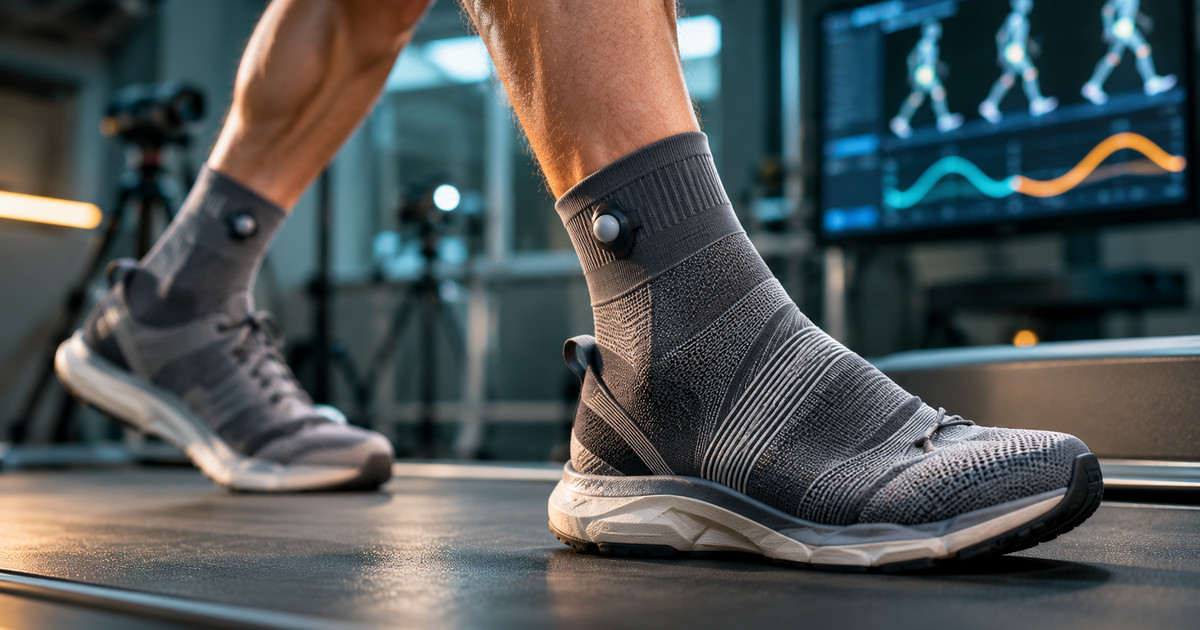
The custom socks had tightly knitted bands around the forefoot, near the ball of the foot. Those bands resisted the way the forefoot spreads outward under load, helping the foot behave as a slightly stiffer structure.
A rigid shoe or insert can also change foot stiffness, but it may restrict movements that are useful during push-off. The researchers wanted a more targeted intervention: support the foot in one direction while allowing the joints and arch to continue their natural motion.
Their idea is subtle. The best walking equipment is not necessarily the stiffest equipment. It may be the one that changes when and how stiffness is available.
The question was whether that change could reduce the effort demanded from the rest of the leg.
The treadmill test—and what was measured
Twelve healthy young adults walked on a treadmill in specially made foot-stiffening socks and in comparison socks without the additional bands.
Researchers measured oxygen consumption and carbon dioxide production, which allow scientists to estimate whole-body metabolic energy expenditure. They also used movement and force measurements to investigate walking mechanics and the behavior of the ankle and lower-leg muscles.
The result: on average, the experimental socks were associated with approximately 2% less net metabolic energy used for walking. Ten of the twelve participants showed a reduction.
Two percent is not dramatic in a single step. But a repeatable reduction in energy demand, if confirmed, could help researchers understand what makes some walking mechanics more economical than others.
The qualifier matters as much as the number: this was a small, short laboratory experiment, not a long-term study of people wearing the socks outdoors for months. It does not establish a benefit for older adults, people with mobility limitations or every type of shoe.
Where did the energy saving come from?
One might imagine that a stiffer foot does less mechanical work, leaving less work for the rest of the body. The findings pointed to a more interesting explanation.
The compression increased foot stiffness in a way that altered the ankle’s movement mechanics. The calf muscles could contract at a slower, more economical velocity, reducing metabolic demand without a corresponding reduction in the mechanical work they performed.
Muscles are not motors that consume the same amount of fuel regardless of speed and force. Their efficiency changes with how they contract. A small modification at the foot can therefore influence the cost of producing motion farther up the leg.
This is why the result is a biomechanics story, not just a product story. The sock served as an experimental tool for testing how the foot and calf cooperate.
Could this explain something about human evolution?
Humans spend an extraordinary amount of time walking on two legs. If stiffer foot structures make that activity more economical under some conditions, natural selection could have favored features that improve the transfer of forces during gait.
The new experiment is compatible with that idea. It provides evidence that deliberately increasing a component of foot stiffness can lower walking’s metabolic cost in the tested participants.
But it does not prove exactly when human foot stiffness evolved, which ancestor first acquired it or that metabolic efficiency was the only evolutionary reason. Feet also have to balance stability, terrain adaptation, running, climbing and injury resistance.
Evolutionary stories become stronger when laboratory mechanics are considered alongside fossils, comparative anatomy and studies across different human populations.
Is a 2% saving actually useful?
It depends on who is walking, for how long, in what environment and with which footwear. An average laboratory reduction is not a guaranteed real-world improvement for one individual.
A small energy advantage might eventually matter in endurance sports or physically demanding occupations. The researchers and outside commentators have discussed such possibilities, and the technology has attracted commercial interest. Yet possible use cases should not be confused with measured outcomes.
The study did not establish that these socks make running faster, improve athletic performance, prevent injuries or treat a medical condition. Nor does it prove that ordinary compression socks produce the same mechanical effect.
For a consumer, the sensible conclusion is curiosity—not an urgent purchase.
What would a larger study need to test?
A useful follow-up would recruit people with different ages, walking abilities, body sizes and footwear preferences. Participants could test the socks in a randomized, blinded-as-far-as-possible design over longer periods, including outdoor walking.
Researchers would need to check whether the average energy advantage persists, whether some walkers benefit more than others and whether concentrated pressure causes discomfort. It would also help to compare the effect with other simple approaches to foot support.
One methodological difficulty is that people can feel when socks fit differently. Awareness of the intervention might subtly change how a person walks. That does not invalidate the result; it is a reason to design stronger follow-up comparisons.
The authors’ summary dataset is openly available, offering another route for independent scrutiny of the participant-level findings.
The little experiment with a much bigger question
Science often learns about the body by changing one apparently ordinary thing. Here, the experimental object was not a new robot or a powered exoskeleton. It was a carefully knitted sock.
The result is modest, specific and still preliminary: in twelve young adults, a particular kind of forefoot support made treadmill walking slightly less metabolically costly.
But the question it opens is larger than the garment: how much of the energy we use every day is determined by subtle properties of the body we rarely notice?
Every step is a mechanical negotiation between flexibility, support and muscular effort. This study suggests that, sometimes, shifting that balance by a small amount is enough to measure a difference.
Sources and research notes
- Tang, H., and Beck, O. N. (2026). Foot-stiffening socks reduce the metabolic cost of walking. Proceedings of the Royal Society B: Biological Sciences. Peer-reviewed experimental report released November 4, 2026.
- The Royal Society (2026). Research release on foot-stiffening socks. Describes the mechanism and measured 2% average reduction.
- Phys.org (2026). Foot-stiffening socks could make walking less tiring. Reporting on the 12-participant treadmill trial and its measurements.
- Tang and Beck. Participant summary data. The Royal Society’s Figshare dataset, posted September 25, 2026.