
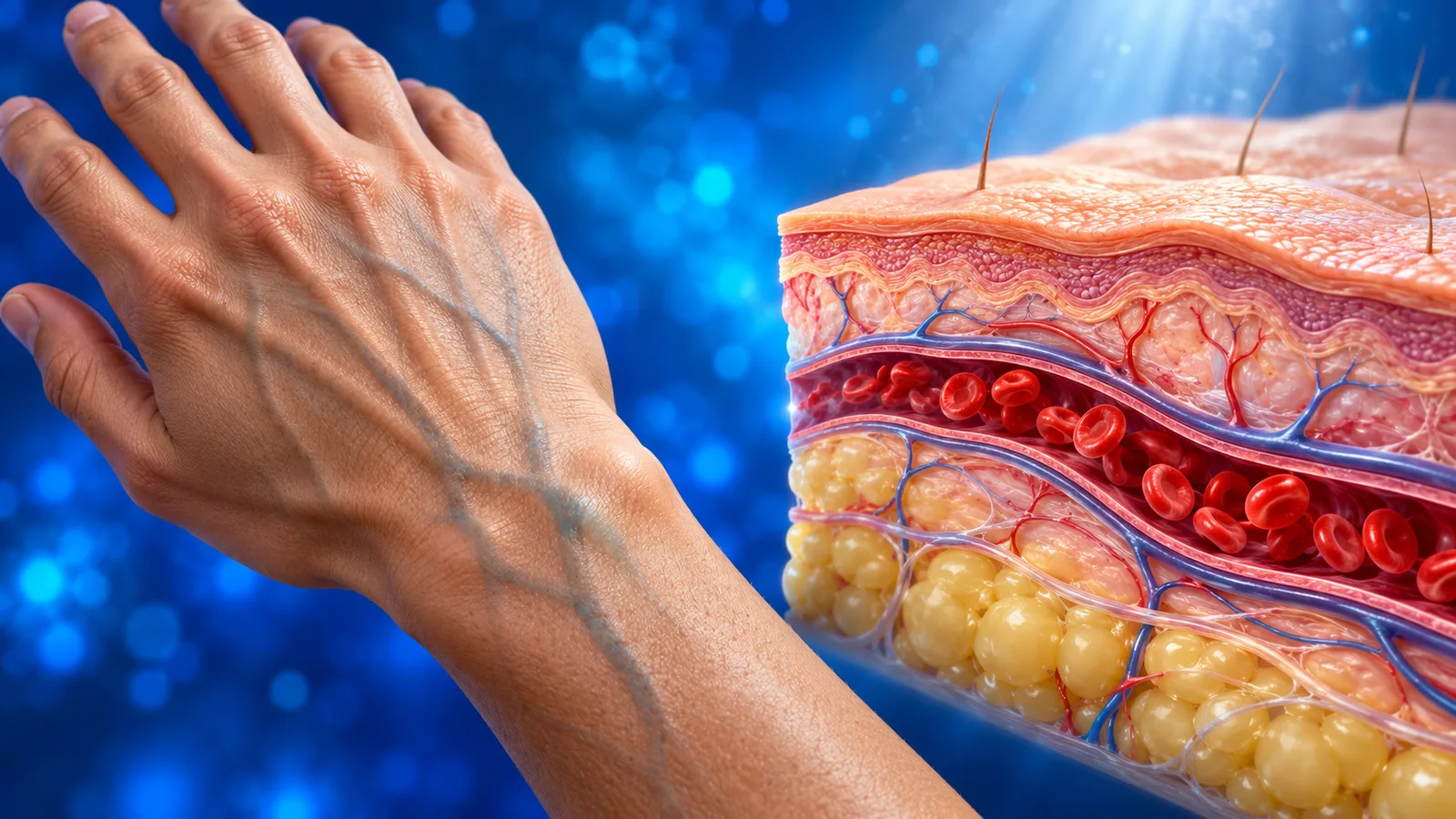
Human blood is already red inside your veins. What changes is the view through the skin. The explanation combines how blood absorbs light, how skin scatters it, and how your visual system compares one patch of color with its surroundings. Arizona State University
Two shades of red
Red blood cells contain hemoglobin, the protein that transports most of the oxygen in your blood. Oxygen binding changes hemoglobin’s optical properties, giving oxygen-rich blood a brighter red appearance. Blood carrying less oxygen is a deeper, darker red. Losing oxygen does not turn it blue.
That distinction matters because a vein is not an empty blue pipe visible beneath transparent wrapping. You are looking at a blood-filled vessel through living tissue, with all the optical complications that introduces. The color visible at the surface is not a direct sample of the color inside. Arizona State University
Skin changes the light that reaches your eyes
White light contains a range of visible wavelengths. When it reaches your hand, some light returns from near the surface, some travels farther into tissue, and some is absorbed. Scattering redirects light along different paths. Neither skin nor blood treats all wavelengths equally.
A superficial vein changes the light returning from the patch of skin above it. Red light generally travels more deeply into tissue, giving it more opportunity to interact with the vessel. Much of the shorter-wavelength blue light is scattered or absorbed nearer the surface and interacts less with that vein.
The important comparison is the light returning from above the vessel versus the light returning from nearby skin. A vein can reduce the red component disproportionately relative to its surroundings. That difference helps produce a blue-looking line even though the blood responsible for the absorption is red. It does not require the vein to send back only blue light. Wagner and colleagues, 2026
Your brain supplies the context
Color perception depends on neighboring colors. The same patch can look different against different backgrounds, so the warm color of surrounding skin contributes to how a darker vein appears.
Researchers explored this perceptual contribution in a 2023 study using gray paper beneath tissue paper and stockings to simulate veins under skin. Their experiments demonstrated how simultaneous color contrast can strengthen a greenish-blue appearance. This was a controlled demonstration of perception, rather than evidence that blood itself changes to blue. Phuangsuwan and colleagues, 2023
Physical light transport and visual interpretation work together. Explaining everything as a blue reflection leaves out the surrounding skin and the observer. Explaining everything as imagination leaves out the measurable changes in returning light.
Why different veins can look different
There is no single blue shade shared by every visible vein. The vessel’s depth and diameter affect which light paths encounter it. Blood oxygenation affects absorption, while skin pigmentation and tissue structure affect the light passing through the skin.
A landmark 1996 study combined measurements with computer simulations and identified wavelength-dependent tissue optics, blood oxygenation, vessel geometry, and visual perception as contributors. Later modeling investigated how collagen structures in the skin scatter light. The familiar appearance comes from a system with several interacting parts, rather than one universal color filter. Kienle and colleagues, 1996, University of Waterloo, 2018
A useful distinction for the next diagram you see
| What you are looking at | What the color tells you |
|---|---|
| Oxygen-rich human blood | A brighter shade of red |
| Human blood with less oxygen | A darker shade of red |
| A vein seen through skin | The combined effect of tissue, blood, light, and perception |
| A blue vein in an anatomy diagram | A conventional visual distinction, not blue blood |
The next time you notice a blue-green vein, remember that your skin is part of the picture. The vessel contains red blood; the view from outside has been shaped by the journey light took to reach your eyes.
Sources
- Arizona State University, Ask A Biologist: Is blood blue?, 2022.
- Kienle et al.: Why do veins appear blue? A new look at an old question, Applied Optics, 1996.
- University of Waterloo: Computer science researchers help answer an age-old medical science question, 2018.
- Phuangsuwan et al.: Demonstration of the bluish color on veins, Journal of the Optical Society of America A, 2023.
- Wagner et al.: Visual appearance of blood vessels: a phantom study, Biomedical Optics Express, 2026.