
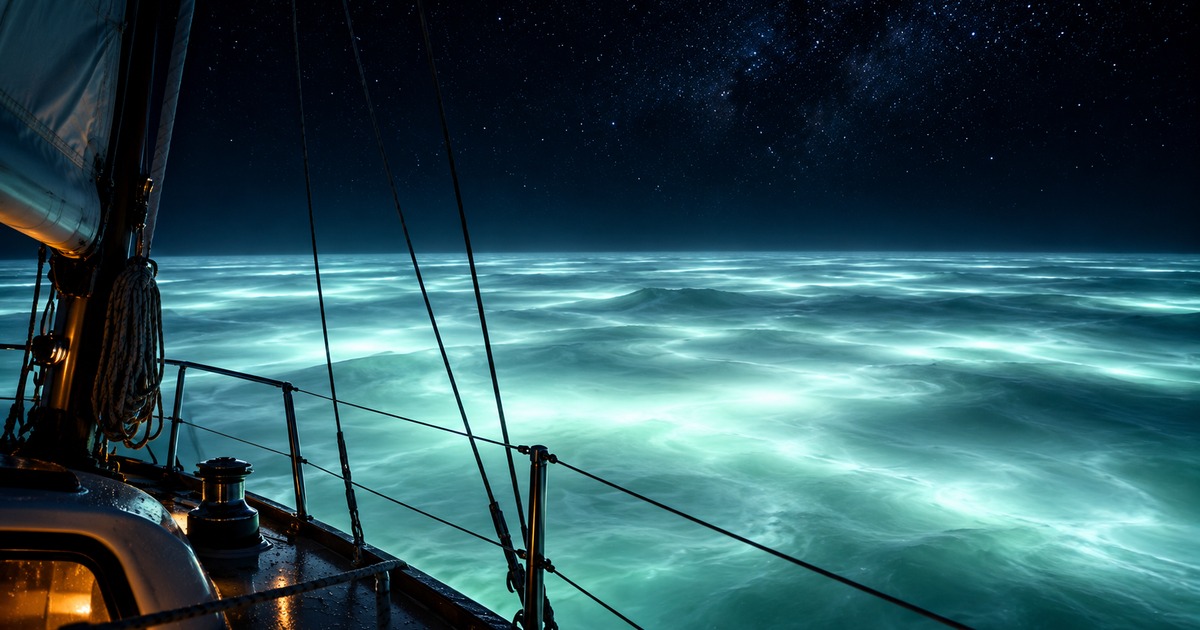
Imagine being at sea on a moonless night. The sky is black, the horizon almost impossible to find, and then the water itself seems to switch on. Not just a wave crest or the foaming wake behind the boat: the entire ocean has become a pale, steady sheet of light. You sail forward, but the glow continues as far as you can see.
For centuries, sailors described such encounters in logs that sounded more like supernatural stories than scientific reports. They called them milky seas. Today, sensitive satellites have shown that at least some of these accounts describe a real, enormous biological phenomenon—one that scientists still cannot fully explain.
So how can a dark ocean apparently illuminate itself over tens of thousands of square kilometers? The strongest explanation involves bacteria, a form of chemical communication, and an extraordinary set of conditions that may allow microscopic lights to act together on a gigantic scale.
A different kind of glowing ocean
The familiar videos of luminous blue waves usually show dinoflagellates, single-celled organisms that can flash when water moves around them. A breaking wave, a swimmer’s hand, or a boat wake disturbs the water; the organisms respond with brief bursts of light. The display is spectacular, but it is triggered by motion and tends to flicker.
A milky sea is different in three important ways:
- The glow is sustained. It can appear continuous rather than flashing with each wave.
- The affected area is immense. Reports describe light stretching to the horizon; satellite-detected examples have exceeded 100,000 square kilometers.
- The color often looks white, gray, or greenish. It is not necessarily the brilliant electric blue familiar from social-media videos of glowing surf.
That distinction is more than a matter of appearance. It points toward different biological sources of light.
Researchers studying the phenomenon describe an ocean surface that can remain luminous over successive nights, and in exceptional cases for many weeks. One of the largest documented displays, south of Java in 2019, was detectable from late July into early September. NASA Earth Observatory explains that its area reached roughly 100,000 square kilometers—comparable to Iceland.
The leading suspect: light-producing bacteria
The central scientific hypothesis is that milky seas are powered by enormous populations of bioluminescent bacteria, possibly associated with microscopic algae or organic particles.
Bioluminescence is light made by a chemical reaction inside an organism. In many luminous bacteria, an enzyme called luciferase helps produce visible light using chemical energy and oxygen. Unlike a flashlight, this process does not require an electrical bulb or an external beam illuminating the water.
One particularly important clue dates to 1985, when a research vessel encountered a milky sea near the island of Socotra in the Arabian Sea. Samples from that rare direct encounter revealed luminous bacteria identified as Vibrio harveyi associated with colonies of the microalga Phaeocystis. It was compelling evidence for a bacterial explanation—not definitive proof that every milky sea is produced in precisely the same way. Miller and colleagues, PNAS (2005)
Why would an algal colony matter? Because an isolated bacterium makes far too little light to illuminate a seascape. A microbial community concentrated on organic particles could give bacteria the density and environment they need to glow brightly enough for human eyes—or a sensitive satellite—to notice.
But this introduces a harder question: how do so many cells start glowing at once?
How bacteria can communicate without speaking
Some bacteria use a mechanism called quorum sensing. As cells grow, they release and detect chemical signals. When enough signals accumulate, a bacterial population can change its behavior—activating genes that might be inefficient for just a few isolated cells.
For certain luminous bacteria, light production is one of those density-dependent behaviors. Think of a room where each person adds a faint scent to the air. When enough people are present, the concentration reaches a threshold that everyone can detect. Bacteria do not make conscious group decisions, but their molecular signaling can produce a coordinated response.
This is a promising explanation for the steady glow of milky seas. Yet normal seawater is too dilute to make the story easy. The microscopic organisms would need unusual conditions to accumulate and remain luminous across a vast region.
Scientists have proposed several contributing factors: dense microbial growth around particles or algal colonies, available nutrients and organic matter, and ocean currents that organize water masses over large distances. These possibilities form a working explanation, not a complete, experimentally established recipe for producing a milky sea. The 2025 review by Hudson and Miller in Earth and Space Science emphasizes that the physical and biological conditions remain poorly understood.
The night sailors met the satellite
For a long time, the central obstacle was simple: the world’s oceans are enormous, and these events tend to happen far from the places scientists can reach. A vessel might sail into one by chance, but by the time researchers heard about it, the glow could have disappeared.
Satellite observations changed that.
In 2005, scientists published a landmark analysis connecting a sailor’s report from the northwestern Indian Ocean with a luminous patch recorded from space. It was an early demonstration that a phenomenon once confined largely to ship logs could leave a measurable signature in orbit. PNAS study
A major advance followed with the Visible Infrared Imaging Radiometer Suite, or VIIRS, carried by satellites including NOAA–NASA’s Suomi NPP. Its exceptionally sensitive Day/Night Band can detect weak nighttime light. Researchers must still distinguish a glowing sea from reflected moonlight, city lights, clouds, atmospheric glow, and other sources.
A 2021 study in Scientific Reports identified 12 candidate milky-sea events in observations from 2012–2021. The bright regions persisted across nights, were not apparent as luminous patches during daylight, and moved in patterns consistent with ocean currents. These are exactly the kinds of checks needed before describing a faint satellite signal as marine bioluminescence. Read the original study.
Then came an especially valuable human confirmation. In 2019, the yacht Ganesha sailed through a glowing ocean south of Java. Its crew documented the extraordinary scene. Researchers later compared their account and photographs with the satellite record of the same event. A 2022 paper in PNAS connected the view from deck with the view from space—an uncommon bridge between direct observation and remote sensing. Read the 2022 paper.
The satellite evidence established that these vast, persistent luminous regions are real. It did not, by itself, tell researchers exactly which microbes produced each one or why those microbes flourished.
How big—and how rare—are milky seas?
The largest well-documented events cover extraordinary distances. A 100,000-square-kilometer patch is not a small bay or a luminous stretch of beach. It is an area larger than many countries, and its edge may lie far beyond a sailor’s horizon.
But rarely observed does not automatically mean extremely rare in nature. The ocean is vast, observations are uneven, and a satellite can miss a faint glow when moonlight or clouds interfere.
In April 2025, researchers Justin Hudson and Steven D. Miller published a database combining historical ship accounts with modern satellite detections. It contains 415 observations with usable locations and dates, spanning centuries. Importantly, those are observations, not 415 independent events. By grouping reports using assumptions about how far and how long a display could extend, the researchers estimated 257 distinct events represented in the collection. That estimate depends on their grouping method. Hudson and Miller, 2025.
The record is also geographically uneven. Many historical reports come from the northwestern Indian Ocean and Arabian Sea, with another concentration around Indonesia. Shipping routes, surviving logs, satellite coverage, and the conditions needed to see a faint glow all influence this map. We should not read it as a complete census of everywhere milky seas actually occur.
The 2025 database makes it easier to investigate potential relationships with large-scale ocean and atmospheric patterns. It does not yet give scientists a dependable forecast of exactly when a new milky sea will appear.
Why does the water look white instead of blue?
The name describes what witnesses perceive: an unusually even, pale glow that can resemble a layer of luminous fog or a snowfield spread over the sea.
Different bioluminescent organisms emit different colors, and human color perception changes dramatically at night. In extremely dim light, our eyes rely heavily on rod cells, which are sensitive to low light but poor at distinguishing colors. A blue-green source can therefore appear whitish or grayish to a dark-adapted observer, especially when a vast surface glows weakly rather than producing bright, isolated flashes.
This does not mean all milky seas have the same exact wavelength or that researchers have measured the chemistry of every event. The color descriptions come largely from observers, while satellite instruments register light within their own wavelength ranges. The safest conclusion is that the sustained, pale appearance is a reliable identifying clue—not a full explanation of the biology.
Could the glow tell us something important about the ocean?
Perhaps. A luminous bacterial population large enough to be noticed from orbit might signal unusual exchanges of organic matter and nutrients. Bacteria help break down organic material and participate in the marine carbon cycle, so understanding these events could eventually teach researchers something about microbial activity at a much larger scale than a single water sample.
There are intriguing possibilities: perhaps particular blooms supply food, currents concentrate microbes, or a combination of environmental conditions creates an enormous natural growth chamber. Some researchers have proposed links to ocean-atmosphere climate patterns that might eventually assist prediction.
For now, however, the ecological role and carbon-cycle significance of milky seas have not been established. We do not know whether an observed glow signals a healthy ecosystem, a stressed one, or something more complicated. Nor should we assume that every glowing sea is toxic, harmless, or safe to swim in simply because it shines.
A direct, well-instrumented expedition remains the missing piece: measure the light, collect samples, identify organisms and their genes, and examine the temperature, nutrients, currents, and surrounding life at the same time.
What scientists still need to discover
The most important unanswered questions are not about whether these seas exist. We now have photographs, ship reports, and satellite measurements showing they do. The mysteries are more specific:
- Which organisms generate the light in different events? The bacterial hypothesis is strong, but direct microbial samples are exceptionally scarce.
- What produces the necessary enormous populations? Researchers need to understand the combination of nutrients, particles, ocean circulation, and biological interactions.
- What starts and stops a display? Satellites can trace persistence and movement but cannot, alone, reveal the microscopic trigger.
- Can we forecast one in time to send a ship? Better monitoring and a growing historical record may make that possible.
The story of milky seas is a reminder that modern science has not exhausted the surprises of Earth’s own surface. We can photograph galaxies billions of light-years away and still struggle to explain why a portion of our ocean occasionally glows through the night.
The strangest part isn’t that the sea can make light. It’s that billions upon billions of microscopic organisms may be able to make an entire horizon look illuminated—and we are only beginning to understand how.
Sources
- Hudson, J., and Miller, S. D. (2025). From Sailors to Satellites: A Curated Database of Bioluminescent Milky Seas Spanning 1600–Present. Earth and Space Science, 12(4). Historical database, satellite observations, uncertainties, and possible environmental connections.
- Miller, S. D. (2022). Boat encounter with the 2019 Java bioluminescent milky sea: Views from on-deck confirm satellite detection. Proceedings of the National Academy of Sciences, 119(29). Eyewitness photographs and satellite correlation.
- Miller, S. D., et al. (2021). Honing in on bioluminescent milky seas from space. Scientific Reports, 11, 15443. Detection methods and 12 satellite-observed events.
- Miller, S. D., et al. (2005). Detection of a bioluminescent milky sea from space. Proceedings of the National Academy of Sciences, 102(40). First satellite detection tied to a ship report; bacterial explanation.
- NASA Earth Observatory (2021). Hunting Milky Seas by Satellite. Explanation of remote sensing, the 2019 Java event, and remaining scientific questions.