
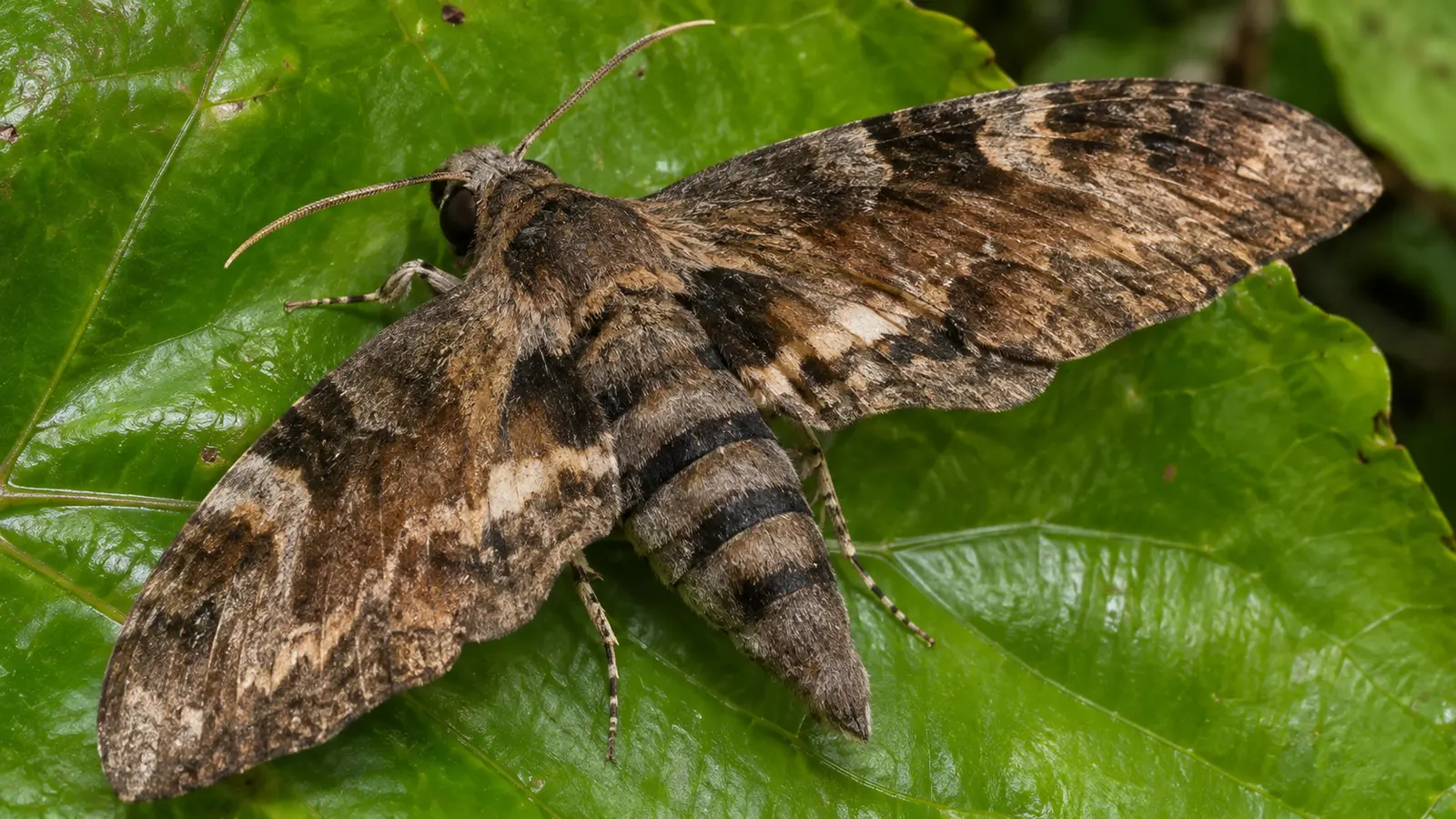
At dusk, a hawkmoth hovers near a flower, its wings beating fast enough to blur. It is searching for nectar. Somewhere in the darkness, a bat is searching for dinner—and listening for the echoes of its own ultrasonic calls. To the bat, the moth is a moving target. To the moth, the next few seconds can determine whether it survives the night.
Some male hawkmoths have a remarkable answer to this threat. They rub specialized scales on structures used in mating against parts of their abdomen, producing sounds far above the range of ordinary human hearing. These ultrasonic bursts may interfere with an approaching bat’s echolocation, warn it away, or startle it at the crucial moment.
The surprise is not merely where the sound comes from. It is that evolution appears to have invented variations of this defense repeatedly.
A study published on November 4, 2026, in Proceedings of the Royal Society B describes three distinct ways male hawkmoths produce ultrasound. Researchers combined nighttime recordings, detailed scans of moth anatomy, and an evolutionary family tree to reconstruct how these unusual sound-making systems developed. Their results tell a story about the hidden technological arms race between predator and prey—and about how far natural selection can push a structure beyond its original job.
A battle fought in sounds we cannot hear
Bats hunting insects in darkness frequently use echolocation. They emit high-frequency calls and analyze the echoes that bounce back from objects. The timing and frequency of those echoes help them judge distance, movement, and the location of potential prey.
Moths have been facing that sensory advantage for millions of years. Some detect approaching bats with sensitive hearing organs. Others use evasive flight, chemical defenses, or acoustic warnings. A number of moth families produce ultrasound of their own, but hawkmoths are especially intriguing because some males use structures associated with reproduction to generate it.
This does not mean they emit sound through a human-style voice or call. Their system is mechanical. A tiny hard surface moves across another, creating vibrations—rather like dragging a fingernail along the teeth of a comb. The process is called stridulation.
If those vibrations are fast enough, the resulting sound is ultrasonic: real sound waves, but at frequencies too high for most people to hear.
What did the researchers actually find?
The team examined responses across 143 hawkmoth species and recorded ultrasound production in 77 of them. They focused on males, because sound-making behavior and anatomy in females remain much less thoroughly documented.
In behavioral tests, researchers played recordings of bat calls to moths flying in place and also simulated physical contact from a predator. High-frequency microphones captured the responses. The team then studied museum specimens with detailed imaging, including scanning electron microscopy and micro-computed tomography, to locate the physical structures involved.
The result was not one universal built-in alarm. The moths used three different combinations of scraper and textured surface:
- Scale on scale. Enlarged scales on the male genital structures scrape across another group of scales near the end of the abdomen.
- Scale on spine. Those specialized scales contact stiff, spine-like projections along the rear of the abdomen.
- Scale on nodule. The scales pass over a region covered in tiny bumps, or nodules, on the underside of the body. The new study describes a previously unrecognized part of this mechanism.
These anatomical differences matter because they affect the sounds the moths can make. Some systems generate intermittent bursts; others can produce relatively continuous sound. The researchers found that moths using the nodule-based system showed a particularly broad range of acoustic patterns.
The underlying parts are minute. To a casual observer, the insects look like ordinary large moths. Their specialized sound-making surfaces are not obvious from a photograph of a moth resting on a leaf.
Why use genital structures at all?
It sounds like a bizarre evolutionary choice only if we assume anatomy must keep the purpose we associate with it today.
Male hawkmoths have paired structures called genital valves, involved in holding a female during mating. Some species also have enlarged scales on these structures. The newly analyzed defensive sounds are generated when those scales meet another textured surface on the abdomen.
A reproductive structure can acquire an additional role when its shape, position, and movement make it useful for something else. Scientists call this sort of repurposing co-option. An organ or behavior that first served one purpose can become useful in a new context without losing its original function.
The researchers have not established exactly what these sounds were used for before they became defensive. One possibility raised by specialists is that sound production began in courtship and was later recruited for protection. But that remains a hypothesis, not a demonstrated history of the trait.
The safer conclusion is that selection repeatedly favored arrangements in which male moths could make high-frequency sound with structures they already possessed.
Did the same trick evolve seven times?
Possibly—but the precise number carries uncertainty.
By comparing the sound-producing traits with the hawkmoths’ evolutionary relationships, the team estimated that genital-based ultrasonic responses to bats appeared at least four and possibly as many as seven times independently over roughly the last 30 million years.
That is an example of convergent evolution: different lineages, facing similar pressures, arrive at solutions that perform comparable jobs. The mechanisms are related in broad function but not identical in their fine anatomical details.
A useful comparison is the evolution of flight in birds, bats, and insects. All three get airborne, yet their wings arose through different evolutionary histories. Hawkmoths provide a smaller-scale example: multiple routes to making ultrasonic noise with a similar part of the body.
And the story can run in reverse. Some hawkmoth lineages active mainly in daylight or twilight have lost the specialized sound-producing equipment. If the pressure from echolocating nocturnal bats becomes weaker, maintaining a complex defense may no longer provide the same advantage.
Does the sound really jam bat sonar?
This is where an exciting headline needs a careful explanation.
The study provides strong evidence that these moths produce ultrasound and that different anatomies generate different sound patterns. It does not prove that every sound-producing species successfully jams a hunting bat in the wild.
There are several plausible defensive effects, and they are not mutually exclusive.
1. Jamming the sonar
A bat detects prey by interpreting faint echoes. If a moth emits sufficiently intense ultrasound at the right moments, that extra sound could make the returning echoes harder to distinguish. Some hawkmoths generate long or frequent bursts consistent with a greater potential to interfere with echolocation.
Think of trying to follow one voice in a room full of overlapping conversations. It is not exactly how bat hearing works, but it conveys the central challenge: important information becomes harder to isolate when another sound competes with it.
2. Startling a predator
Other moths produce shorter, irregular sound bursts. These could surprise an approaching bat or cause it to hesitate, especially during the instant when the predator captures or handles its prey.
A momentary interruption may be all a moth needs to escape, but direct behavioral experiments are necessary to quantify how often that happens for each species.
3. Sending a misleading warning
Some moths are genuinely distasteful or chemically defended, and bats can learn to associate particular sounds with unpleasant prey. A palatable hawkmoth making a similar acoustic signal might gain protection by resembling those better-defended species.
This is a plausible form of acoustic mimicry, rather than proof that the hawkmoth itself contains a toxin. The new research helps characterize the sound patterns that might make such strategies possible.
Which explanation is most important probably varies among lineages. Sound production, timing, bat species, and the context of an encounter all matter.
The surprising role of hearing
There is one more twist: not all hawkmoths have the same ability to hear bats.
The researchers found that differences in acoustic output correlated partly with whether species possessed hearing organs. In some lineages, detecting incoming calls and generating extended sounds may work together as a coordinated defense. An insect that senses the timing of an attack can potentially direct its response more effectively than one making noise only after contact.
Some moths without the relevant hearing organs still emitted sound when handled. That raises the possibility of a last-ditch defense, useful even if the moth cannot detect a bat at a distance.
But correlation is not the same as a complete behavioral explanation. The anatomical and acoustic evidence narrows the possibilities; it does not settle every interaction between moth and bat.
What remains unknown?
The work leaves several questions worth pursuing:
- How often does each type of ultrasound actually save a moth? Researchers need controlled observations of predator responses, not just recordings and anatomy.
- How do different bat species react? A signal that disrupts one predator may have little effect on another.
- What happens in females? Some female hawkmoths are known to produce ultrasound, but the structures and evolutionary history remain less well understood.
- Which defense came first? Courtship, startle, mimicry, and jamming are possible chapters in the story, but their order is still uncertain.
These are not minor details. They are the difference between saying “the moth can produce a potentially defensive ultrasound” and claiming “the moth can defeat any bat.” The first is supported by the research; the second is not.
An evolutionary arms race hiding in plain sight
There is something wonderfully counterintuitive about an insect that looks silent to us yet carries a tiny acoustic machine at the end of its abdomen.
Hawkmoths are often noticed for their graceful hovering at flowers. Bats are often celebrated for their precise echolocation. The new study reveals the contest between them is even more elaborate than it appears: an invisible exchange of signals, played out in frequencies we cannot hear, with anatomy repeatedly reshaped by the danger of being eaten.
The Wondecode takeaway: This is not a story about a strange body part doing one strange thing. It is about evolution solving the same survival problem again and again—with different microscopic tools—and reminding us that much of the natural world’s drama happens beyond our senses.
Sources
- Masonick, P. K., et al. (2026). The repeated evolution of anti-bat bioacoustics in hawkmoths. Proceedings of the Royal Society B, published November 4, 2026. Primary research.
- Science News (2026). How hawkmoths turned their genitals into bat-busting weapons. Published November 3, 2026. Expert reporting and interpretations.
- Smithsonian Magazine (2026). These Moths Use Their Genitals to Fend Off Bats. Published November 6, 2026. Research summary and interviews.
- Discover Wildlife (2026). These bizarre insects make sounds with their genitals to escape hungry predators. Published November 6, 2026. Researcher comments and outstanding questions.