
Researchers at Aarhus University say some bacteria can keep producing DNA after they die. That sounds like science fiction, but the reality is more precise—and more interesting. The cells themselves are dead. What continues working is part of their molecular machinery, released into the sticky bacterial community known as a biofilm. Aarhus University
This is not bacterial resurrection
The headline temptation is obvious: “zombie bacteria.” But the study does not show dead bacteria coming back to life.
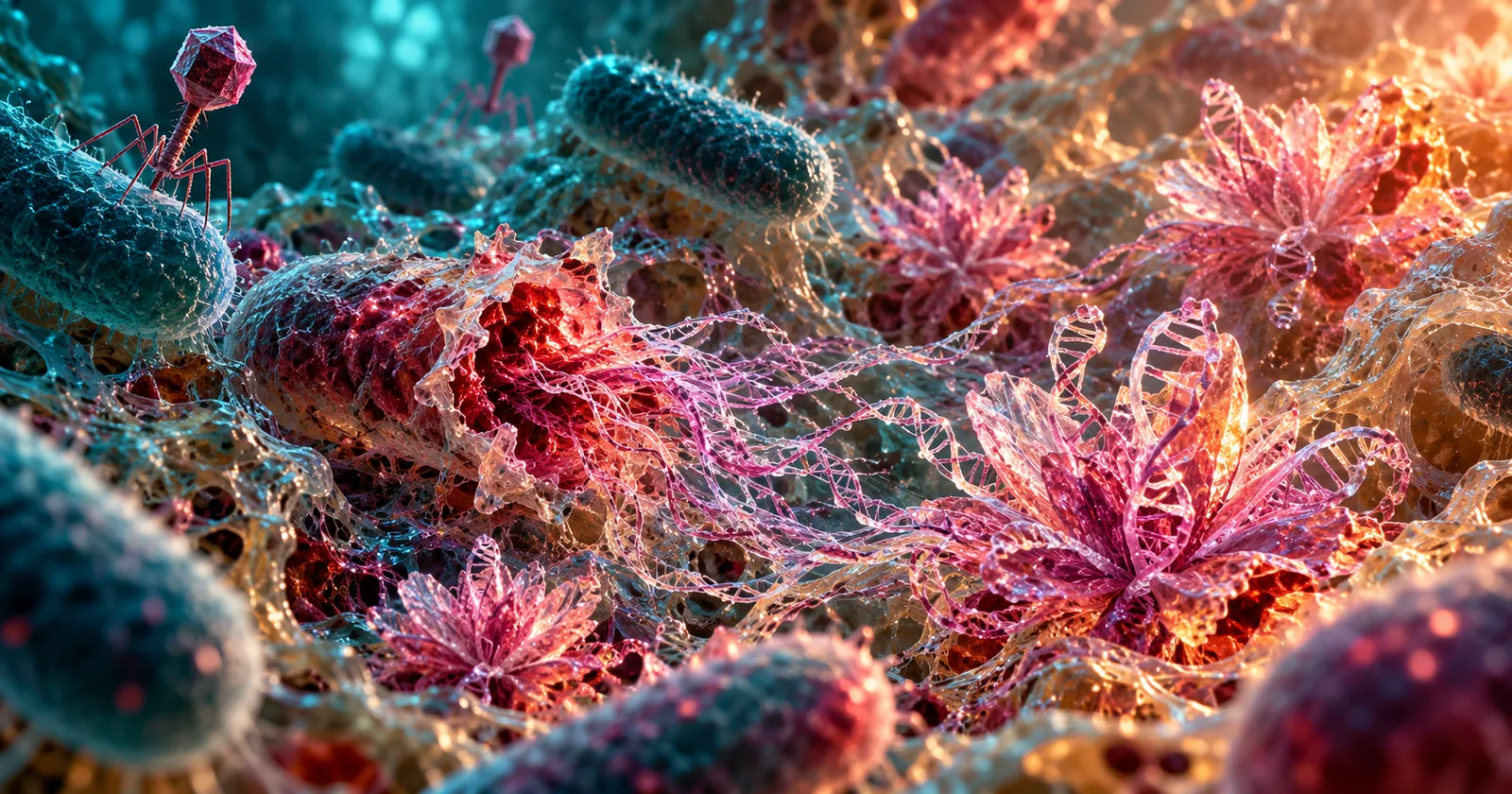
Instead, the researchers describe a process in which bacteriophages—viruses that infect bacteria—can trigger some bacterial cells to burst open. When that happens, the cells release enzymes and DNA building blocks into the biofilm around them. Under the right conditions, those enzymes can keep synthesizing DNA outside the dead cell. The cell is gone, but part of its machinery keeps running. Aarhus University
That is the central idea of the new research: death ends the bacterium, but not necessarily every chemical process it set in motion.
Why biofilms matter here
A biofilm is a community of microorganisms embedded in a sticky protective matrix. Bacteria form biofilms on rocks, pipes, teeth, medical devices, and countless other surfaces. Inside them, microbes do not behave like isolated single cells. They interact, exchange materials, and sometimes even reshape the environment around them.
The Aarhus team studied two bacteria that can form biofilms: Shewanella oneidensis and Bacillus subtilis. The first is known for its unusual ability to transfer electrons to its surroundings, which is why it often interests researchers working on microbial electricity and environmental biotechnology. The second is a classic model organism used across microbiology and industry. Aarhus University
The surprising part: new DNA, not just leftover DNA
At first glance, an outsider might wonder whether the researchers simply detected genetic debris from broken cells. The team specifically tested that possibility.
To distinguish newly made DNA from pre-existing DNA, they added a small artificial circular DNA template to the bacterial cultures. That ring acted like a blueprint. The released enzymes copied it again and again, producing DNA that could be identified using fluorescent markers.
Under the microscope, the DNA did not just remain as invisible strands. In one species it assembled into flower-like crystalline structures; in another it formed long thread-like shapes. And when the researchers used a bacterial strain that lacked the relevant viruses, this particular DNA production did not occur. That helped show the phenomenon was not just accidental debris. Aarhus University
So what is actually doing the work?
The hidden actors in the story are bacteriophages. These are viruses that infect bacteria. Some bacteriophages can lie dormant inside a bacterial genome and later become active. When activated, they can trigger the destruction of the host cell.
In this case, that destructive step appears to release a toolkit into the biofilm: enzymes, raw molecular ingredients, and the conditions needed for a kind of extracellular DNA synthesis. The researchers describe this process as rolling circle replication, a mechanism that repeatedly copies circular DNA templates into long DNA strands.
That makes the discovery more than a Halloween-friendly curiosity. It suggests that viruses infecting bacteria may help reorganize the chemistry of bacterial communities even after individual cells die.
Why the “flower” structures matter
The team did more than show that dead-cell machinery can keep copying DNA. They also say they learned how to influence what kind of DNA gets produced.
Among the structures they induced were G-quadruplexes, special DNA configurations that fold into distinct shapes. These shapes can bind other molecules and may behave in enzyme-like ways, speeding up certain chemical reactions.
That matters because DNA is not only a genetic storage molecule. Under some conditions, it can also act like a structural or chemical material.
The researchers found that these DNA-based products could alter properties of the biofilm, including catalytic behavior and electrical characteristics. In other words, this was not just a weird biochemical trick. It changed what the microbial material could do. Aarhus University
Could this become useful technology?
Possibly—but not anytime soon.
The study raises the possibility of using bacterial communities as microscopic factories for useful biological materials. One long-term idea is environmental biotechnology: instead of manufacturing certain biomaterials in a conventional factory and transporting them elsewhere, perhaps engineered bacterial systems could make them where they are needed.
That could matter in areas such as wastewater treatment, bioenergy systems, or pollution breakdown.
But this is the point where good science communication has to slow down. The researchers did not demonstrate a ready-to-use cleanup technology. They did not show these systems solving an industrial problem in the real world. What they showed is a laboratory proof of principle in two bacterial species, with DNA templates supplied by the researchers themselves. Aarhus University
The deeper question: why would nature do this?
The discovery also points to an evolutionary puzzle.
Why do some bacteria carry dormant viruses that can ultimately kill them? Is the interaction purely parasitic? Or, under some conditions, does the larger bacterial community benefit from what happens after some cells burst?
The Aarhus researchers do not claim to have answered that question. But the findings make it harder to think about bacterial death as a simple stop signal. In a biofilm, one cell’s destruction may contribute to a larger communal structure or chemistry.
That is part of what makes the finding so memorable. It blurs the clean boundary we like to imagine between life and non-life. The bacterium is dead. Yet enzymes, templates, and viral mechanisms continue generating new molecular structures in the environment around it.
What the study does—and does not—show
Here is the careful version of the story:
- the study shows that some bacterial systems can continue producing DNA outside the dead cell
- the process appears to depend on bacteriophage-triggered cell lysis and extracellular DNA replication
- the researchers showed they could influence the kind of DNA produced
- the work was done in laboratory biofilms, not in natural ecosystems at large scale
- the study does not show that dead bacteria come back to life
- it does not prove a ready-made technology for pollution cleanup or bioenergy production
Those limits do not weaken the result. They define it accurately.
Why this feels so strange
Most people think of death as the moment biological activity stops. At the level of the organism, that is broadly true. But biology is often messier at smaller scales. If the right molecules, enzymes, and structures remain in place, some processes can keep unfolding after the cell itself is gone.
That is why the discovery feels almost spooky without requiring any supernatural interpretation. The bacteria are not undead. Their chemistry is simply more persistent—and more programmable—than most of us expect.
And that may be the most Wondecode part of the whole story: a horror-movie headline that leads, not to fantasy, but to a deeper understanding of how life’s machinery can outlast the cell that built it.