
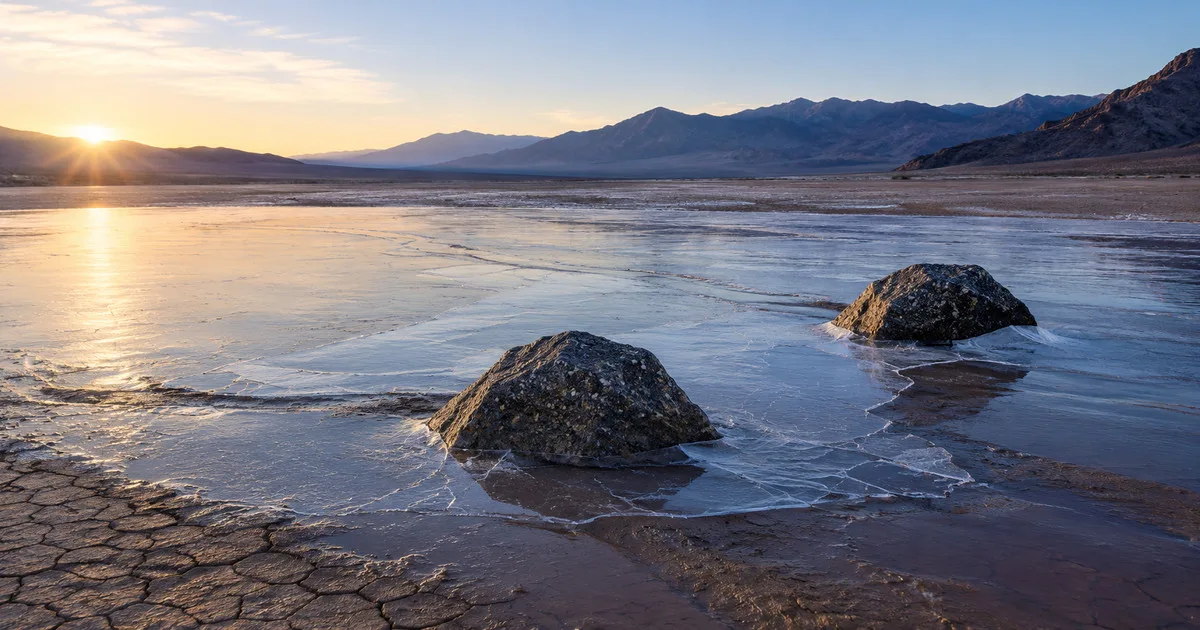
Walk across Racetrack Playa in California’s Death Valley National Park, and the evidence seems impossible to ignore: heavy rocks sit on a dry lakebed with long grooves trailing behind them. Some tracks run straight. Others curve or turn together, as though a group of stones had agreed on a route.
Yet the ground is usually empty, still, and dry. No footprints follow the rocks. No machinery is there to pull them. And a visitor could return years later to find that a stone has barely moved at all.
So what pushes rocks across a desert without anyone touching them?
The answer is stranger—and more precise—than either a gust of desert wind or an unexplained force. Under the right winter conditions, the rocks are nudged by floating panels of remarkably thin ice. Scientists finally caught the process in action in 2013, turning decades of speculation into an observable physical mechanism.
The tracks were real long before the explanation
Racetrack Playa is a broad, nearly level dry lakebed in a remote basin of Death Valley. Rocks eroded from surrounding slopes end up scattered across its clay-rich surface. Behind some of them lie unmistakable trails: shallow furrows carved into the ground.
Researchers investigated these “sailing stones” for decades. The difficulty was not proving that the rocks moved. Maps and repeat photographs made that clear. It was seeing a movement event happen.
According to the 2014 study in PLOS ONE, the stones can remain stationary for years, sometimes a decade or more. The motion is brief enough that a visitor might miss it even if they arrived on exactly the right day.
That left scientists with plausible but unconfirmed explanations. Perhaps powerful winds slid the stones across slippery mud. Perhaps whirlwinds pushed them. Perhaps thick ice froze around the rocks and carried them like miniature rafts.
Each idea addressed part of the evidence. None had yet been confirmed by directly documenting rocks in motion.
The experiment that finally caught them moving
In 2011, a team led by Richard and James Norris began monitoring Racetrack Playa. They installed a weather station, time-lapse cameras, and GPS units in 15 specially prepared rocks. The National Park Service did not permit the researchers to drill into the park’s original stones, so the team brought in comparable rocks instead.
They expected an exceptionally long wait.
Then, in December 2013, they arrived to find something rare: the desert lakebed had become a shallow pond. Nighttime freezing temperatures were producing ice; daytime sunlight was beginning to break it apart.
The researchers watched rocks move. On December 20, more than 60 stones moved during one observed event. Across several events between December 2013 and January 2014, some GPS-equipped stones accumulated movements of up to 224 meters (735 feet).
The team documented the mechanism with direct observations, photographs, GPS data, and measurements of weather and water. Their findings appeared in PLOS ONE on August 27, 2014—a historical result, not a new discovery from 2026. The Scripps Institution of Oceanography account describes how the researchers happened to be present during the rare event.
The four conditions that move a stone
The mechanism requires several ordinary ingredients to arrive in an extraordinary combination.
First: enough water to cover the playa. Rain or melting snow produces a shallow pond. The water wets the clay and provides a surface on which ice can float. But the pond must not be so deep that the stones disappear completely beneath it.
Second: a freezing night. A sheet of thin, relatively smooth ice forms across the water.
Third: the morning sun. As temperatures rise, the sheet begins to crack and separate into large floating panels. In the observed events, the ice was roughly 3–6 millimeters thick—closer to a pane of thin glass than to the heavy ice of a frozen lake.
Fourth: a steady breeze. Winds of approximately 4–5 meters per second—about 9–11 miles per hour—push the floating panels across the shallow pond. Some panels can extend for tens of meters. When their edges meet an exposed rock, the ice presses against it and nudges it over the slick, muddy lakebed.
The wind does not have to blow a heavy stone directly across the desert. Instead, it acts on a much larger sheet of ice, which transfers force to the rock. Flowing water beneath the ice also influences the stone’s direction.
The result is slow movement, typically around 2–5 meters per minute in the instrumented events. It is not spectacular to watch in real time. Yet over several minutes, a rock can travel far enough to leave a striking trail.
Why can multiple stones turn at the same time?
This is one of the clues that made the puzzle so compelling.
If each rock simply responded to wind blowing on its own surface, stones of different sizes and shapes should not necessarily move together. But Racetrack Playa is famous for tracks that appear parallel, curve in unison, or make sharp turns.
A drifting ice sheet can push more than one rock at once. When the wind changes or the water beneath the sheet flows differently, several stones can change direction together. The ice is the shared moving surface, not an invisible hand controlling each stone separately.
The tracks may remain concealed beneath shallow water while the event occurs. As the pond drains or evaporates and the mud dries, the grooves become visible. A visitor arriving later sees the aftermath without the water and ice that made it possible.
That is why the desert appears to hold a contradiction: dry ground, heavy rocks, and trails that imply movement across a surface that looks completely unsuitable for it.
Why did the mystery last for so long?
Because the crucial conditions rarely coincide.
Death Valley is famous for extreme heat, but the Racetrack is in a high, remote desert basin that can experience freezing winter nights. For the stones to move in the documented way, there must also be sufficient precipitation to create a pond—and the timing of melting ice and wind must line up.
The event may last only seconds to minutes. Researchers recorded some movements lasting up to 16 minutes. At a distance, motion of just a few centimeters per second can be difficult to perceive, especially when multiple rocks are moving together and the observer lacks a fixed point of reference.
The investigators therefore needed both patience and equipment: time-lapse images to catch the event, GPS instruments to track distance and speed, and weather measurements to connect the movement to its cause.
This case illustrates a useful lesson about scientific mysteries. A lack of direct observation is not evidence that the mechanism is supernatural. Sometimes the missing ingredient is simply being able to measure a rare event at exactly the right moment.
Does this explain every stone, including the biggest ones?
Not necessarily—and that distinction matters.
The 2014 researchers directly documented thin-ice-driven movement of particular stones under particular conditions. That is compelling evidence that the mechanism is real and capable of making tracks. But the park also contains rocks far heavier than those used in the experiment. Some are reported to weigh hundreds of kilograms.
The researchers themselves cautioned that they had not observed the very largest rocks moving. It would overstate their findings to say that every historical track made by every boulder has been individually explained by the same documented event.
The broad mystery has a strong physical explanation. The details of every individual stone’s history remain much harder to reconstruct.
Can you see the rocks move today?
Usually not. Visitors mainly see the trails left behind, not a live demonstration.
Racetrack Playa is also fragile. A muddy footprint or tire track can damage the surface and persist for years. The National Park Service prohibits driving off established roads, asks visitors not to move or remove the rocks, and advises against walking onto muddy areas when the playa is wet.
There is another reason to treat the site carefully: it is remote, with rough access roads and no reliable cell service. The National Park Service recommends appropriate high-clearance vehicles, robust tires, fuel, and water for anyone planning a visit.
The real wonder
The sailing stones are not powered by magnetism, mysterious energy, or some previously unknown property of rock. They move because familiar parts of the natural world—rain, freezing temperatures, sunlight, ice, and wind—occasionally cooperate in a way that is difficult to witness.
The surprising part is not that nature breaks its own rules. It is that something as thin as a few millimeters of ice can move solid stone, leaving evidence that lasts long after the ice has vanished.
And that is what makes Racetrack Playa so memorable: the desert keeps the record of an event while erasing almost every trace of the forces that caused it.
Sources
- Norris, R. D., Norris, J. M., Lorenz, R. D., Ray, J., & Jackson, B. (2014). Sliding Rocks on Racetrack Playa, Death Valley National Park: First Observation of Rocks in Motion. PLOS ONE, 9(8), e105948. Primary peer-reviewed observational study.
- Scripps Institution of Oceanography, UC San Diego (August 27, 2014). Mystery Solved: Sailing Stones of Death Valley Seen in Action for the First Time. Research-team account and experimental context.
- National Park Service, Death Valley National Park. Death Valley’s Moving Rocks. Official explanation and site-protection guidance.
- National Park Service, Death Valley National Park. The Racetrack. Location, access information, and visitor protection rules.