
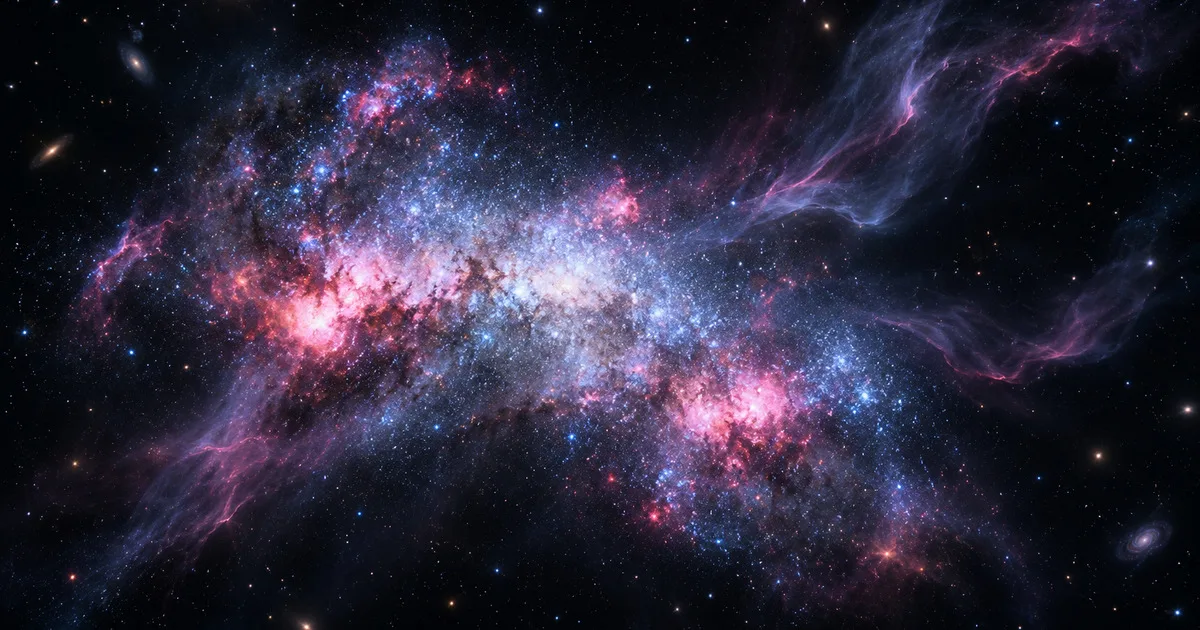
Imagine a galaxy that has spent billions of years building stars. Inside some of those stars, nuclear reactions forge oxygen. When massive stars die, they send newly made elements back into the surrounding gas. Over time, you might expect a substantial store of that oxygen to accumulate in the galaxy that produced it.
But a new astronomical accounting exercise suggests that many small galaxies are remarkably bad at keeping what their stars make.
In a study of 37 nearby dwarf galaxies, astronomers found that the galaxies retained only 4% to 25% of the oxygen estimated to have been produced by their stars. The average was about 11%. That leaves an enormous apparent shortfall—and an unusually revealing mystery about how galaxies evolve.
The results were published in The Astrophysical Journal on November 2, 2026, and announced that day by NASA. The research is part of a project called GLOW, short for Galaxies Losing Oxygen via Winds.
So where is the missing oxygen? The leading explanation involves powerful outflows driven by massive stars and supernova explosions. But the precise whereabouts of most of the oxygen are still uncertain. Some may surround the galaxies in vast, thin clouds; some may have traveled farther away.
A galaxy can be small and still make a lot of stars
Dwarf galaxies are much less massive than systems such as our Milky Way. Some contain relatively few stars; others host hundreds of millions or more. Their shapes can be irregular, and their gas reservoirs can be surprisingly important compared with their stellar populations.
Size matters because a galaxy’s gravity affects how easily gas can escape. A massive galaxy has a deep gravitational well. A smaller one generally has a shallower well, so energy released by stellar activity has an easier time pushing material outward.
The 37 galaxies in this study were selected from the nearby universe, within approximately 6 megaparsecs—about 20 million light-years—so that the Hubble Space Telescope could distinguish individual stars. They are also comparatively gas-rich and low in heavy elements, making them useful laboratories for studying how new chemical elements circulate.
One of the galaxies associated with the study is NGC 4449, a clumpy, star-forming dwarf galaxy roughly 12 million light-years away in the constellation Canes Venatici. NASA’s Hubble image of NGC 4449 shows bright clusters of stars and patches of glowing gas. It is a genuine image of a target galaxy, not a picture of oxygen escaping: the outward movement of oxygen was inferred from the chemical accounting, not photographed directly.
Where does a galaxy’s oxygen come from?
The oxygen we breathe was made in an earlier generation of stars. The universe began with mostly hydrogen and helium; stars subsequently manufactured many heavier elements through nuclear reactions.
Massive stars are especially important producers of oxygen. During their lives, they fuse lighter nuclei into heavier ones. When some of these stars end in explosive deaths, the material they manufactured can be thrown into space. Additional material is returned by stellar winds and other stellar processes.
That enriched gas can later mix with the material between stars, cool, and participate in the formation of new stars or planetary systems. The cycle is not one-way: gas can enter a galaxy, form stars, flow out again, and sometimes fall back. Astronomers call this ongoing exchange the baryon cycle.
The word metal means something broader in astronomy than it does in a chemistry textbook: astronomers often call all elements heavier than helium metals. Oxygen, despite being a gas under everyday conditions, is therefore a “metal” in astronomical discussions.
Oxygen makes a useful tracer of this cycle. It is abundant, its production in stars can be modeled, and astronomers can estimate its presence in gas using light emitted by ionized atoms. That gives researchers a way to connect star formation with the chemical history of a galaxy.
How can astronomers count oxygen they cannot see?
This was not a case of Hubble watching an oxygen cloud vanish. The GLOW team compared how much oxygen the galaxies should have produced over their lifetimes with how much oxygen is currently accounted for within them.
First, researchers reconstructed each galaxy’s star-formation history. Archived optical images from the Hubble Space Telescope are detailed enough to separate many individual stars in these nearby systems. Their colors and brightnesses help astronomers infer when successive generations of stars formed.
Next, the team estimated the oxygen produced by those generations of stars, using models of stellar evolution and chemical yields. This is the expected oxygen budget: not a direct measurement of each atom, but a calculation grounded in the inferred history of the galaxy.
Then came the inventory. The researchers estimated oxygen still present in stars, interstellar gas and dust. To do that, they combined Hubble observations with data from the retired Spitzer Space Telescope, radio observations—including those from the Very Large Array and Australian Telescope Compact Array—and previously published measurements of gas-phase oxygen abundances.
The basic comparison can be expressed in plain language:
Oxygen produced by stars − oxygen still accounted for inside the galaxy = oxygen not accounted for inside the galaxy.
This missing amount is a model-based estimate, with uncertainties in the stellar histories, oxygen production models, and measurements of the galaxy’s components. It does not mean an oxygen detector measured a literal hole in space.
The detailed methods and results appear in the researchers’ primary paper, GLOW II: A Census of Oxygen in Low-Mass Galaxies. Its companion study, GLOW I, documents the multi-observatory dataset assembled for the sample.
The number that changes the story: 11%
The researchers estimated an average oxygen retention fraction of 10.7%, usually rounded to 11%. Their individual results ranged from approximately 3.8% to 24.8%. In 29 of the 37 galaxies, the estimated retention was 15% or less.
Here is a useful mental picture: if the stars in a typical galaxy in this sample had produced 100 units of oxygen, the investigators’ estimate would leave about 11 units accounted for inside that galaxy. The other 89 units would be missing from the inventory of stars, gas and dust within the galaxy itself.
That is a comparison, not an observation of 89 atoms physically flying away. It also does not mean that 89% of all oxygen in the universe is missing—or that every dwarf galaxy behaves exactly like the 37 targets.
Another intriguing result is where the retained oxygen resides. In these gas-rich, low-mass galaxies, nearly all the oxygen that remains accounted for is in the interstellar gas, rather than locked into stars. More massive galaxies can show a different balance because their stellar populations and longer histories make stars a larger reservoir of elements.
The pattern suggests that low-mass galaxies can manufacture significant amounts of oxygen without building up correspondingly large reserves of it.
Supernovae may be powerful chemical escape engines
Imagine the interstellar medium as a patchwork of gas clouds. A massive star pours radiation and particle winds into its surroundings. When it explodes as a supernova, the blast drives a shock wave through nearby material. Multiple massive stars acting together can carve enormous cavities and help launch galactic winds.
These winds can carry hot, oxygen-enriched gas away from the regions where stars formed. In a galaxy with weak gravitational binding, some of the enriched material may travel far enough that it no longer belongs to the galaxy’s main reservoir.
The GLOW results indicate that this outward transport could be more effective than some current galaxy simulations predict. Importantly, the same simulations may reproduce familiar relationships between a galaxy’s mass and its average metal abundance while still getting the fraction of oxygen retained wrong.
That is a revealing distinction. A model can match one observed property yet misrepresent the physical processes that produced it. The new oxygen budgets offer another test: instead of asking only how metal-rich is this galaxy today?, researchers can ask how much of the oxygen its stars made did the galaxy manage to keep?
The paper suggests that details such as wind mass-loading—how much material is swept into an outflow—and the amount of oxygen carried by the wind are central to this discrepancy. But the study did not directly measure every galaxy’s historical wind, and the relative roles of different mechanisms remain an active research question.
Is the oxygen hiding in a halo around the galaxy?
The space around a galaxy is not empty. Galaxies can be embedded in enormous, diffuse reservoirs of gas called the circumgalactic medium, or CGM. Such gas can be far too thin to show up as an obvious bright cloud in a conventional image.
Scientists can sometimes detect chemical elements in this material through the absorption features they leave in light from more distant objects. Previous studies have found oxygen in the circumgalactic surroundings of dwarf galaxies. That makes the halo a plausible destination for some of the missing oxygen.
But it is not yet a complete answer. The GLOW team’s paper discusses existing measurements of ionized oxygen in dwarf-galaxy halos, while stressing the uncertainties involved in estimating how much total oxygen these faint reservoirs hold. Depending on assumptions about the gas’s ionization, some estimates suggest a halo could contain a fraction of the oxygen produced—but those estimates do not conclusively account for the full shortfall.
Some oxygen may be in forms or regions that are especially difficult to detect. Some may lie farther away, mixed into the intergalactic medium between galaxies. Material expelled in the past could also have been recycled or redistributed later.
For now, the scientists have stronger evidence for a missing balance in the galaxies themselves than for one definitive location where all that oxygen ended up.
The unexpected role of neighboring galaxies
Not every dwarf galaxy in the study had the same retention fraction. The researchers found hints that environment matters.
Galaxies with more massive neighbors or those living in denser surroundings showed a broader range that included higher oxygen retention. One possibility is that their surroundings change how material is expelled, falls back, or is acquired from elsewhere.
That complicates a simple picture in which small galaxies always lose the same fraction of their oxygen. A galaxy is not an isolated container. Its local gravitational environment, past encounters and access to fresh gas can shape its chemical evolution.
The team also reported a surprising disconnect: a galaxy’s position relative to the familiar mass–metallicity relation did not reliably reveal its oxygen retention fraction. Knowing that a galaxy has a particular measured metal abundance does not automatically tell you how much of the oxygen made by its stars has left its main body.
This is one reason the new accounting approach matters. It adds information that ordinary measurements of chemical abundance can miss.
What the next telescopes need to find
The GLOW results pose at least two distinct observational challenges: identify smaller, fainter galaxies with well-measured star-formation histories, and trace enriched gas farther beyond the galaxies’ visible bodies.
According to NASA’s announcement, lead investigator Kristen Wingfield McQuinn plans to use the wide-field Nancy Grace Roman Space Telescope to locate even fainter nearby galaxies. Follow-up observations with Hubble and the James Webb Space Telescope could help reconstruct their stellar histories in greater detail.
Co-investigator O. Grace Telford is also studying individual massive stars in some GLOW galaxies, seeking to learn more about the stars that generate and help disperse oxygen.
Future observations of gas in and around dwarf galaxies, combined with better models of their stellar populations, should help narrow down the size of the apparent oxygen deficit and the locations of possible reservoirs. Researchers will also need to understand how different assumptions about stellar oxygen yields affect the numbers.
The universe’s missing oxygen is a story about recycling
The oxygen is almost certainly not being destroyed or erased. What appears to be missing is oxygen from the main bodies of galaxies that produced it—an accounting problem with profound implications for how small galaxies build and lose their chemical ingredients.
That changes how we think about a galaxy. It is not a closed factory, storing everything its stars manufacture. It may be part of a much larger exchange network, contributing elements to enormous clouds of gas or to the space between galaxies.
The iron in rocks, the carbon in living things, and the oxygen around us all belong to the history of cosmic chemical production and redistribution. Some of those elements may have traveled far beyond the galaxies in which they first formed before becoming part of new systems.
A dwarf galaxy can make the building blocks for future worlds—and lose most of them. The unanswered question is how far those building blocks go next.
Sources
- McQuinn, K. B. W., et al. (2026). GLOW. II. A Census of Oxygen in Low-mass Galaxies. The Astrophysical Journal. Primary research on oxygen production, retention fractions, galaxy environments and simulation comparisons. Full-text preprint.
- McQuinn, K. B. W., et al. (2026). GLOW I: Comprehensive Measurements of Gas-Rich, Star-Forming, Low-Mass Galaxies in the Nearby Universe. Companion paper documenting observations and the 37-galaxy dataset.
- NASA Hubble Mission Team (November 2, 2026). NASA’s Hubble Uncovers Case of Missing Oxygen in Nearby Dwarf Galaxies. Official science release, observing context, team statements and planned follow-up work.
- Rutgers University (November 2, 2026). Stars Make Oxygen for Small Galaxies. They Lose Most of It.. University account of the research and retention figures.
- NASA/ESA Hubble (November 2, 2026). Dwarf Galaxy NGC 4449. Authentic Hubble image, astronomical details and full photo attribution; this article’s packaged hero illustration is conceptual, not that photograph.