
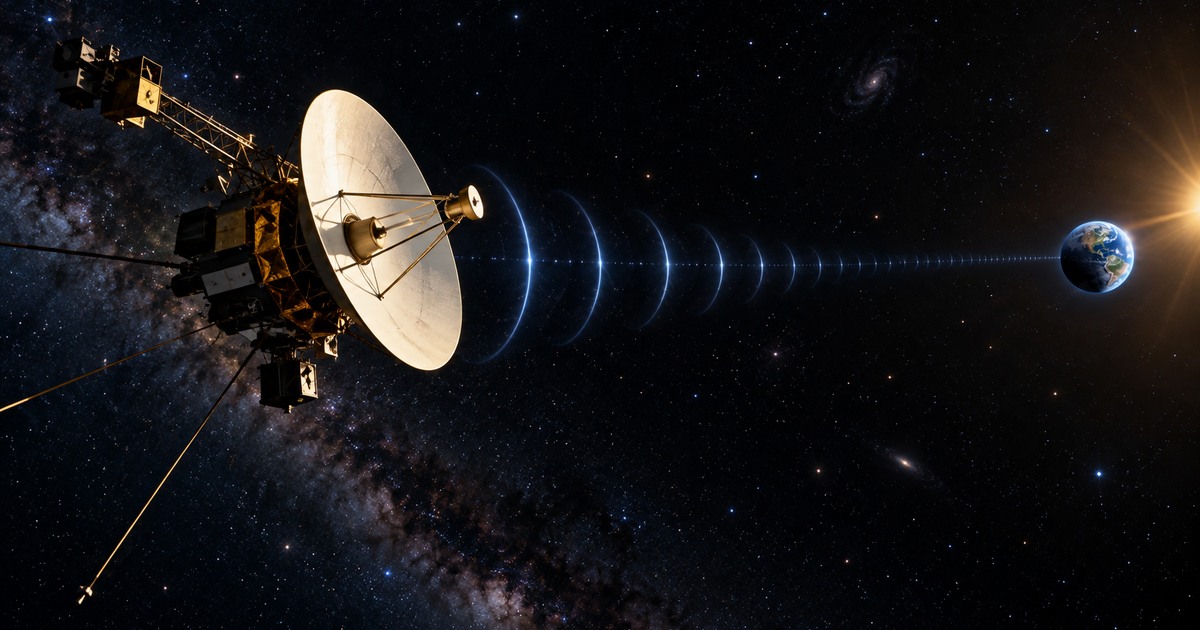
Imagine sending a message to a machine and knowing that, even if it responds immediately, the answer cannot arrive for almost two days. No internet outage is involved. Nothing is buffering. The message is simply crossing an almost unimaginable distance at the fastest speed nature allows.
That is increasingly what communicating with Voyager 1 looks like. Launched in 1977, the spacecraft has been operating beyond the Sun’s heliosphere since 2012. On November 18, 2026, NASA expects it to become the first human-made object to reach one light-day from Earth: about 25.9 billion kilometers (16.1 billion miles) away. A radio command will then take 24 hours to arrive, and an immediate reply will take another 24 hours to return. NASA’s mission tracker gives the milestone’s predicted timing.
But the compelling question isn’t just how far Voyager has traveled. It’s this: how do you operate and repair a spacecraft when you cannot have a conversation with it?
A light-day is a distance, not a new speed
Radio waves travel through the vacuum of space at the speed of light: approximately 300,000 kilometers per second. That sounds instantaneous until the gap stretches across the outer solar system.
On Earth, a command to a computer can come back with a result in a fraction of a second. At the one-light-day distance, the physics is different:
- First 24 hours: your instruction is traveling from Earth to Voyager 1.
- Next 24 hours: if the spacecraft responds immediately, its reply is traveling back to Earth.
- Total: about 48 hours between sending the instruction and receiving the earliest possible confirmation.
And that is the best-case signal delay, not a promise that operations happen on a two-day schedule. Antenna availability, command preparation, onboard processing and additional tests can add time. The distance also changes as Earth travels around the Sun and Voyager continues outward.
Nothing dramatic will happen aboard Voyager at the moment it crosses the one-light-day mark. No boundary will flash past its instruments. The milestone is a measure of distance and human engineering endurance, not a physical wall in space. NASA emphasizes this distinction.
How do we hear something so incredibly faint?
Voyager does not connect to a satellite internet service. It relies on a carefully aimed high-gain radio antenna and NASA’s Deep Space Network (DSN), an international system of enormous ground antennas.
The DSN has major complexes near Goldstone, California; Madrid, Spain; and Canberra, Australia. Their separation around the globe means that as Earth rotates, different stations can take turns communicating with distant spacecraft. Its largest dishes are 70 meters across. NASA explains how the network works and why antenna size matters.
Here is the paradox: the signal has crossed billions of kilometers, but by the time it reaches Earth it is extraordinarily weak. Engineers need exquisitely sensitive receivers, large dishes, precise timing and sophisticated signal processing to recover meaningful information from it.
The communication is not a visible blue laser streaking through space, as illustrations sometimes suggest. It is an expanding radio wave, carrying encoded data that receivers can distinguish from background noise. Onboard, Voyager’s attitude-control system must also keep the big dish pointed toward Earth. A spacecraft traveling that far away can lose contact simply by failing to orient its antenna properly.
Voyager needs to make decisions without asking Earth
Suppose a thruster, heater or sensor behaves unexpectedly. Waiting almost a day for ground controllers to respond may be too risky.
That is why Voyager was built with fault-protection routines. Its onboard computers monitor conditions and can take predefined protective actions, such as switching to backup equipment or placing the spacecraft in a safer operating state. This is not a modern AI system improvising solutions. It is carefully designed autonomy: specific responses to specified problems.
The Voyager spacecraft technical overview describes its command computer, attitude-control system and fault-detection routines. Together, these functions help a spacecraft remain viable while mission controllers are still waiting for telemetry.
The trade-off is revealing. Autonomy can protect a vehicle, but it can also create a mystery on Earth: engineers may know a protective routine ran without yet knowing what triggered it. They have to reconstruct events from telemetry that is hours old.
October 2026: Voyager went quiet, then returned
That exact problem became very real this month.
According to a NASA update published October 29, 2026, the Deep Space Network could not detect Voyager 1’s signal during scheduled contacts on October 18 and 19, about 24 hours apart. Communications resumed on October 20, after an interruption of roughly 48 hours.
Engineers determined that one group of thrusters had gone offline and a backup group had activated. Such a change is consistent with the spacecraft’s automatic fault-protection behavior. But NASA was clear that the cause of the interruption was still under investigation as of October 29. The thruster change is an important clue; it is not yet a complete explanation.
NASA also reported that contact had been maintained after the signal returned. That is very different from saying the spacecraft was lost, dead or beyond recovery. The distinction matters: a silence can be alarming without providing enough evidence to diagnose what happened.
The art of debugging a spacecraft you cannot touch
Imagine discovering an anomaly in a system built with 1970s hardware, running far beyond Pluto, with no possibility of a technician arriving to repair it.
A sensible troubleshooting sequence can look like this:
1. Listen before intervening. Mission teams analyze whatever telemetry is available, looking for changes in power, orientation, temperatures, computer status and instrument behavior.
2. Form a limited hypothesis. Rather than trying many commands at once, they identify what a small change should reveal and what risks it creates.
3. Send carefully checked instructions. The command must be suitable for a spacecraft with extremely limited power, old hardware and long communication delays.
4. Wait for evidence. A command taking nearly a day to reach Voyager cannot be evaluated until a return signal arrives. Engineers must resist the urge to assume silence means the command failed.
5. Preserve the spacecraft. A cautious test that keeps the antenna pointed toward Earth may be worth more than an aggressive experiment that risks losing communications.
These are general principles illustrated by NASA’s published mission operations, not a claim that a particular unpublished October diagnostic sequence followed exactly these five steps.
In deep space, patience isn’t a virtue added to engineering. It is part of the engineering specification.
There is another clock running: the power supply
Even if Voyager’s radio and computers keep working, they need electricity. The probe does not rely on sunlight this far from the Sun. It uses radioisotope thermoelectric generators, which convert heat from radioactive decay into electrical energy.
Its power output gradually declines. NASA says the Voyager spacecraft lose roughly four watts of available power each year. Four watts may sound trivial, but when a machine has only a small remaining power margin, those watts can decide whether a scientific instrument stays on or must be shut down.
In September 2026, NASA’s engineers completed a complex energy-saving operation on Voyager 1, nicknamed the “Big Bang.” They switched three devices to lower-power alternatives in a coordinated operation while preserving the distribution of heat needed for the spacecraft’s survival. NASA says the change should let its remaining scientific instruments operate longer, avoiding another shutdown that otherwise might have been needed as early as summer 2027.
The name is dramatic. The real accomplishment is subtler: managing electrical power, heat and risk in a machine that has already outlived the era of technology in which it was designed. NASA describes the operation here.
What is Voyager actually doing out there?
Voyager 1 is not racing toward a particular destination where someone is waiting to greet it. It is collecting measurements in interstellar space, beyond the heliopause: the outer boundary of the Sun’s bubble of charged particles and magnetic influence.
This does not mean it has escaped every possible meaning of “the solar system.” For example, the much more distant Oort Cloud is commonly considered part of the solar system’s gravitational domain. “Interstellar space” refers specifically to Voyager’s location beyond the heliosphere.
Voyager’s instruments have supplied direct measurements of magnetic fields, plasma waves and energetic particles in an environment that no other kind of probe has explored in the same way. The science is valuable precisely because an instrument there can measure conditions that telescopes on Earth can only infer indirectly. As the spacecraft ages, individual instruments may be powered down to preserve its mission.
The real achievement is not the number on the odometer
When the calendar reaches November 18, the one-light-day milestone will be striking: a command sent from our planet will need a full day simply to arrive. But the milestone does not make Voyager suddenly harder to operate. Every additional kilometer has already been increasing the communication delay, bit by bit, for decades.
The deeper achievement is that a machine launched before personal computers became commonplace still supports a scientific mission using limited onboard autonomy, extraordinarily sensitive radio communication, careful fault recovery and relentless power management.
It offers an unexpectedly practical lesson about exploration: the farther we go, the less we can rely on immediate instructions from home. Future probes traveling deeper into the outer solar system—and perhaps someday toward other stars—will need even greater capacity to remain safe and useful while Earth is still waiting for their messages.
The universe has no instant-reply button. Voyager 1 is teaching us how to work without one.
Sources and further reading
- NASA — Voyager 1 Conserves Power, Resolves Brief Communications Pause (October 29, 2026)
- NASA — Where Are Voyager 1 and 2 Now? (mission tracker and November 18 milestone)
- NASA — How the Deep Space Network Communicates with Spacecraft
- NASA — Voyager Spacecraft: Design, Control and Fault Protection
- NASA Space Place — How Does NASA Communicate with Spacecraft in Deep Space?