
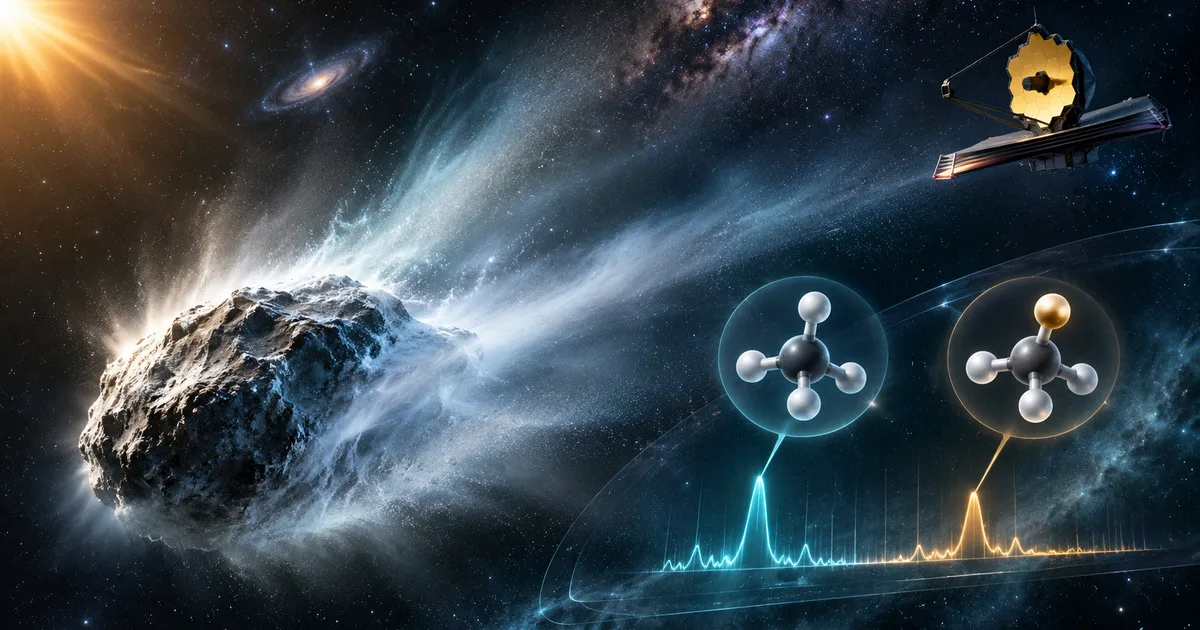
The visitor came from beyond our Solar System. It swept around the Sun, released gas from its ice, and carried on toward the stars. But in that escaping gas, astronomers found something stranger than a dramatic tail: a chemical fingerprint unlike the methane measured in any Solar System object so far.
The interstellar comet 3I/ATLAS contains methane unusually rich in deuterium, a heavier form of hydrogen. A study published in Nature Astronomy on October 23, 2026 reported that the deuterium-to-hydrogen ratio in its methane is about 13 times that measured in comet 67P, the only other comet with a comparable methane measurement. The result was highlighted in a November 1 report.
Why would a tiny difference inside a molecule tell us anything about where a comet was born? The answer begins with an extra neutron, extends into the chemistry of exceptionally cold clouds, and ends with a warning about how much a chemical clue can—and cannot—reveal.
A visitor that does not belong to our Solar System
3I/ATLAS was discovered in July 2025 and is the third confirmed interstellar object observed passing through the Solar System. Its trajectory identifies it as a visitor rather than a body permanently bound to the Sun. It offers a rare chance to investigate material that formed in a different environment from the one that produced Earth, Jupiter and our familiar comets.
A comet is not just a frozen rock. As solar radiation warms it, some of its ice changes directly into gas through sublimation. That gas and escaping dust form an extended cloud around the nucleus called the coma. Astronomers can study the coma from enormous distances because its molecules leave recognizable signatures in light.
NASA reported in June 2026 that the James Webb Space Telescope had detected methane in the comet and found an unusual chemical mixture. The October paper examines a more demanding question: not merely whether methane is present, but which hydrogen isotopes that methane contains.
The distinction matters. Finding a chemical element or molecule tells us something about composition. Measuring its isotopes can reveal clues about the conditions under which that material formed or changed.
The difference between ordinary and heavy hydrogen
Ordinary hydrogen has a nucleus consisting of a single proton. Deuterium is hydrogen with one proton and one neutron. It is still hydrogen, and it can participate in many of the same chemical reactions, but its greater mass changes some reaction rates and the way molecules interact with light.
Most methane molecules are written CH₄: one carbon atom bonded to four hydrogen atoms. Replace one of those hydrogens with deuterium and the molecule is written CH₃D. The two forms behave similarly in many respects, but they do not have identical infrared spectra.
The Webb telescope is equipped to study such differences. In near-infrared observations made December 22–23, 2025, researchers investigated the radiation emitted by gases in the comet’s coma. They modeled contributions from other molecules and searched for the faint spectral features associated with deuterated methane beside the stronger signatures of ordinary methane.
The resulting D/H ratio for methane was (3.18 ± 0.30)%. In everyday terms, that measures the relative abundance of deuterium atoms to ordinary hydrogen atoms associated with the measured methane—not the fraction of the comet’s mass made of deuterium, and not simply the percentage of methane molecules containing one heavy atom.
For comparison, measurements of methane in 67P/Churyumov–Gerasimenko made by the Rosetta spacecraft gave a value around thirteen times lower. Webb observed 3I/ATLAS remotely; Rosetta obtained its result by investigating a comet within our own Solar System at close range. The new comparison is striking, but it is based on a very small set of directly comparable comet measurements. (Nature Astronomy, 2026)
How can ice preserve a record of extreme cold?
Imagine two kitchens using the same ingredients but at different temperatures. The final dishes can differ because certain reactions proceed more easily in one environment than in the other. Something similar happens to chemicals in space, though the temperatures and processes are extraordinarily different.
In dark, cold molecular clouds and the environments surrounding young stars, chemical reactions can sometimes favor putting deuterium into particular molecules. At very low temperatures, the reactions that would normally reverse some of that enrichment become less efficient. Chemistry on the surfaces of tiny dust grains can then help lock unusual isotope proportions into ice.
That ice may eventually become part of larger bodies. If a comet preserves it without completely resetting its chemistry, isotope ratios can become a kind of partial chemical archive of an earlier environment.
The team behind the October study argues that 3I/ATLAS’s methane is consistent with ice formed in an extremely cold, relatively metal-poor interstellar or protostellar setting with substantial cosmic-ray irradiation. In astronomy, metal-poor means comparatively low abundances of elements heavier than helium—not a shortage of visible pieces of iron or gold.
Cosmic rays also matter because energetic particles can change ionization and kick-start chemical pathways that enrich some molecules in deuterium.
But ‘consistent with’ is not the same as ‘proved to have formed at one specific location.’ Different combinations of temperature, radiation and chemical history can sometimes leave overlapping signatures. The investigators also note that directly comparable methane isotope measurements from distant star-forming regions are scarce. (Nature Astronomy, 2026)
A second clue was already hiding in the comet’s water
The methane result does not stand alone. An earlier study published in Nature in June 2026 measured remarkably unusual isotope ratios in 3I/ATLAS’s water and carbon-bearing gases.
That work reported a water D/H ratio of (0.98 ± 0.06)%, far higher than typical values measured in Solar System comets. Its authors argued that the comet’s original water ice may have formed at temperatures around 30 kelvin or lower—roughly minus 243 degrees Celsius—under model-dependent assumptions about its early history.
Now the methane measurement provides an additional and somewhat different piece of the picture. The methane’s D/H ratio is roughly three times the ratio in the water. That does not mean the measurements contradict one another. Different molecules can acquire or preserve their isotope signatures through different chemical pathways and at different stages.
The contrast could help researchers reconstruct the sequence of ice formation. It also presents a challenge for chemical models: can they reproduce the water and methane isotope abundances together, rather than explain each one in isolation?
Some interpretations of the broader isotopic evidence suggest that 3I/ATLAS could contain material assembled in a very ancient environment, perhaps billions of years older than the Solar System. But there is no direct, uniquely established birth date for the comet, and the methane result by itself is not a clock that tells us how old it is.
What Webb measured—and what it did not
It is tempting to treat the comet as a message bearing the exact address of another star. Science is more careful than that.
What the measurements establish: Webb detected a strong enrichment of deuterium in methane released into the coma of an interstellar comet. This is a rare and quantitatively unusual chemical signature. The published result supports the view that its material experienced conditions unlike those typical of our nearby Solar System samples.
What remains uncertain: the precise stellar system where the comet formed, the full path it took through the Galaxy, and which combination of early chemical processes produced its particular isotope pattern. The measured gas also comes from ice exposed and released during the comet’s solar passage, so interpreting its original composition requires physical and chemical models.
The finding is not evidence of extraterrestrial life. Methane can arise through many non-biological processes, and a high deuterium ratio is not a biological signature. Nor is the observation evidence that 3I/ATLAS is an artificial object. Its value comes from what its natural chemistry can teach us.
This is an especially important distinction for an interstellar visitor: rarity makes a story fascinating, but rarity does not automatically justify an extraordinary explanation.
Why a passing comet can teach us about distant planetary systems
We cannot usually visit the icy outskirts of another planetary system and return a sample. Even powerful telescopes struggle to observe small bodies forming in dusty, distant environments.
An interstellar object does something remarkable: it brings material shaped elsewhere into the reach of our instruments. Webb does not need to land on 3I/ATLAS to investigate the gases escaping from it. By dividing infrared light into wavelengths and comparing the resulting patterns with molecular physics, astronomers can recover details of its chemistry that are invisible in ordinary pictures.
One object cannot establish what all distant comets are made of. But it can show that the variety of planetary building materials is broader than our local inventory suggests. Future observations of interstellar visitors, better laboratory measurements, and improved models of isotope chemistry may help researchers distinguish among the possible formation histories.
And because scientists can compare several kinds of molecule within the same comet—water, methane, carbon-bearing gases—they can ask whether those materials share a common history or preserve evidence of different stages of formation.
That is a deeper payoff than the headline number alone. The discovery turns 3I/ATLAS into a test of how chemistry works before, during and after planets begin to form.
The extraordinary clue is only one neutron wide
The most surprising part of the story is not that a comet from elsewhere contains methane. It is that replacing an ordinary hydrogen atom with a slightly heavier version can change a molecule’s spectral fingerprint—and that a telescope can detect the difference across space.
Webb has not found 3I/ATLAS’s home star. Instead, it has retrieved a trace of the conditions under which some of its icy ingredients may have formed. The answer is incomplete, and that incompleteness is precisely where the next scientific questions begin.
Wondecode takeaway: an isotope ratio is not a cosmic address. It is a measurable clue that lets researchers test competing stories about an interstellar comet’s past.
Sources
- Roth, N. X., Cordiner, M., Milam, S., et al. (2026). An enriched methane D/H ratio in the interstellar object 3I/ATLAS. Nature Astronomy. Published October 23, 2026. DOI: 10.1038/s41550-026-03002-5.
- Cordiner, M., Roth, N. X., Micheli, M., et al. (2026). Isotopic evidence for a cold and distant origin of 3I/ATLAS. Nature. Published June 22, 2026. DOI: 10.1038/s41586-026-10771-6.
- NASA (June 1, 2026). NASA’s Webb Detects Methane on Interstellar Comet 3I/ATLAS. NASA Science; background on methane detection and cometary gases.
- Zinin, A. (November 1, 2026). Heavy hydrogen in 3I/ATLAS’s methane points to a frigid birthplace. Phys.org. Contemporary report on the October study.