
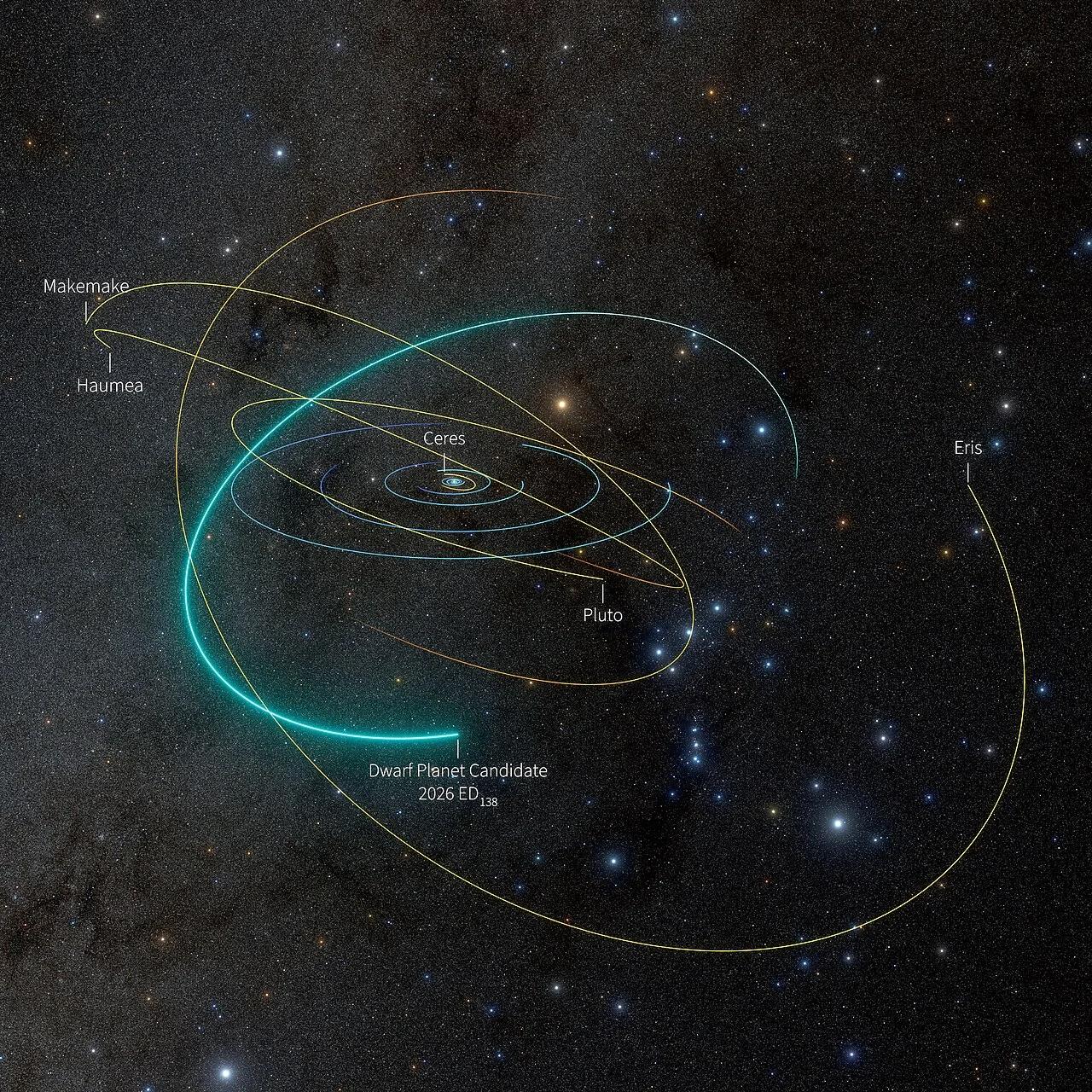

Astronomers have found a possible new dwarf planet beyond Pluto. But the most surprising part is not simply that it was hiding in the distant Solar System. It is that the object had already been photographed years before anyone recognized what those images contained.
On October 27, 2026, the NSF–DOE Vera C. Rubin Observatory announced 2026 ED138, a distant, icy world whose estimated size could make it one of the largest dwarf-planet candidates discovered beyond Neptune. The discovery is real. Its precise diameter and dwarf-planet status are not yet settled.
So how does an object potentially hundreds of kilometers across escape detection for so long?
Hidden in a sky full of stars
Picture trying to recognize a single slow-moving speck of dust against a wall covered in millions of nearly identical specks. Now imagine that the speck changes position so gradually that a single photograph cannot tell you which one it is.
That is roughly the challenge astronomers faced with ED138. The object was detected in a region close to the apparent plane of the Milky Way, where an exceptionally crowded background of stars can hide faint Solar System bodies. Earlier searches either avoided much of this busy sky or did not examine it deeply enough. Rubin Observatory · Rubin Solar System team
Unlike the fixed pattern of distant background stars over a short observing period, an object orbiting the Sun slowly changes its position against that background. The trick is not just taking a sharper picture. It is identifying the same moving object in many different images, taken at different times.
How the Rubin Observatory found it
On October 13, Rubin team member Matthew Holman was processing observations collected earlier in 2026. He was using search software developed with colleague Kevin Napier to connect detections of moving objects across immense catalogs of recorded points of light.
One candidate stood out: ED138 appeared unusually bright for something so far from the Sun. That combination suggested it might be a substantial body, not simply another tiny rock. Researchers checked the result and searched for additional detections. Rubin Observatory
Rubin had actually captured the object 30 times across 20 nights, from March 4 to July 11, 2026. Those observations helped establish its motion and orbit.
Then came the remarkable part. Researchers searched archival observations from the Dark Energy Camera (DECam), mounted on the Blanco 4-meter telescope in Chile. With help from an astronomical archival-search service, they identified older observations dating back to 2016. Rubin Observatory · Rubin research community
The object had not suddenly appeared. Its light had already been recorded. What changed was our ability to connect the evidence.
Astronomers call this precovery: finding an object in images taken before its discovery was recognized. Old photographs become newly valuable once scientists know where to look.
Just how far away is 2026 ED138?
At the time of the announcement, ED138 was about 46 astronomical units (AU) from the Sun. One AU is approximately the average distance between Earth and the Sun. In other words, it was roughly 46 times farther from the Sun than Earth is. Its orbit carries it beyond Neptune, making it a trans-Neptunian object. Rubin Observatory
That distance makes it extremely difficult to study in detail. We are not looking at a close-up photograph of a world with visible mountains or glaciers. In the available discovery images, it is a faint point of light identified by its movement through a star field.
Its orbit is also tilted about 25 degrees relative to the main plane of the Solar System. Such orbital properties can preserve clues about the complex gravitational history of the outer planets, especially Neptune. Rubin Observatory
Is it really a dwarf planet?
Not confirmed yet. That distinction matters.
Astronomers can estimate how bright a distant object appears, but brightness alone does not reveal its size. A smaller, highly reflective icy body can look as bright as a larger, darker one. Scientists need to know more about the surface’s albedo—how much incoming light it reflects.
Depending on that reflectivity, the Rubin team estimates ED138 could be approximately 600 to 1,500 kilometers in diameter. That is an enormous uncertainty, and it is why the discovery was announced as a dwarf-planet candidate, not an officially established sixth dwarf planet. Rubin Observatory
Under the International Astronomical Union’s definition, a dwarf planet orbits the Sun, has enough mass for its own gravity to make it approximately round, is not a moon, and has not cleared its orbital neighborhood. A large icy object may plausibly be round, but astronomers still need stronger measurements to determine ED138’s physical properties.
Follow-up observations, including measurements at longer infrared wavelengths, may help constrain its size and surface characteristics. For now, the honest label is candidate.
What the discovery changes
The real story is bigger than one newly recognized body. ED138 illustrates how astronomy is shifting from occasional snapshots toward systematic surveys that repeatedly image enormous parts of the sky and compare what changes.
Rubin’s Legacy Survey of Space and Time is designed to keep returning to the southern sky, building a record of movement and variation over years. Its cameras collect the raw evidence; algorithms help sift through it; astronomers interpret and verify the results. Rubin Observatory · National Science Foundation
That combination could reveal many objects that previous surveys overlooked—not because those objects were invisible in principle, but because the sky was too crowded, the data too scattered, or the search methods insufficiently sensitive.
There is another lesson here: a discovery does not always begin when a telescope takes a picture. Sometimes it begins years later, when a new question is asked of an old image.
A world we know mostly as a moving point
We do not yet know what ED138’s surface looks like. We do not know its precise diameter. We should not picture it as a detailed miniature Pluto simply because it may belong to the same broad family of distant icy worlds.
What we do know is fascinating enough. A large body moving beyond Neptune spent years hidden in crowded astronomical observations. Researchers recognized it by linking faint points of light, then reached backward through a decade of archived images to reconstruct its path.
The universe was not keeping the secret from us. The evidence had been there. We were only just learning how to read it.
How many other worlds might already be sitting unnoticed in the photographs we have taken?
Sources
- NSF–DOE Vera C. Rubin Observatory — First dwarf-planet candidate (October 27, 2026)
- U.S. National Science Foundation — New dwarf-planet candidate discovered
- Rubin Observatory LSST Community — Discovery data and orbital analysis
- International Astronomical Union — Pluto and the definition of a dwarf planet