
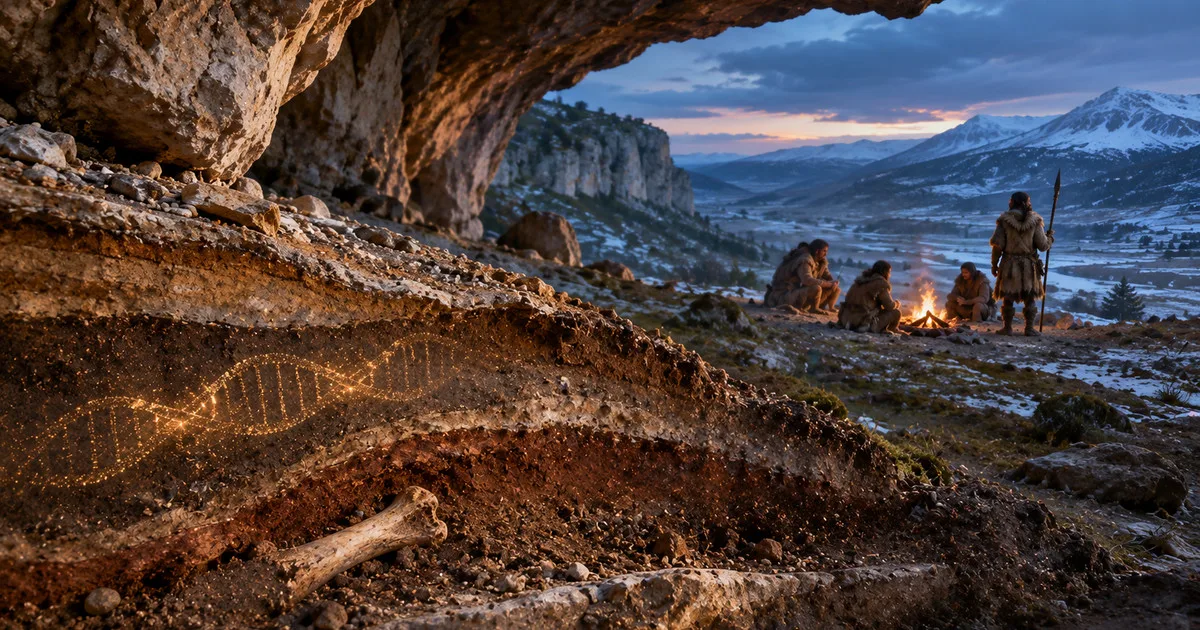
Imagine standing in a cave in southwestern France, looking at a small fragment of ancient bone. It offers no obvious clue about the journeys its owner might have known. There is no map, no written account, and no name. Yet microscopic traces preserved inside that fragment contain a surprising message: people in Ice Age Europe were connected across greater distances than one simple picture of isolated communities would suggest.
Now imagine a second cave, hundreds of kilometers away, where researchers investigate a layer of earth but find no human skeleton in it. Even there, human DNA remains. The sediment holds molecular evidence that people occupied the region during one of the coldest chapters of the last Ice Age.
These are two parts of the same scientific story. In a study published on October 23, 2026, in Science Advances, an international team led by the University of Vienna brought together DNA from ancient human remains and DNA recovered directly from cave sediments. The research does not reveal an entire forgotten civilization. It offers something more precise: evidence of genetic exchange between distant populations, alongside long-term continuity in parts of southwestern Europe.
What can fragments of DNA, separated from us by about 30,000 years, genuinely tell us about the people who lived there?
Europe before the coldest part of the Ice Age
By the time of this story, modern humans had lived in Europe for thousands of years. Between roughly 34,000 and 25,000 years ago, many archaeological sites across the continent shared features associated with the Gravettian: distinctive stone and bone tools, ornaments, portable art, and varied burial practices.
It is tempting to imagine the Gravettian as one people spreading across Europe. Archaeologists use the term for a broad cultural tradition, however, not a single ethnic group or genetically uniform population. Similar kinds of objects can spread through contact, shared techniques, migration, or a combination of these processes. A style of tool cannot tell us, by itself, how closely its makers were related.
A major 2023 genomic study in Nature had identified two broad ancestry patterns among Gravettian-associated individuals. One, often labeled the Fournol cluster, was especially associated with western and southwestern Europe. Another, the Věstonice cluster, was prominent among samples from central, eastern, and parts of southern Europe.
These labels are scientists’ shorthand for patterns of genetic similarity in a limited collection of ancient genomes. They are not the names that prehistoric people used for themselves, and they do not describe neat, sealed-off populations with fixed borders.
Until recently, the available genomic evidence suggested that those broad regional ancestry patterns remained relatively distinct for long periods. But ancient DNA is scarce, and a small number of surviving individuals can make a complex past look deceptively simple.
A woman at Isturitz changes the picture
The most striking new evidence comes from Isturitz Cave, in what is now southwestern France, near the western Pyrenees. The cave has a rich archaeological record and has long been considered a possible gathering place for prehistoric groups.
Researchers obtained genome-wide data from bone belonging to a woman who lived around 30,000 years ago. According to the 2026 study, the dataset includes approximately 454,000 sampled genetic variants, making it an unusually informative resource for this period and the oldest genome-wide dataset yet reported for a modern human from southwestern Europe.
Much of her ancestry resembles the western Fournol-related pattern. But not all of it. The team also found a statistically detectable connection to ancestry associated with populations farther east, including central and eastern European Gravettian groups.
That result matters because it is not merely a shared style of ornament or a similar tool. It is a signal in the DNA itself: at some point in the ancestry of these populations, people from previously differentiated genetic groups had children together.
The researchers also examined an individual from Ormesson, France, whose genomic data had been published previously. That individual showed a related signal, offering support for the possibility that the genetic connections were more widespread than one isolated case.
Using a method that estimates the timing of ancestral mixing from the lengths of inherited DNA segments, the team modeled an admixture event at approximately 32,500 to 31,500 years ago. This is an estimated interval, not a historical date engraved into the DNA. The timing also depends on the simplifying assumption that the observed mixing can be approximated as one episode. The corresponding date estimate for Ormesson was less statistically secure than the estimate for Isturitz.
Crucially, the woman herself did not have to travel from eastern Europe. The genetic signal might have reached her through earlier generations, through several intermediate communities, or through movements that the available data cannot resolve. The study supports long-distance population connections; it does not identify a particular caravan, migration corridor, or meeting between two named groups.
How can a scientist read an ancient genome?
DNA decays after death. Time, heat, water, microbes, and chemical reactions break its long strands into much shorter pieces. The challenge is not simply finding a molecule: it is showing that the molecule really comes from the ancient specimen rather than a modern person who handled it.
Ancient-DNA laboratories therefore use specialized clean rooms, protective procedures, and negative controls. Researchers extract tiny fragments, prepare sequencing libraries, and compare the recovered sequences with reference genetic positions. In this study, the team used approaches including targeted DNA capture to enrich the small fraction of fragments relevant to human genetic analysis.
Scientists also examine the chemical damage patterns typical of old DNA. Those patterns can help distinguish ancient fragments from modern contamination, although no single signal is a perfect guarantee. The study reports estimated contamination below 5% for the especially informative Isturitz and Ostuni samples; another sample from Chufín required more restrictive filtering because its DNA was poorer and showed a higher contamination estimate.
Finally, statistical tools compare many genetic sites across individuals and populations. A result is usually about relative ancestry and probabilities, not about reading someone’s complete life story from a few letters of DNA. That distinction becomes especially important when the surviving material comes from soil rather than a bone.
A cave floor that kept human DNA
At El Mirón Cave in Cantabria, northern Spain, the team went looking for genetic evidence in a layer of sediment dated to approximately 22,100–21,730 years ago. The layer belongs to the Solutrean archaeological period, during the Last Glacial Maximum, a prolonged interval of particularly cold conditions extending approximately from 26,500 to 19,000 years ago.
No human bones or teeth from that layer were required for this part of the analysis. Researchers recovered DNA fragments directly from the sediment—known as sedimentary ancient DNA, or sedaDNA.
The signal was faint. After extensive sequencing and filtering for damage consistent with old DNA, the team retained roughly 14,700 genetic variant positions for comparison. That is far less information than the hundreds of thousands of positions obtained from the Isturitz woman. Yet it was enough to identify a broad genetic affinity to the western, Fournol-related ancestry pattern.
It is a remarkable change in what archaeology can ask. A cave floor may contain biological traces from people who left no identifiable skeleton in a particular layer. Sediment can therefore help fill gaps in the human record that bones alone cannot bridge.
But the limitation is just as important. Soil is not necessarily the genetic signature of one identifiable person. Material from more than one individual may contribute to a sample, and ancient molecules can move, degrade, or become contaminated. The researchers describe these challenges explicitly. The result supports a population-level ancestry inference; it does not reconstruct the full genome of a single 22,000-year-old person.
Survival and continuity through the cold
Together with ancient remains from Chufín Cave and other previously studied sites, the El Mirón evidence strengthens the case that a western-related ancestry persisted in southwestern Europe across thousands of years, including during the Last Glacial Maximum.
This is one reason the Iberian Peninsula and the Franco-Cantabrian region feature prominently in discussions of Ice Age refuges: places where some human populations may have persisted while other regions were harder to inhabit.
The word refuge should not imply a comfortable sanctuary or an unchanging community. Climate varied over time, sites were occupied differently, and groups could move, disappear, return, and exchange ancestry. Genetic continuity means that related ancestry remained detectable across the sequence of samples. It does not prove that an identical group lived continuously in the same cave or that no newcomers arrived.
The data also complicate an earlier suggestion of a major population turnover in southwestern Europe around 28,000 years ago inferred from aspects of dental morphology. The new genomic evidence favors a more continuous regional history. Still, the researchers acknowledge the small number of surviving genomes available from this immense span of time.
A mother and her unborn son in Italy
The study has another deeply human dimension. At Ostuni in southern Italy, researchers examined DNA from remains known as Ostuni1b, associated with the burial of a pregnant woman known as Ostuni1. The burial dates to roughly 27,800–27,400 years ago.
Genetic analysis identified the young individual as a first-degree relative of the woman and, in the context of the archaeological find, most likely her son. The study also compared their ancestry to ask what could be inferred about the child’s father.
The results were consistent with a father whose broad ancestry resembled the mother’s. Analyses of long, matching regions in the child’s genome showed no evidence that the parents were close biological relatives.
This does not tell us how their relationship began, whether it followed a marriage custom, or what rules their community had about partners. It does show that even a very small number of ancient genomes can illuminate questions about family relationships and population structure that tools and ornaments cannot answer on their own.
The Ostuni evidence belongs to a somewhat different genetic context from Isturitz. Its significance is not that all Gravettian people were members of one huge family. Rather, this collection of finds reveals different scales of connection: close biological kinship within a burial, genetic exchange between regional ancestries, and longer-term continuity across generations.
What the discovery does—and does not—prove
The findings are strongest when read together, with their limitations in view:
- Supported: the Isturitz woman’s genome contains evidence of ancestry related to both western and more easterly Gravettian populations.
- Supported, with modeling assumptions: a detectable episode of genetic mixing may date to roughly 32,500–31,500 years ago.
- Supported: human DNA from approximately 22,000-year-old sediment at El Mirón adds evidence for western-related ancestry during the Last Glacial Maximum, even without human bones from that layer.
- Not established: a specific migration route, the identity of the people who carried the ancestry, or whether Isturitz served as a meeting place in precisely the way archaeologists currently hypothesize.
- Not established: the language, personal beliefs, political identity, or social customs of the people represented by these DNA traces.
The discovery is also a reminder that prehistoric genetic clusters are not modern nationalities. They are analytical patterns built from limited ancient samples. Projecting today’s borders or identities backward by 30,000 years would distort the evidence.
As additional samples are recovered—and as sediment techniques improve—some details of this interpretation will inevitably be refined. That is not a weakness unique to this study. It is how reconstructing a distant past works when most of the evidence has vanished.
The bigger story beneath the soil
The new results offer a more nuanced picture than either of two extremes. Ice Age communities were not all one undifferentiated population. Nor were they necessarily locked into separate, isolated regions for millennia.
In southwestern France, one woman’s DNA carries a trace of connections stretching beyond her local region. In northern Spain, a cave layer preserves evidence of people through a severe climatic era even where no skeleton was recovered. In Italy, a mother and her unborn child add a glimpse of biological relationships within an ancient community.
These are not complete biographies. They are carefully extracted fragments of a lost human story. Yet together they suggest something both scientifically important and recognizably human: even in the Ice Age, local roots and distant connections could exist at the same time.
Sources
- Gelabert, P., et al. (2026). Early Gravettian genomic data from Western Europe reveal population movements before the LGM. Science Advances, 12(43), eaeh6128. Primary peer-reviewed study; samples, chronology, admixture modeling, sedaDNA, caveats, and Ostuni relationships. Open-access full text.
- University of Vienna (October 23, 2026). Ancient human DNA reveals hidden connections across Ice Age Europe. Institutional research announcement with explanations from Pere Gelabert and Ron Pinhasi.
- Sapienza University of Rome (2026). DNA dating back 30,000 years reveals new connections between Palaeolithic European populations. Institutional context for the Ostuni mother-and-child material and the broader collaboration.
- Posth, C., et al. (2023). Palaeogenomics of Upper Palaeolithic to Neolithic European hunter-gatherers. Nature, 615, 117–126. Earlier large-scale study defining western Fournol- and central/southern Věstonice-related ancestry patterns, providing background for the 2026 findings.