
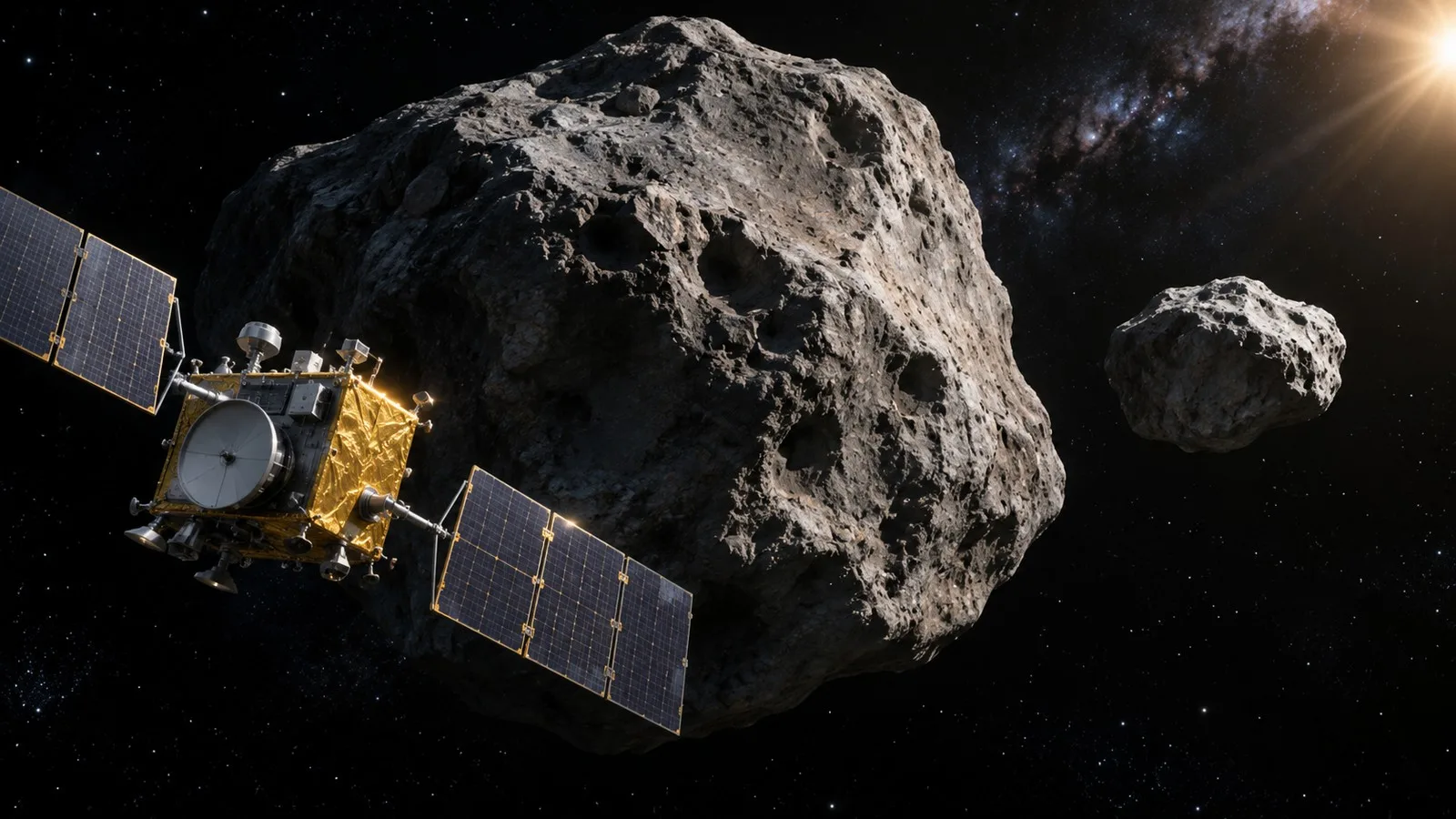
The most remarkable result of NASA’s 2022 asteroid experiment was not an explosion. It was a timetable change: a small moonlet began circling its parent asteroid about 33 minutes faster than before. Humanity had deliberately altered the motion of another world.
But an important question remained unanswered. What, exactly, happened to the asteroid when a spacecraft hit it at high speed?
Four years later, a European spacecraft has arrived to investigate. On November 5, 2026, the European Space Agency (ESA) published Hera’s first close-up look at the Didymos asteroid system. The image reveals a rugged, boulder-strewn parent asteroid and only a limited glimpse of its much smaller companion, Dimorphos — the actual target of NASA’s collision.
This is not the final answer to the DART experiment. It is the beginning of the forensic work that can make asteroid deflection something scientists understand well enough to repeat.
The asteroid we intentionally hit
On September 26, 2022, NASA’s Double Asteroid Redirection Test, or DART, crashed into Dimorphos, a small asteroid orbiting the larger Didymos. The test was designed to answer a simple but consequential question: if scientists discover a dangerous asteroid years in advance, could a spacecraft change its course by hitting it?
In the case of Dimorphos, the answer was a measurable yes. DART was a roughly 580-kilogram spacecraft traveling at about 6.1 kilometers per second when it struck the moonlet. Afterward, Dimorphos completed each orbit around Didymos approximately 33 minutes sooner than before.
That is an extraordinary outcome, but the measurement comes with a critical distinction. DART changed Dimorphos’s orbit around Didymos. It did not push an Earth-threatening asteroid away from our planet. Neither Didymos nor Dimorphos was on a collision course with Earth. The system was selected because it offered a safe test of a technique called kinetic impact.
The test also raised questions. How much material was thrown out? Did the collision reshape the moonlet? How did the impact’s mechanical shock move through a body made of loosely bound rocks? And why was the orbital change greater than some pre-impact predictions?
What Hera can finally inspect
Hera launched in 2024 with a mission fundamentally different from DART’s. Where the American spacecraft was built to collide, Hera was built to observe, map and measure.
ESA’s November 5 announcement describes an image taken by Hera’s monochrome Asteroid Framing Camera from approximately 60 kilometers away. It shows the roughly 780-meter-wide Didymos from a side not seen in comparable detail by DART’s final approach. The smaller, approximately 151-meter-wide Dimorphos is largely hidden in shadow.
Researchers noticed Didymos’s equatorial ridge, along with boulders, craters, and groove-like patterns. Those features are intriguing because material blasted from Dimorphos may have traveled across the space separating the two asteroids and reached the parent body. That is a possibility under investigation, not a confirmed explanation for every surface feature.
The distinction matters. A picture can reveal shapes and textures, but it does not automatically establish how they formed. Hera’s value lies in gathering observations that can separate competing explanations.
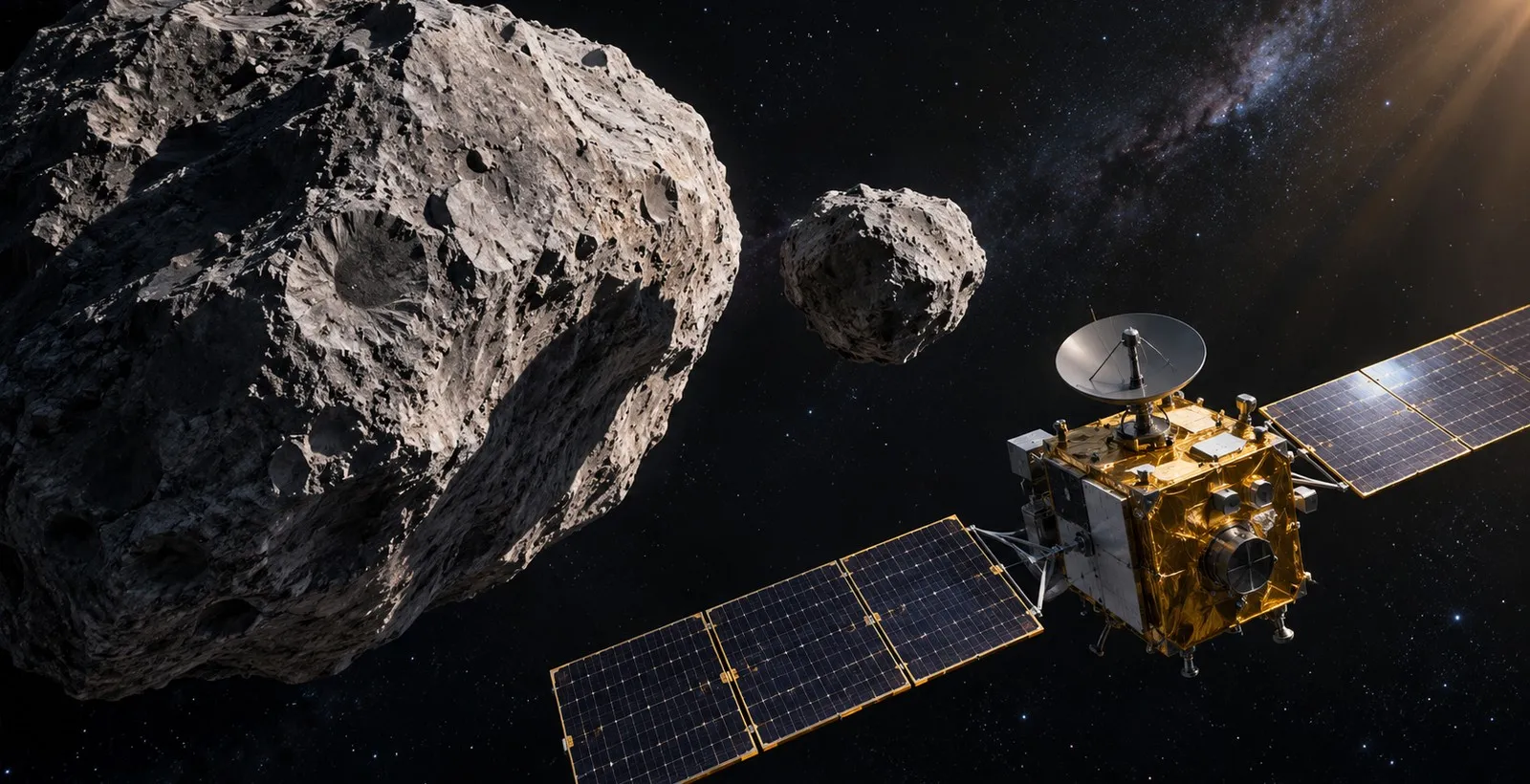
The hidden physics inside a cosmic collision
It may sound obvious that hitting an asteroid makes it move, but a kinetic impact is more complicated than an everyday collision between solid objects.
Asteroids can be collections of rock fragments held together by their own weak gravity. When a spacecraft strikes such a target, momentum comes from more than the spacecraft itself. Material ejected into space can produce a recoil, rather like the force that pushes a rocket in the opposite direction of its exhaust.
That recoil can make the change in an asteroid’s motion considerably larger than a simple estimate based only on the impactor’s mass and speed.
To build dependable planetary-defense plans, scientists need to understand how that response depends on an asteroid’s structure, density, composition and shape. A solid rock, a porous body and a loose rubble pile may react differently to similar impacts.
Hera will help researchers understand what happened after DART struck Dimorphos, including the system’s altered geometry and the possible redistribution of material.
What we know — and what is still coming
The first close-up image is a milestone, not a complete survey. ESA has said that more detailed images of both asteroids are scheduled to be unveiled on November 25, 2026. Until then, sweeping statements about the full impact site, subsurface structure or the moonlet’s precise post-collision shape would be premature.
The mission also carries a broader goal: turning one successful demonstration into knowledge that can guide a real response to a future threat. Scientists cannot assume every incoming asteroid would behave exactly like Dimorphos. They need observations that reveal which physical properties control the outcome.
Hera therefore matters even if the latest picture does not look like a dramatic crater photograph. It represents the move from a successful experiment to an attempt at predictive science.
Would this work against an asteroid headed for Earth?
Potentially — but only under the right conditions. A deflection mission would need sufficient warning time, good measurements of the object, and a calculated impact that changes the asteroid’s path by enough to avoid Earth. A small adjustment made years before an expected encounter can accumulate into a substantial difference in position. An impact attempted too late may not provide the same opportunity.
Nor is DART proof that one spacecraft could handle every hazard. Objects vary enormously in size, structure and orbit. Planetary defense depends first on finding and tracking asteroids early, then choosing a response grounded in what is known about the particular object.
Hera’s investigation is part of closing that knowledge gap.
The bigger picture
In 2022, DART answered whether people could deliberately shift a small celestial body’s orbit. In November 2026, Hera began showing us what that intervention left behind.
The most important images may still be ahead. For now, the story is already remarkable: rather than waiting for a dangerous asteroid to appear, two space agencies have used a harmless asteroid pair to practice a kind of intervention humanity might one day depend on.