
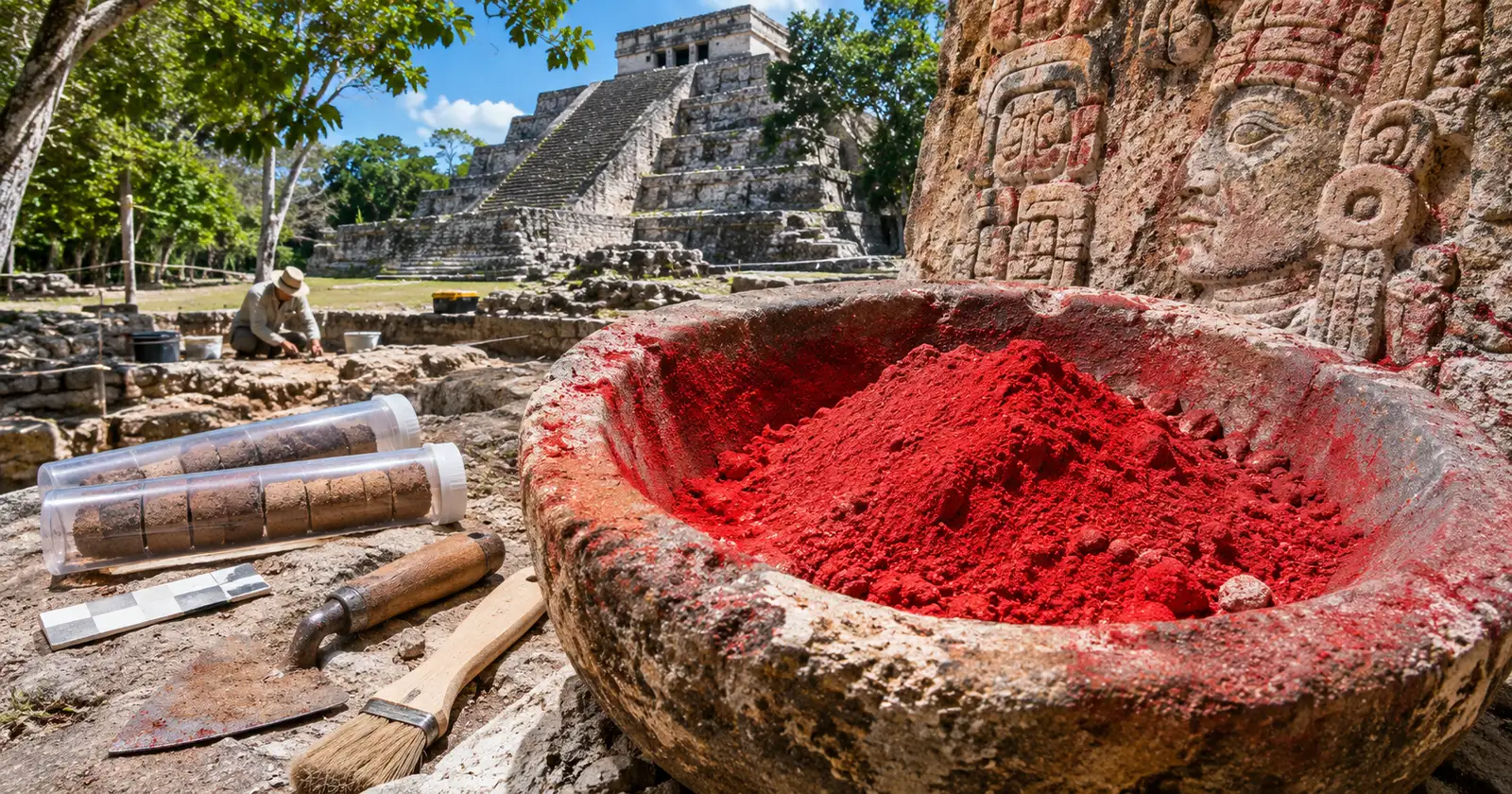
Centuries before industrial factories began releasing mercury into the environment, a treasured red pigment was leaving an invisible record in the lakes of the ancient Maya. The color came from cinnabar, a mineral that can turn paintings, ceremonial objects and burial materials a striking red. Its chemistry is much less inviting: cinnabar is primarily mercury sulfide.
A study published in Science Advances on November 4, 2026 used layers of lake mud to reconstruct contamination near two Maya sites in Mexico’s northern Yucatán Peninsula. The findings suggest that mercury linked to historical cinnabar use entered nearby waters at levels capable of damaging aquatic ecosystems. The results add a previously underappreciated environmental pressure to the story of Maya urban life. They do not prove that mercury brought down an entire civilization.
The remarkable part is how researchers found it: not by discovering a surviving paint jar, but by reading a centuries-long record preserved beneath the surface of lakes. The study and Reuters’ interviews with its authors provide the evidence behind the finding.
A sacred color with a hidden cost
Cinnabar’s vivid red made it a meaningful material in ancient Mesoamerica. Red could evoke blood, life, ritual power and death; Maya artists and ritual specialists used red pigments in architecture, funerary settings and objects of significance. Cinnabar was one source of that color, though it would be wrong to assume that every red Maya surface contains mercury.
A mineral’s symbolic value and its toxicology are very different things. Mercury compounds can harm living organisms, but their behavior depends on chemical form, surrounding conditions and routes of exposure. A red cinnabar deposit is not interchangeable with liquid metallic mercury or every other mercury compound.
That distinction matters because the new study investigated mercury measured in environmental sediments, not a direct medical diagnosis of ancient residents.
Two lakes became accidental archives
The research team examined sediment cores associated with Cobá, a major Maya center, and Xcach, a less extensively studied site. A sediment core is essentially a vertical time capsule. Mud accumulates year after year, preserving changing traces of minerals, organic matter and small organisms. Dating and analyzing successive layers allows scientists to reconstruct environmental conditions over long periods.
The team identified major mercury peaks at Cobá beginning around 250 CE and persisting for roughly 150 years. At Xcach, the record indicated several episodes: roughly 125–200 CE, another around the period of Cobá’s elevated levels, and a later period extending approximately 535–820 CE. These estimates are ranges from sediment interpretation, not exact dates on which someone dumped a known quantity of pigment into a lake.
The findings are important geographically. Earlier evidence of mercury contamination had been documented at other Maya sites, including Tikal, but the northern lowlands had a sparser record. The new cores suggest that the phenomenon was not restricted to a few previously investigated cities.
How pollution reached more than the mud
Mercury concentrations alone would have been a compelling warning. The researchers also studied biological indicators preserved in the same sediments, including evidence associated with microorganisms, algae, cyanobacteria, shelled organisms and insect midges.
Across contaminated periods, some indicators declined sharply or disappeared, according to the authors. The pattern is consistent with severe ecological disruption extending through multiple components of the aquatic food web. It is harder to establish every biological mechanism from an ancient core than it would be to observe a lake in real time. A sediment record can reveal associations and timing; it cannot interview the people who once lived along the shore.
The team argues that mercury could have moved beyond the original pigment deposits and into waterways and food webs. That is not the same thing as proving the dose received by an individual ancient Maya person. People may have consumed contaminated water or fish, but the authors explicitly distinguish that possibility from direct human-exposure measurements.
Why would anyone bring cinnabar to the Yucatán?
Cinnabar does not occur in abundance everywhere Maya communities lived. The new study’s authors discuss its movement through trade networks, including sites where the mineral would have had to be acquired from elsewhere.
That creates an intriguing historical chain. A pigment valued for color and ceremony travels between communities. It is applied or deposited in ways whose original cultural meaning matters greatly. Over time, mercury associated with that material can enter local soils and water. A choice made for artistic or ritual reasons leaves a chemical signature far outside the original setting.
The paradox is familiar today. Materials can seem harmless, useful or beautiful within one context while producing unanticipated effects when they accumulate in an ecosystem. Modern knowledge of mercury toxicity makes the old sediment record legible in a way its creators could not have imagined.
Did mercury cause the collapse of Maya cities?
This is where the most dramatic interpretation must stop. The Classic Maya world underwent political, demographic and environmental changes over centuries. Scholars study drought, warfare, shifting trade networks, political breakdown and local variation—not one universal explanation for every city’s history.
The mercury study does not establish a direct causal link between contaminated lakes and the decline of Classic-era centers. Some locations saw contamination decrease well before major political changes, and the evidence from lake sediments cannot demonstrate that a specific city fell because its inhabitants were poisoned.
Mercury pollution is better understood here as one additional possible stressor—one that may have compounded challenges related to water quality or ecology in certain places. That is historically interesting precisely because it avoids the false simplicity of a single-cause collapse story.
What the lake mud can and cannot tell us
There is a final reason this discovery deserves attention. We often imagine archaeology as a story of monuments, bones, inscriptions and objects. Environmental archaeology adds another archive: the chemistry of the places people inhabited.
A centuries-old lake bed may preserve traces of how a civilization used color, traded materials and changed its surroundings, even when the original people left no written account of an environmental consequence.
The new study does not reduce Maya history to a poisoning narrative. It reveals a more complicated relationship between culture and ecology. A brilliant red mineral helped shape artistic and ritual worlds. It also seems to have left a much less visible legacy in the waters nearby.