
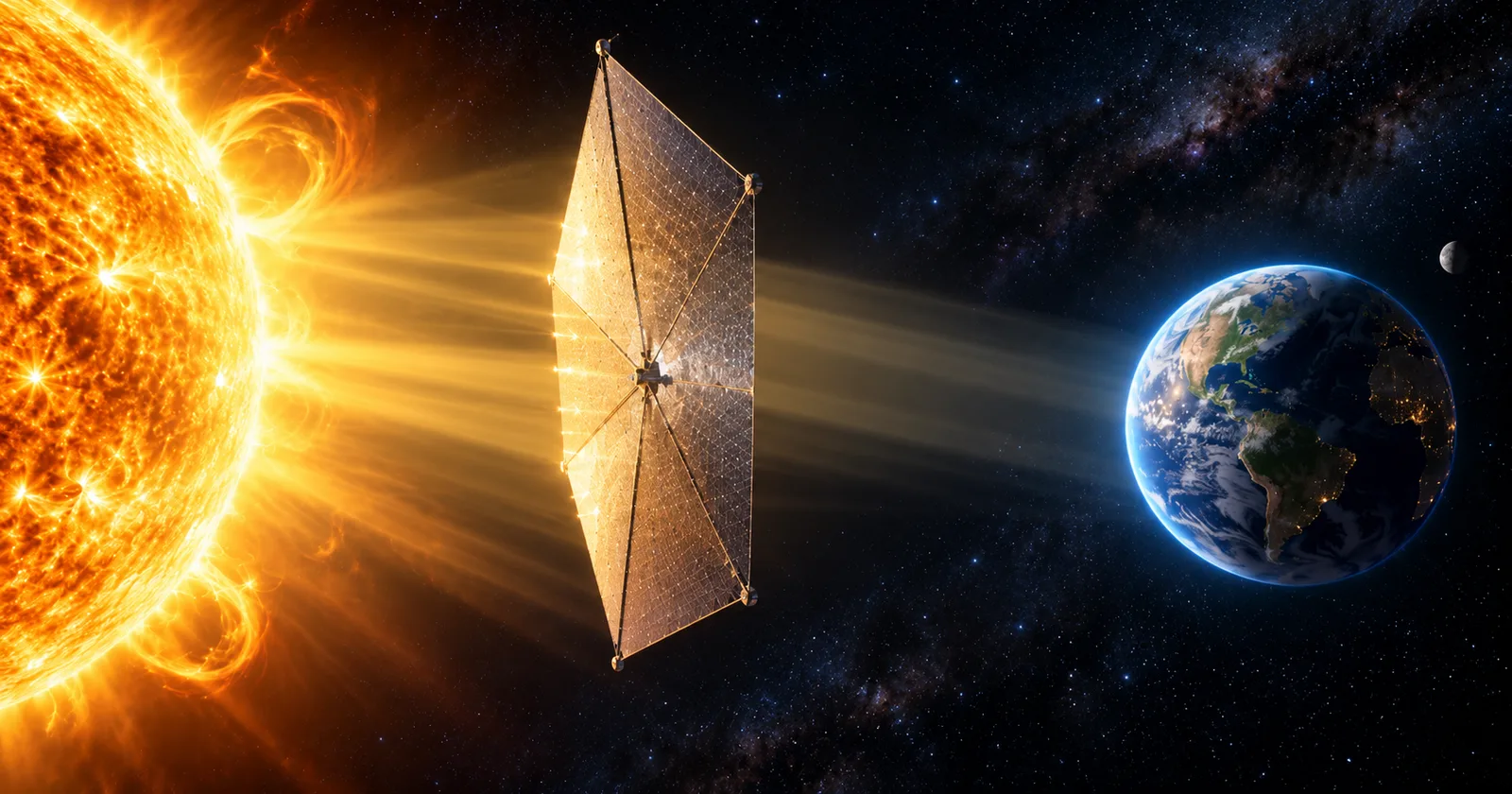
A giant parasol floating in space sounds like pure science fiction. But in late 2026, the idea is being discussed in a far more technical way than many people realize. A new baseline survey from the Planetary Sunshade Institute argues that a space-based sunshade could be physically buildable with known physics, even if it remains enormously difficult and likely decades away. Planetary Sunshade Institute: Space Reflector Baseline Survey
The idea is simple. The engineering is not.
At its core, a planetary sunshade would do one thing: slightly reduce the amount of sunlight reaching Earth. It would not need to plunge the planet into darkness. Even a very small reduction in incoming solar energy could, in principle, counter part of the warming caused by greenhouse gases.
The preferred location in many proposals is near the Sun–Earth L1 point, a place about 1.5 million kilometers from Earth in the direction of the Sun. NASA explains that Lagrange points are positions where gravitational forces and orbital motion create useful locations for spacecraft. L1 is already valuable for solar observation because a spacecraft there remains on the Sun–Earth line with relatively modest station-keeping. NASA: What are Lagrange Points? NASA: SWFO-L1
That does not mean you can simply park a giant sheet in space and forget about it. The Sun–Earth L1 point is not a magical fixed hook. Objects there still require active control, careful navigation, and long-term maintenance. A real sunshade system would be less like hanging a curtain and more like operating a delicate, continent-scale machine in deep space.
Why even consider something this extreme?
Because the climate problem is extreme too.
Researchers interested in space-based solar radiation modification are not usually arguing that this is a substitute for cutting emissions. The usual argument is narrower: if warming overshoots dangerous thresholds, humanity may want an emergency option that can be adjusted or reversed more quickly than many other large-scale interventions.
The Planetary Sunshade Institute says a sunshade is distinctive because its shading level could be adjusted on the scale of days and, in theory, sustained over decades. Its 2026 baseline survey also says no new physics is required, but estimates that a realistic deployment timeline is still around 20 to 40 years away, depending heavily on heavy-lift launch capacity and large-scale use of space resources. Planetary Sunshade Institute: Space Reflector Baseline Survey
That estimate is one reason the topic is attracting attention. It moves the idea from “pure impossibility” into the more uncomfortable category of “maybe technically imaginable, but still politically and operationally daunting.”
What would the sunshade actually look like?
There is no single agreed design.
Some concepts imagine enormous thin-film structures or fleets of reflective elements. Others explore clouds of specially controlled particles. NASA’s 2026 NIAC study “DimSun” describes a concept that would reduce solar insolation by using a controllable dust cloud near the Sun–Earth L1 point, and emphasizes reversibility: if control stops, the cloud would disperse rather than persist indefinitely. NASA: DimSun
The Planetary Sunshade Institute’s own work compares multiple architectures and says one dust-cloud concept may offer a dramatic mass advantage over more conventional sail-like ideas. That does not mean the problem is solved. It means researchers are trying to identify which version of the impossible might be least impossible.
Why are scientists and governments cautious?
Because reducing sunlight is not the same as repairing the climate system.
The UK government’s formal position on solar radiation modification, published in September 2026, is unusually clear. It says the government does not support deployment of solar radiation modification and does not plan to do so. At the same time, it supports responsible research into the risks and impacts. That distinction matters. Studying a technology is not the same as endorsing its use. UK Government: Solar radiation modification approaches — the government’s view
Scientists worry about several issues at once:
- a sunshade would treat incoming sunlight, not greenhouse gas concentrations themselves
- regional climate effects could differ from global averages
- governance would be extraordinarily difficult because the entire planet would be affected
- maintenance failure, geopolitical conflict, or abrupt removal could create new risks
- the very existence of the option could weaken political pressure to reduce emissions
Those objections are not side notes. They are central to the debate.
Blocking sunlight is not the same as fixing climate change
This is the most important idea in the whole story.
A sunshade could, in principle, reduce some warming. But it would not remove carbon dioxide from the atmosphere. It would not solve ocean acidification. It would not restore ecosystems already damaged by heat, drought, or pollution. And it would not eliminate the social and economic causes of climate change.
In other words, even its supporters usually frame it as a potential supplement under extreme conditions, not as a planetary reset button.
That is also why the idea feels so strange. The question is not simply whether humans can engineer a partial shade for Earth. The deeper question is whether a civilization struggling to coordinate emissions cuts should trust itself with the power to tune the amount of sunlight reaching the planet.
So are we really heading toward a space sunshade?
Not imminently.
What is happening now is more interesting, and in some ways more unsettling, than either a yes or a no. The concept is maturing just enough to force serious questions. Researchers can now point to concrete architectures, rough timelines, logistics analyses, and policy concerns. Governments are beginning to draw lines between research and deployment. And the rest of us are left with a very Wondecode kind of question: when an idea sounds absurd at first, at what point does it become a real option that society has to think about seriously?
For now, the answer is probably this: a planetary sunshade is not a climate solution waiting in the wings. It is a technically grounded but deeply controversial proposal that reveals just how far climate anxiety is pushing human imagination — and engineering.
Did you expect “cooling Earth by blocking the Sun” to be a real research topic?