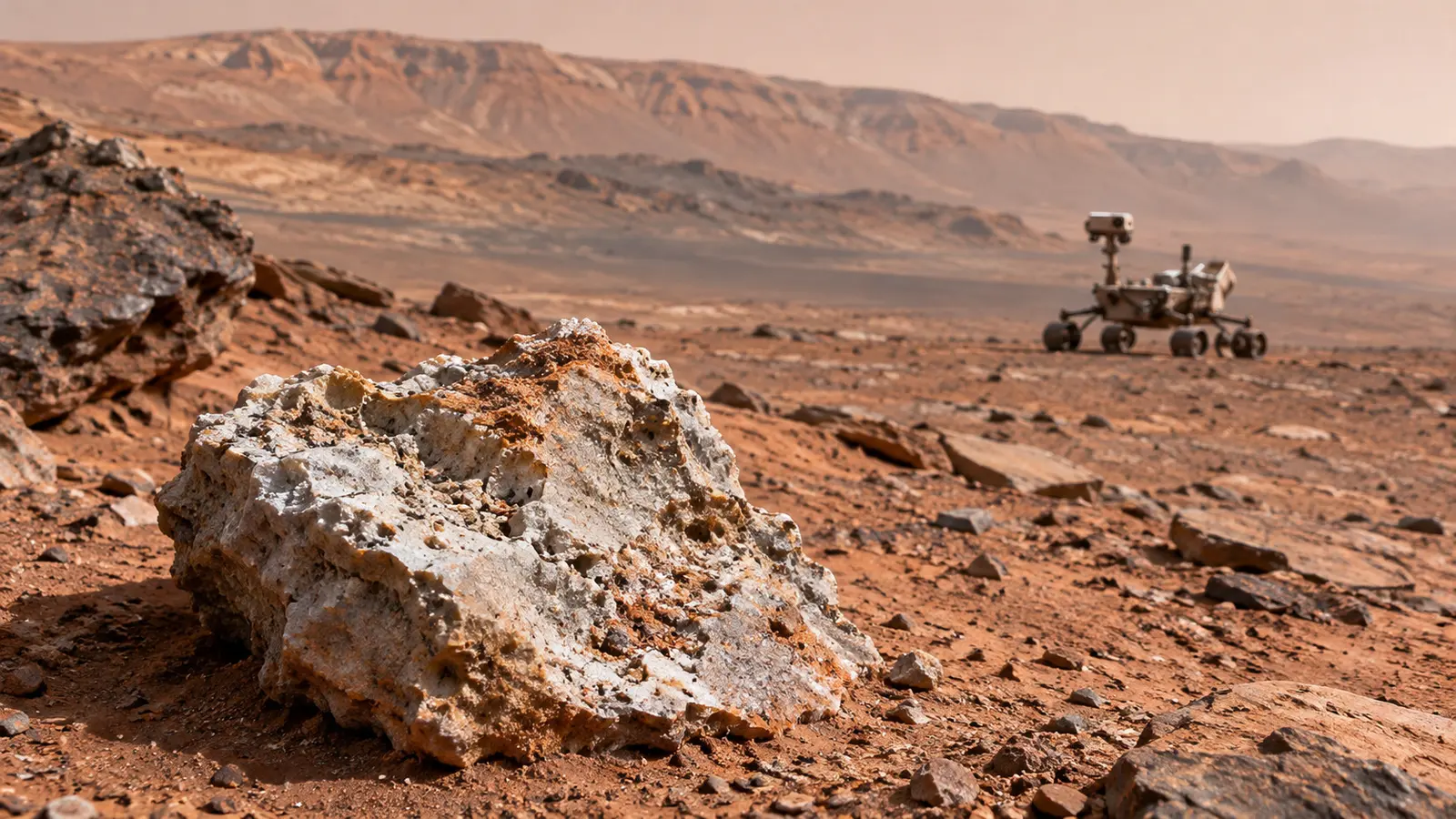

On the edge of an ancient Martian crater, a laser fired at a pale rock and found something researchers did not expect: a spectral fingerprint associated with corundum, the mineral that forms rubies when it contains chromium. That sounds like the beginning of a gemstone hunt. For NASA’s Perseverance team, it is a clue to a much older and more interesting story—how rocks were transformed on a planet that does not work like Earth.
In a NASA update published November 9, 2026, SuperCam principal investigator Roger C. Wiens described the surprising detection and how the team has begun using the rover’s instruments in a new way. The original scientific results were published earlier in 2026, so the announcement is not a report of newly discovered jewelry-grade gemstones. It is a fresh explanation of a geological puzzle that an unexpected capability of Perseverance helped uncover.
The laser saw a signature, not a gemstone
Perseverance carries instruments that examine Martian rocks without bringing them back to Earth. Among them is SuperCam, mounted on the rover’s mast. It can analyze material using laser-based techniques that reveal chemical composition and other properties of a target. One of its less obvious abilities is to measure time-resolved luminescence: light emitted by a material after it has been excited, including the timing of that emission.
When the team fired the laser at a light-colored Martian rock roughly two years before NASA’s November 2026 update, the spectrum contained two unusually sharp signals at 692.7 and 694.1 nanometers. The wavelengths fall in the deep-red part of visible light. They were distinctive enough to make scientists take another look.
The explanation was chromium ions within a corundum crystal structure. Chromium can occupy positions normally filled by aluminum in the mineral. Under excitation, those ions produce characteristic narrow emission lines; the measured delay provided additional evidence that the signal came from chromium-bearing corundum rather than an unrelated material.
This is a chemical-mineralogical identification inferred from an instrument reading, not a photograph of a brilliant red crystal protruding from Martian soil. The research paper led by Ann Ollila reports corundum signatures in small, scattered, light-toned rocks encountered around Jezero crater’s rim.
Why everyone thinks of rubies
On Earth, ruby is the red gemstone variety of corundum, and chromium is responsible for its characteristic color. The connection is real—but it is easy to carry it too far. A mineral identification does not establish the presence of large, gem-quality, transparent stones. NASA explicitly says the rover has not found collectible rubies on Mars.
The ruby analogy is useful for a different reason: it explains why the detection was striking. Wiens recalls that, during preflight testing, the team shone SuperCam’s laser at a ruby and observed a remarkably bright red response. Years later, a related optical signature appeared in data sent back from Mars.
The main prize is the information. Tiny crystals can preserve evidence of the conditions under which a rock formed or changed. To a planetary geologist, a small mineral grain can be more revealing than a large, beautiful stone.
A mineral that raises a planetary question
Corundum is aluminum oxide. On Earth, it can occur in certain metamorphic or igneous environments, including some pegmatitic settings. Those settings depend on particular combinations of rock chemistry, temperature and geological history.
Mars does not have Earth-style active plate tectonics, so scientists cannot automatically borrow the familiar terrestrial explanation for corundum formation. The mineral is unusual in the context of the Martian rocks the team had expected to examine. Its presence demands an account of how aluminum-rich, silica-poor conditions developed and how the rocks were subsequently modified.
One possible answer lies in the same ancient violence that shaped the ground Perseverance now explores. Large meteorite or asteroid impacts can generate intense heating and alter surrounding materials. An impact can transform rocks locally, even on a planet without the moving plates that drive many metamorphic settings on Earth.
The Geophysical Research Letters study argues that impact-induced metamorphism is the most plausible explanation for the corundum-bearing rocks examined, potentially involving interactions between different rock types and fluids at some stage. But the authors do not claim to have ruled out every alternative. That distinction matters: the mineral is an observation; the geological history is an interpretation supported by the available evidence.
Why Jezero crater changes the stakes
Perseverance is exploring ancient terrain around the rim of Jezero crater, an impact basin with a long and complicated history. Its mission is famous for investigating environments that may once have been habitable, but the rover is also an unusually capable field geologist. Understanding the rocks around the crater can help reconstruct what happened before, during and after major events in the region’s history.
The team’s study describes small, light-toned, plagioclase-rich rocks scattered across the surface. They are not all identical, and researchers must connect evidence from chemistry, mineralogy and geological context before drawing conclusions about their origins.
That is why the corundum signal matters. It may help identify episodes of heating and alteration that are otherwise difficult to piece together from weathered or displaced fragments. It also raises new questions. How widespread are these minerals? Are they consistently associated with certain rock types? Could different events have produced similar signatures? Additional measurements may help answer them.
A scientific bonus hidden inside an instrument
There is another discovery here, and it concerns how the rover is used. SuperCam was not sent to Mars specifically to hunt for ruby-related minerals. The team found that an existing spectroscopic capability could be exploited to detect a faint but diagnostic optical response.
According to Wiens, time-resolved luminescence observations were uncommon earlier in the mission. After the team recognized their value, researchers began applying the technique more often to pale rocks in the ancient terrain near the crater rim.
That change illustrates an underappreciated side of planetary exploration: instruments can become more powerful as scientists learn from unexpected data. The hardware has not changed. The questions researchers know how to ask of it have.
What the finding does—and does not—tell us
What scientists have detected: convincing spectroscopic evidence for chromium-bearing corundum in Martian rocks, supported by specific emission wavelengths and timing measurements.
What scientists suspect: ancient impact-related heating and rock alteration may explain how this unexpected mineral formed in the Jezero region.
What remains unknown: the full history of those rocks, how common the mineral is across Mars, and whether other processes contributed to its formation.
What NASA has not announced: deposits of collectible Martian rubies or proof that the planet once had Earth-like plate tectonics.
A ruby would be a spectacular souvenir. But the real value of these grains is that they may record a moment when Mars changed—perhaps when an impact heated and transformed material that still lies scattered near an ancient crater today. Perseverance is not treasure hunting. It is learning to read those fragments, one unexpected signal at a time.
Sources
- NASA Science — “Rubies on Mars?” (November 9, 2026). Mission-team explanation by Roger C. Wiens.
- Ollila and colleagues — “Corundum discovered by SuperCam and the Perseverance rover at Jezero crater, Mars” (Geophysical Research Letters, 2026). Original peer-reviewed research.
- U.S. Geological Survey — research publication record (August 11, 2026). Abstract and bibliographic details.