
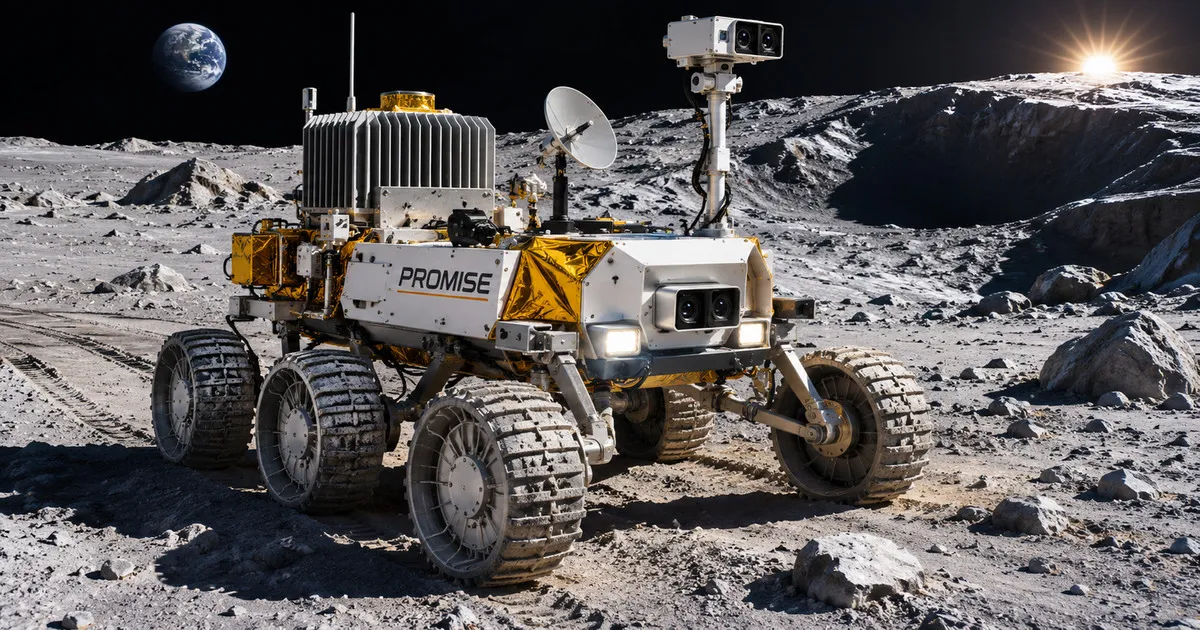
NASA has a plan for one of the Moon’s most frustrating places to explore: terrain where the Sun can disappear for weeks—or, in some craters, never shine at all. The agency has approved development of a six-wheeled rover called PROMISE, designed to work in the cold and darkness around the lunar south pole. Its advantage is not a more powerful battery or a larger solar panel. It is a compact generator that draws energy from radioactive decay.
Announced on November 7, 2026, PROMISE stands for Polar Rover for Observation, Mapping, and In-Situ Exploration. NASA wants it to search for useful resources, study the ground beneath its wheels, and help identify places where future lunar infrastructure could be built. The planned launch is in late 2028, followed by an 18-month primary mission—a target schedule, not a completed flight. NASA’s mission announcement and PROMISE mission page describe the project.
Why the lunar south pole is such a difficult neighborhood
A familiar image of the Moon shows a bright, sunlit desert. But near its poles, the Sun travels low across the horizon. Hills and crater rims throw long shadows, and some deep depressions stay in darkness year-round. These are called permanently shadowed regions, or PSRs.
That darkness is scientifically valuable. Without direct sunlight, extremely low temperatures may help preserve water ice and other volatile materials deposited over immense spans of time. Those substances matter to researchers studying lunar history. They might also become resources for future explorers: water for drinking, oxygen production or, with substantial processing infrastructure, components of rocket propellant.
The catch is obvious: a solar-powered machine cannot count on reliable sunlight in a place that has none. A robot could carry batteries, but batteries eventually need recharging. Meanwhile, the rover’s electronics, instruments and mechanisms must survive a bitterly cold environment. PROMISE addresses the power problem differently.
“Nuclear-powered” does not mean a nuclear reactor
PROMISE is designed to use a multi-mission radioisotope thermoelectric generator, or MMRTG. It does not work like a commercial power station with a controlled nuclear chain reaction. Instead, a radioactive material naturally releases heat as it decays. Thermoelectric devices convert part of the temperature difference between a hot side and a cooler side into electrical power.
The conversion is not particularly efficient, but efficiency is not the main attraction. The important feature is that the generator can continue supplying electricity without sunrise, wind or an external charging station. Waste heat can also help protect vulnerable systems in severe cold. NASA has already used radioisotope power on the Mars rovers Curiosity and Perseverance; PROMISE would adapt that experience to a different environment.
This is a trade-off rather than a magical power source. Radioisotope units produce limited electricity, their radioactive fuel requires careful handling, and launch and landing still involve substantial engineering risk. What they offer is persistence where intermittent solar energy would be an especially severe constraint.
A Moon rover assembled from Mars experience
NASA’s Jet Propulsion Laboratory will manage and build PROMISE. Instead of beginning with an entirely new machine, engineers intend to reuse flight spares, engineering models and components associated with Curiosity and Perseverance. The mission page describes work based on the Curiosity duplicate vehicle used as a test bed, including parts of its body and mobility system.
Reusing proven components does not make a lunar mission identical to a Martian one. Lunar dust, thermal conditions, terrain, gravity and mission communications pose their own difficulties. NASA says it has assessed the compatibility of the chosen hardware with the intended polar environment. Testing still has to turn that assessment into a rover that can survive launch, landing and months of exploration.
The practical benefit of reuse is less glamorous but important: engineers already know a great deal about many of these parts. That can reduce development uncertainty and allow more of the budget and effort to focus on the tasks that make PROMISE different.
The drill that could change the mission’s value
A headline about a nuclear rover draws attention to its power source. But the scientific instrument package is where the mission will earn its place.
NASA says PROMISE will carry a drill capable of sampling the regolith to roughly one meter (about three feet) below the surface. Spectrometers will examine chemical composition, while temperature and radiation sensors, cameras and other instruments will help characterize the surrounding environment. The vehicle is also planned to demonstrate high-performance spaceflight computing and more capable autonomous navigation technologies.
A drill is significant because an image of a cold crater is not evidence of accessible ice beneath a specific patch of ground. Scientists need measurements to understand where potential resources occur, how they are mixed with soil, and what kind of extraction equipment might eventually be useful. Finding a promising region is not the same thing as proving that a base can economically mine it.
Even negative results could be valuable. If a location expected to contain accessible material turns out to be dry or difficult to excavate, future mission planners can avoid costly assumptions.
An ambitious schedule—and a real delivery dependency
NASA is targeting a launch in late 2028. It has awarded Blue Origin a $94 million base contract, with a potential additional option worth $140 million, for delivery of PROMISE to the lunar south pole. Those numbers describe the delivery contract announced by the agency, not the total cost of the complete rover program.
The lander, rover, instruments and power system must all work together. A successful launch would only begin the challenge; safely depositing a heavy robotic vehicle in polar terrain is an entirely separate engineering feat. No one should read the announcement as confirmation that PROMISE has already reached the Moon.
Why this rover matters beyond a future Moon base
There are two overlapping stories here. One concerns resources: how much water ice is actually accessible in specific south-polar locations, and how could future crews use it? The other is about robotic endurance. Can a rover keep learning about the Moon when darkness and cold would shut down more conventional solar-powered machines?
PROMISE will not settle the economics of lunar settlement on its own. It will not automatically transform ice into drinking water or fuel. But if the rover launches, lands and performs as planned, its measurements could replace optimistic maps and engineering guesses with something far more useful: observations made by a working robot inside one of the Moon’s least forgiving environments.
The real promise of PROMISE is that it could turn darkness from a reason to stop exploring into a place to begin.