
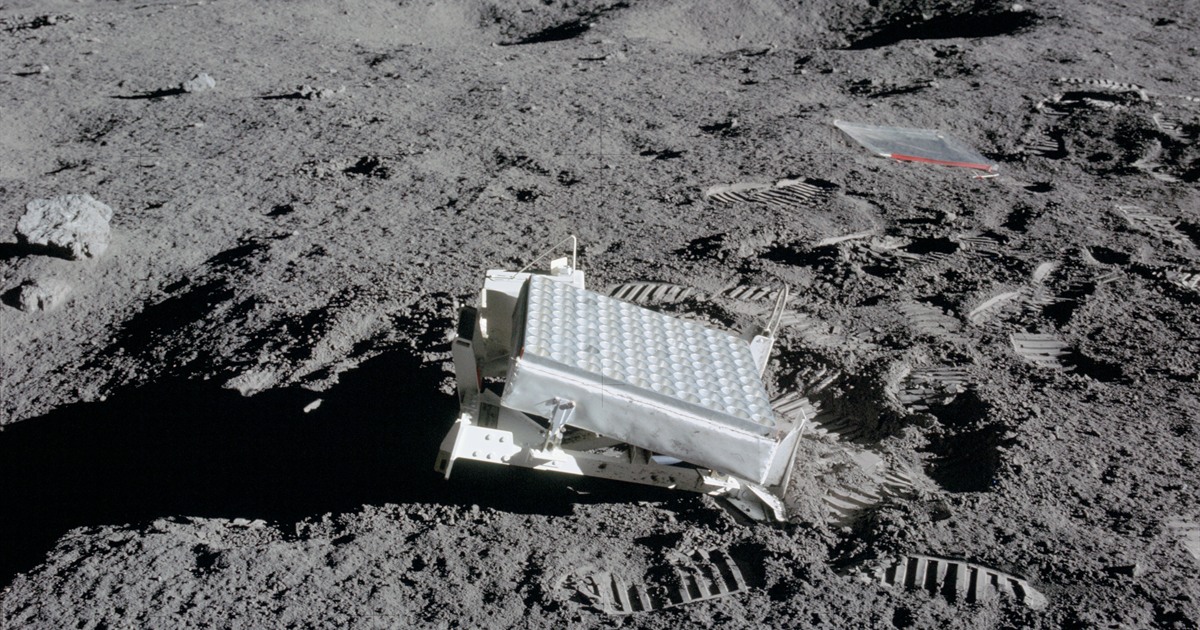
Apollo astronauts left retroreflector arrays on the Moon; observatories on Earth still fire lasers at them and time the return. The measurements show the Moon receding at 3.8 centimeters a year, reveal the lunar interior, and test whether gravity behaves as Einstein predicted. The experiment has run for more than five decades.
At Apache Point Observatory in New Mexico, a telescope fires a short laser pulse at the Moon. By the time the beam reaches the lunar surface, it has spread to several kilometers. Most of the light misses. A tiny fraction strikes a suitcase-sized array of mirrors left behind by Apollo astronauts, bounces back, and returns to the telescope as a handful of photons.
The round trip takes about 2.5 seconds. By timing it, astronomers can measure the distance to the Moon to within a few millimeters. That sounds like a stunt. It is one of the longest-running precision experiments in physics.
The mirrors are not ordinary mirrors. They are retroreflectors, arrays of corner cubes made of fused silica. A corner cube has three mutually perpendicular faces; light entering it is reflected back toward its source, roughly parallel to the direction it came from, even if the incoming beam is slightly off-axis. The Apollo 11 array contained 100 of these cubes mounted in a 46-centimeter aluminum panel. Each cube was 3.8 centimeters across. There are no electronics, no power supply, no moving parts. The arrays are passive hardware. They simply sit there and return light.
Apollo 11 left the first array in 1969. Apollo 14 and Apollo 15 left others. The Soviet Union’s Luna 17 and Luna 21 missions added two more. For decades, those five arrays were the entire lunar laser ranging network. In 2025, a new generation arrived.
What the laser measures
Lunar laser ranging is a timing experiment. A telescope sends a short pulse toward a reflector. A detector records the return. The distance is half the round-trip time multiplied by the speed of light. The hard part is not the arithmetic. It is getting enough photons back, and knowing the timing with sufficient precision.
The beam spreads enormously over the 384,400-kilometer journey. The reflector is small. The atmosphere distorts the pulse. The reflector itself may be tilted, dusty, or degraded. The return signal can be so weak that a single photon matters. Observatories such as Apache Point’s APOLLO facility fire thousands of pulses in a session and use statistical methods to pull a distance estimate out of the noise.
The result is a measurement of the Earth-Moon distance that has improved from meters in the early years to millimeters today. That long baseline is what makes the experiment scientifically valuable. A single measurement tells you where the Moon was. Decades of measurements tell you how the Earth-Moon system is changing.
The most famous result is the Moon’s recession. The Moon is moving away from Earth at about 3.8 centimeters per year, roughly the rate at which fingernails grow. This is not a recent escape. It is a consequence of tides.
Earth’s gravity raises tides in the oceans and in the solid body of the planet. Because Earth rotates faster than the Moon orbits, the tidal bulge is carried slightly ahead of the line joining the two bodies. The Moon pulls back on that bulge, and the bulge pulls forward on the Moon. The interaction transfers angular momentum from Earth’s rotation to the Moon’s orbit. Earth’s spin slows; the Moon’s orbit grows. The day gets longer, and the Moon gets farther away.
The 3.8-centimeter figure is an average over a long period, not a speedometer reading for tonight. The Moon’s distance also varies because its orbit is elliptical. Laser ranging measures the full geometry, not a single number. The recession rate is one parameter extracted from a model that includes the Moon’s orbit, its rotation, the Earth’s orientation, and the reflectors’ positions.
What else the mirrors reveal
Lunar laser ranging is not only about the Moon’s slow retreat. It is a probe of the Earth-Moon system and of gravity itself.
The reflectors provide fixed reference points on the lunar surface. By tracking them, scientists can measure the Moon’s orientation and rotation, including small wobbles that carry information about the lunar interior. The data have been used to argue that the Moon has a liquid core, and to constrain the size and properties of that core. The evidence is indirect: it comes from the way the Moon’s rotation responds to torques, not from a direct sample. But it is a useful window into a body we have not drilled.
The same measurements test the equivalence principle, the idea that gravity accelerates all objects equally regardless of their composition. Earth and the Moon have different densities and different amounts of iron. If gravity treated them differently, the lunar orbit would show it. Laser ranging has found no such difference, within the precision of the data. That is one of the reasons the experiment matters beyond lunar science: it is a test of general relativity in the weak-field regime, using a natural laboratory that is close enough to measure and far enough to be interesting.
The data also help reconstruct Earth’s orientation in space. The Moon’s gravity pulls on Earth’s equatorial bulge, causing the planet’s axis to precess. Laser ranging helps measure that motion, which is part of the framework used to interpret ancient eclipse records and to understand how Earth’s rotation has changed over time.
None of this means that a laser beam has directly measured the Moon’s interior or proven a particular theory of gravity. The measurements constrain models. The models are strong, but they are models. The value of lunar laser ranging is that it keeps adding independent data to a problem that cannot be settled with a single observation.
The new reflector
The Apollo arrays are aging. They were designed for a shorter mission and have been exposed to micrometeorites, dust, and the harsh lunar thermal environment. The return signal from some arrays is weaker than it once was. That is one reason NASA and the University of Maryland developed the Next Generation Lunar Retroreflector, or NGLR.
NGLR-1 flew to the Moon on Firefly Aerospace’s Blue Ghost Mission 1, launched on January 15, 2025. The lander touched down in Mare Crisium on March 2, 2025. Unlike the multi-cube Apollo arrays, NGLR-1 contains a single monolithic corner-cube retroreflector. It was designed to improve the precision of lunar laser ranging, with sub-millimeter measurements a goal rather than a demonstrated outcome of the first returned signals. In March 2025, NASA reported that NGLR had successfully reflected laser light from two Lunar Laser Ranging observatories. The signal was returned. The experiment is no longer only a historical artifact.
The new reflector is not a replacement for the Apollo arrays. It is an additional target, in a different location, with better optical performance. More reflectors mean more geometry, more redundancy, and better constraints on the Moon’s orientation and interior. They also make the network less vulnerable to the loss of any single array.
The NGLR-1 result is a good example of how the experiment evolves. The underlying idea is unchanged: put a mirror on the Moon, shoot a laser at it, and time the return. The engineering is what improves. A corner cube that returns more light, a telescope that fires a cleaner pulse, a detector that can catch a single photon—each advance buys a little more precision, and precision is what turns a distance into a measurement of the Earth-Moon system.
What the experiment does not say
It is tempting to turn the 3.8-centimeter figure into a story about the Moon abandoning us. The reality is more interesting. The Moon is not escaping; it is responding to a tidal exchange that has been going on for billions of years. The recession rate is tiny compared with the Moon’s distance. It will not change the night sky on human timescales. It is a slow leak of angular momentum from Earth’s spin into the Moon’s orbit.
It is also not a direct measurement of dark matter, dark energy, or the nature of gravity at all scales. Lunar laser ranging tests gravity in a specific regime, with specific assumptions. It is one of several independent tests, and its power comes from its long timeline and its simple geometry.
The remaining uncertainties are real. The reflectors’ positions and orientations must be modeled. The atmosphere affects the timing. The return signal is sparse. The lunar interior is inferred, not imaged. The next generation of reflectors will reduce some of those uncertainties, but it will not eliminate them.
What the experiment does establish is remarkable enough. A mirror left by astronauts more than half a century ago is still returning light. A laser fired from a mountain in New Mexico can measure the distance to the Moon to within millimeters. And from that measurement, we can see the Moon moving away, the Earth’s rotation slowing, and gravity behaving as Einstein’s theory predicts, at least to the precision we can test.
The Moon is not a static lamp in the sky. It is a body in a long gravitational conversation with Earth. The mirrors are the microphone.
Sources
- NASA JPL: “The Apollo Experiment That Keeps on Giving”
- NASA: “Laser Beams Reflected Between Earth and Moon Boost Science”
- International Laser Ranging Service: Lunar Laser Ranging
- ILRS: Next Generation Lunar Retroreflector-1
- NASA: “NASA Anticipates Lunar Findings From Next-Generation Retroreflector”
- NASA: “NASA Science Data Received, Blue Ghost Captures Eclipse From Moon”
- Eos: “Seeing the Light”
- NASA: Apollo 15 Lunar Laser Ranging Retroreflector