
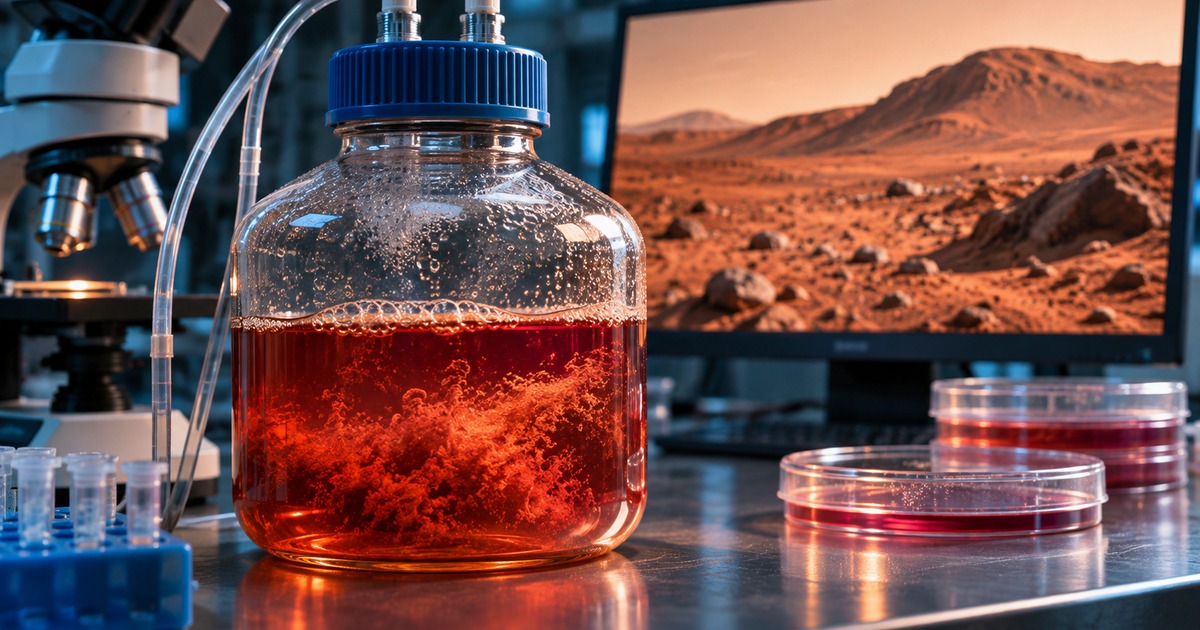
A jar of salty liquid is not what most people imagine when they think about the search for life on Mars. There is no rover, no red desert stretching to the horizon, and certainly no tiny Martian waving at the camera. There is just an Earth microorganism in a laboratory, quietly doing something that matters: making more of itself under conditions designed to resemble one possible environment beneath the Martian surface.
For 160 days, researchers kept cultures of Haloferax volcanii under low pressure, without oxygen, in extremely salty liquid. Some cultures continued to grow by using chemicals relevant to Mars. That is a more consequential observation than merely finding cells still alive after a difficult afternoon. But it comes with a crucial qualification: the laboratory created a hypothetical Martian habitat, not an environment that scientists have actually confirmed exists on Mars.
The study, published on November 5, 2026, in Applied and Environmental Microbiology, asks a precise question. What would happen if a place beneath the Martian surface combined liquid brine, suitable chemicals and low atmospheric pressure? Would a living organism necessarily stop at survival—or might it continue its life cycle?
Why survival is not the same as living well enough to reproduce
When scientists test organisms against extreme environments, an important distinction can get lost in headlines. A cell may remain intact during cold, dryness or radiation and later resume activity once conditions improve. That demonstrates resilience. Growth, however, requires energy, raw materials and a chemical environment that allows the organism to build new cells.
The team chose Haloferax volcanii, a salt-loving archaeon. Archaea are microscopic organisms distinct from bacteria, although many look similar at a glance. This species is known for tolerating salt-rich conditions; it was not collected from Mars, and its success does not make it an extraterrestrial organism.
Researchers incubated cultures for roughly five months in 24 millibars of pressure, a small fraction of ordinary sea-level pressure on Earth, with carbon dioxide-rich, oxygen-free gas. The liquid was exceptionally salty—about seven times saltier than seawater. The cultures received either nitrate or perchlorate, compounds that can participate in chemical reactions relevant to some environments proposed for Mars.
Perchlorate deserves a little explanation. It is an oxidizing compound associated with chlorine and oxygen. In everyday descriptions it is sometimes compared with bleach-like chemicals, but it should not be confused with pouring household bleach into a culture. Under the experimental conditions, the archaeon could use supplied chemical electron acceptors in place of oxygen during metabolism.
The telling comparison was not between a living culture and a sterilized one. Cultures given neither nitrate nor perchlorate remained viable but showed no measurable growth. That control helps separate a microbe enduring harsh conditions from one actively multiplying in them. The researchers’ abstract reports increases in optical density and biological reduction of the supplied compounds in growing cultures.
The surprising importance of a sticky microbial community
Under the microscope, the low-pressure cultures also developed substantial biofilms: communities of microorganisms associated with a surrounding matrix. Biofilms are familiar on Earth, from river stones to the film that can build up on surfaces. In this experiment, the researchers suggest they may have helped the cultures retain liquid in a difficult environment.
Over the 160-day experiment, the hypersaline liquids lost less than 4% of their water. The study also describes persistent carotenoid signatures detected by Raman spectroscopy. Those pigments matter because a future Mars investigation might try to distinguish chemical signs of biological activity from remains left by organisms long dead.
But neither a pigment signature nor a biofilm in a laboratory is a biosignature observed on Mars. The experiment provides a useful test case for how biological processes could look under some conditions, not evidence that such processes have been seen on the planet itself.
The Martian environment scientists have not found
Mars has a severe surface environment: low atmospheric pressure, strong radiation exposure, dryness, cold and reactive chemistry. It may be tempting to think the experiment reproduced all of those hardships at once. It did not.
The cultures were maintained at around 21°C (70°F)—far warmer than most of the Martian subsurface is expected to be. Researchers supplied nutrients and stable liquid media. They did not reproduce the full radiation environment. Most importantly, the particular pockets of accessible, long-lasting liquid brine envisaged for this test have not been confirmed in the shallow Martian subsurface.
That limitation does not make the study trivial. Experiments are often valuable precisely because they isolate a plausible combination of conditions and test whether it is chemically and biologically possible. Here, the answer was yes for one salt-loving Earth archaeon under the tested setup. Whether Mars contains all the required ingredients in one place remains an entirely separate question.
Where a future Mars mission might look differently
For decades, much of the public conversation about Mars has focused on ancient rivers, lakebeds and sedimentary rocks—places where traces of long-extinct life might have survived. That remains a compelling strategy. This experiment raises a complementary idea: some future search techniques may also need to be designed to recognize active metabolism.
Imagine examining a sample that contains organic molecules. Those molecules could have a nonbiological origin, or could be ancient remnants, or conceivably be associated with organisms still doing chemistry. Disentangling those possibilities requires more than detecting one suggestive compound. Repeated measurements, appropriate controls and several independent signs of activity would be needed.
The result also has an uncomfortable implication for exploration itself. If Earth microbes can remain active under a larger range of Mars-relevant conditions than we assumed, engineers must keep considering planetary protection: preventing spacecraft from delivering terrestrial organisms to places where they could confuse future life-detection studies or alter a potentially sensitive environment.
What the experiment changes—and what it does not
The most exciting line in this story is not “life discovered on Mars.” That would be false. Nor does the experiment prove that present-day Mars contains underground oceans, accessible liquid lakes or colonies of salt-loving aliens.
What it changes is the boundary of a question. The researchers have shown that one Earth archaeon can do more than wait out several combined Mars-relevant stresses: supplied with a suitable brine, nutrients and chemical energy sources, it can grow over months at very low pressure.
For anyone searching another world, that is a useful reminder. A place can be extraordinarily hostile to humans without automatically being chemically impossible for every form of life. The next challenge is not to imagine life hiding anywhere we want it to, but to find out whether the necessary water, energy and time actually come together somewhere on Mars.
Sources
- Robinson, A., et al. (2026). Cultivation of halophilic archaea in shallow subsurface Martian conditions has implications for extant life on Mars. Applied and Environmental Microbiology, published November 5, 2026. Primary research. Abstract and bibliographic record.
- University of Florida (November 5, 2026). Microbes can grow in Mars-like conditions. What that means for the search for life. Institutional explanation, experimental conditions and limitations.
- Robinson, A., et al. (June 20, 2026). Perchlorate-supported anaerobic growth in Haloferax volcanii. Earlier related laboratory research, not the new 160-day experiment.