
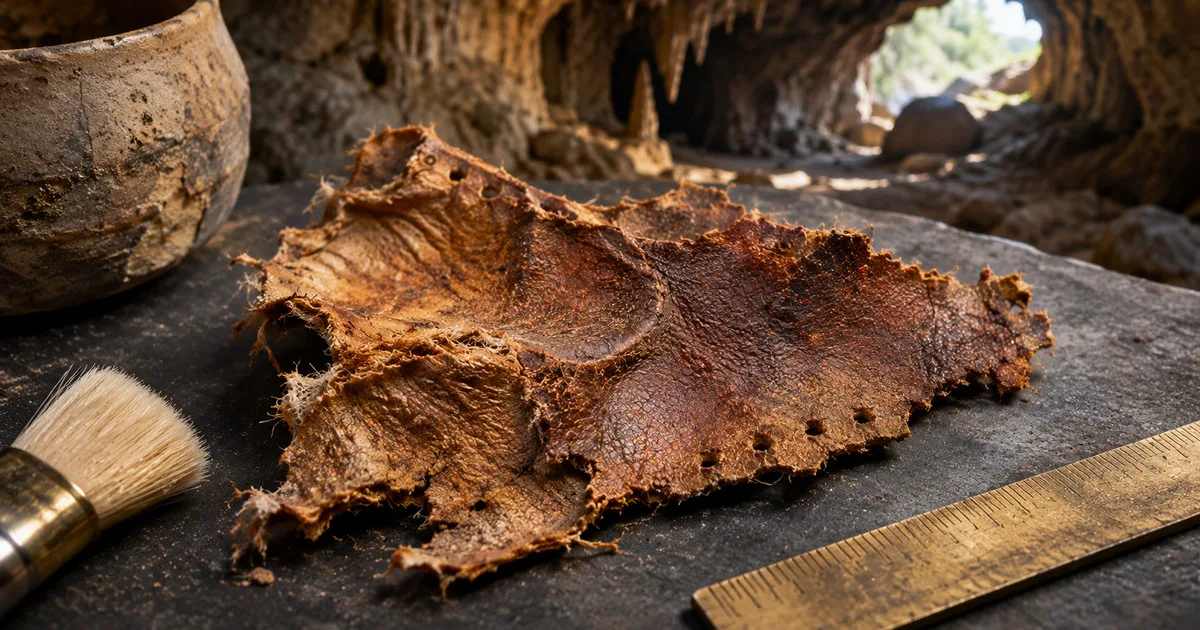
Leather is not supposed to last forever. It cracks, dries, decays, and disappears. Archaeologists normally reconstruct prehistoric clothing from hints: a needle, a polished tool, perhaps a trace left in the soil.
Yet in a cave in southern Spain, a fragment of worked animal skin kept something extraordinary inside its damaged fibers: enough DNA for researchers to investigate the animal from which it came roughly 7,000 years ago.
The study published in PLOS ONE on November 4, 2026 does more than identify an old material. It connects an everyday object to the arrival and development of farming communities on the Iberian Peninsula—and to living goats in Spain today.
The result begins with an object most people would never expect to become a genetic archive.
A fragile survivor in a Spanish cave
The artifact came from Cueva de los Murciélagos, near Albuñol in the province of Granada. The cave is famous for its exceptional organic preservation. Objects made from plant fibers, wood and other materials—normally lost to time—have survived there in unusual condition.
The leather fragments were associated with ancient human burial contexts. The material shows signs of human working, including treatment and perforations. Researchers consider it possible that leather served as clothing, a protective covering or part of a funerary arrangement. Its precise use is not established by genetic testing alone.
Radiocarbon dating places the material in the Early Neolithic, around seven millennia ago. That was a period when agriculture and the management of domestic animals were reshaping human life in many parts of Europe.
The most interesting evidence, however, was not visible from the outside. It was hidden inside the degraded skin itself.
DNA can outlive the animal—but not usually the leather
After an animal dies, its DNA begins to break into shorter fragments. Temperature, moisture, chemistry, microbes and time all influence how quickly those pieces degrade. Over thousands of years, sequencing becomes an exercise in recovering incomplete information rather than reading a pristine genome.
Ancient DNA research is often associated with frozen bones or teeth, because hard tissues can protect genetic material. Soft tissues can be especially vulnerable. That is why ancient skin preserved outside cold environments is so unusual.
The team led by Jolijn A. M. Erven of University College Dublin, working with other specialists, recovered both mitochondrial DNA and nuclear DNA from the leather. Mitochondrial DNA is inherited through the maternal line and occurs in many copies per cell; nuclear DNA can offer a broader picture of relationships across populations.
These sequences were fragmented, but they were informative enough for researchers to determine that the artifact came from a domestic goat (Capra hircus), not a wild Iberian ibex.
That distinction carries an important historical meaning. It places the object within a society that kept or obtained domestic livestock rather than relying only on hunted wild animals.
How do you recognize a goat from seven millennia ago?
Animal hair or the texture of a hide can suggest a group of species, but such clues are not always enough to distinguish related animals. Genetics provides another line of evidence.
Scientists compare recovered fragments with reference genomes from modern and ancient populations. Patterns of shared genetic variation can suggest which groups are more closely related, even when the available ancient sequence is incomplete.
In this case, the goat leather showed a notable genetic affinity with Bermeya goats, a breed associated with Asturias in northern Spain. The comparison offers a vivid connection between Neolithic livestock and modern Iberian breeds.
But it is worth being exact: genetic affinity is not proof that one specific ancient goat was a direct ancestor of every modern Bermeya goat. Populations mix, change and pass through bottlenecks over many generations. A single ancient genome can show a relationship; it cannot, by itself, reconstruct every stage of 7,000 years of breeding.
The finding is a clue about long-term genetic continuity, not a complete family tree.
One object, two histories
We can read the artifact in two ways. As an object, it reflects a craft: people prepared animal skin, altered it and used it for some purpose. As a genetic specimen, it preserves information about the herds available to those people.
Together, the two stories illuminate an often-overlooked side of the Neolithic. Farming was not merely a change in what people ate. It changed the materials they wore, the tools they made and the relationships they built with animals.
A goat might supply milk, meat or skin, and its descendants might be bred or exchanged across settlements. Yet the presence of goat DNA in one piece of leather does not tell us precisely who owned the animal, where it was raised or the route by which it moved.
That is the boundary between a vivid historical interpretation and what the material actually demonstrates.
What about the missing African ancestry?
The researchers reported no detectable African genetic ancestry in the sampled ancient goat, unlike some patterns seen in later or modern European goat populations. This invites an intriguing question about when different livestock populations came into contact around the Mediterranean.
It would be tempting to turn that absence into a dramatic declaration that a particular migration or exchange route did not yet exist. But that would be too much to infer from one incomplete ancient sample.
Ancestry components can be difficult to detect in sparse data, and a single animal cannot represent every herd or community on the peninsula. The finding is consistent with some possible historical scenarios, but it does not establish an exact date for Mediterranean population mixing.
Good archaeology does not hide that uncertainty. It uses the sample to sharpen the questions that future finds can test.
Why the preservation itself is a major result
If geneticists had relied only on bones and teeth, an object like this might have been studied primarily for its construction. Instead, the survival of DNA inside worked leather expands the range of materials that can contribute to ancient-genome research.
That matters because many prehistoric economies left behind more objects made from skin, wood and fiber than we can now recover. In rare places where these survive, carefully chosen samples may reveal details about animals, trade and production that are missing from skeletal remains alone.
Ancient DNA is not a magic recorder of the past. Material can be contaminated, sequences can be incomplete and destructive sampling must be justified. Archaeologists also need to preserve the object, document the context and collaborate with conservators before removing material for laboratory analysis.
The strongest conclusions come when genetics, radiocarbon dating, physical examination and archaeological context agree.
The real photograph matters
For this story, there is a genuine image of the leather, not merely a reconstruction. The PLOS research announcement reproduces a photograph of the preserved artifact credited to the MUTERMUR Project under CC BY 4.0. Its cracks, surviving hair and worked edges are part of the evidence.
That image is preferable when illustrating the research itself. A conceptual image can evoke an archaeological setting, but it cannot replace a photograph of the actual object. The distinction should remain visible to the reader.
An ordinary material, an extraordinary timescale
The people who prepared this hide could not have imagined that someone would one day search it for molecules. They were making or using something practical, perhaps something worn close to the body or placed with a person in burial.
Seven thousand years later, we can still recognize a domestic goat in its fibers and detect a genetic relationship with animals living far into the future.
The most surprising part of the story is not simply that the leather survived. It is that an everyday object continued to carry information about a society long after its makers had disappeared.
Sources and research notes
- Erven, J. A. M., et al. (2026). Genetic analysis of 7,000 year old preserved goat leather from Cueva de los Murciélagos (Albuñol, Spain). PLOS ONE, 21(11), e0358468. Primary open-access research published November 4, 2026.
- PLOS (2026). Research announcement with photograph of the actual leather and the modern Bermeya goat. Photographs credited MUTERMUR Project, CC BY 4.0.
- Durham University research repository. Publication record and coauthors.
- Creative Commons. Attribution 4.0 International (CC BY 4.0). If republishing the real artifact photograph, name the creator/project, cite the source and licence, and mark modifications.