
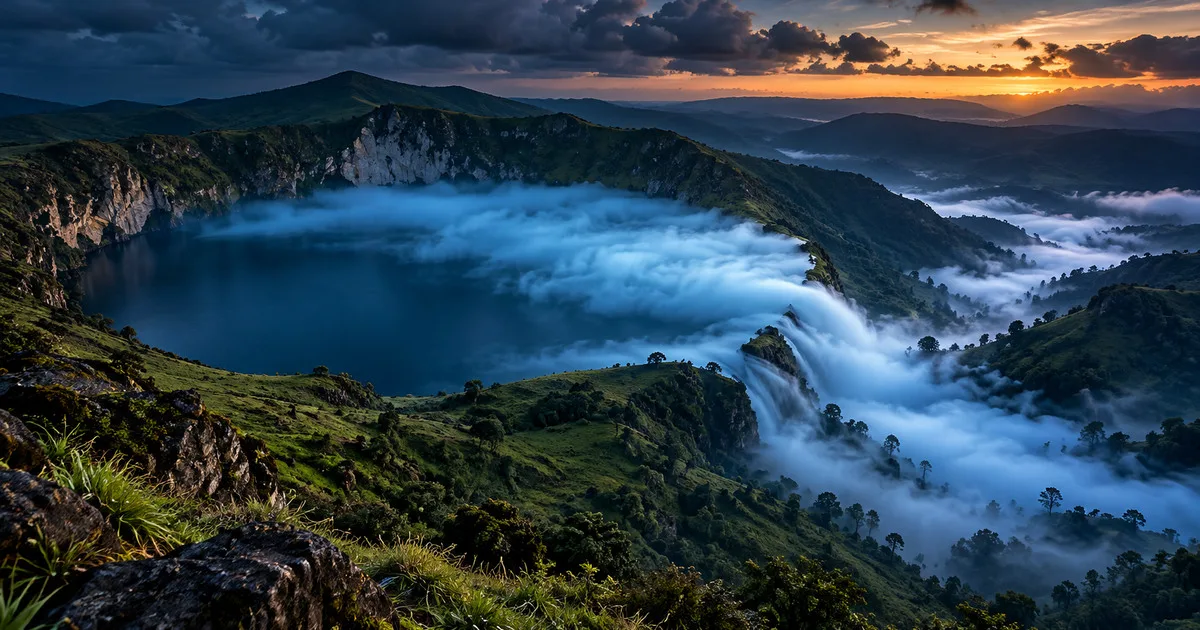
On the evening of August 21, 1986, something terrible moved through valleys in northwestern Cameroon. It was not lava. It was not a wildfire. There was no conventional volcanic eruption. Yet people and animals in communities near Lake Nyos were overcome, and by the time investigators reconstructed what had happened, at least 1,700 people were dead.
The killer was an invisible gas released from the lake itself.
That sounds impossible until you understand how a deep lake can behave like a gigantic, pressurized bottle of sparkling water—and why opening that bottle at the wrong moment can turn a peaceful landscape into a hazard.
A disaster without the eruption everyone expected
Lake Nyos occupies a volcanic crater in Cameroon. That setting made a volcanic explanation seem obvious after the catastrophe. But researchers examining the water, gases, rocks and victims reached a different conclusion: a vast quantity of carbon dioxide (CO₂) had accumulated in deep lake water and was suddenly released. The underlying gas had a magmatic origin, but the evidence did not point to a significant volcanic eruption occurring that night.
A scientific account published in Science in 1987 reported at least 1,700 deaths. NASA’s overview describes the toll as nearly 1,800 people, alongside thousands of livestock. These are approximations reported by different sources, not evidence of two different disasters.
What makes Nyos unsettling is the contrast between the setting and the mechanism. Water can look calm at the surface while something extraordinary is happening hundreds of feet below.
How can a lake store so much gas?
CO₂ enters Lake Nyos from geological sources beneath the region. Deep underground, gas associated with magmatic processes migrates upward and dissolves in groundwater that ultimately reaches the lake.
Water under pressure can hold dissolved gas. Because the deepest water has considerable weight pressing down on it, it can retain much more dissolved CO₂ than water at the surface. Lake Nyos also has stable layers that do not mix freely all the way from top to bottom. That stratification lets gas-rich water persist at depth as additional CO₂ gradually accumulates.
Think of a sealed bottle of fizzy drink. As long as the pressure is high, much of the gas stays dissolved. Reduce the pressure, and bubbles rapidly appear. In a sufficiently gas-rich lake, an initial release can help drive more deep water upward. As that water rises, pressure drops, more CO₂ emerges from solution, and a self-amplifying release becomes possible.
Scientists call this kind of event a limnic eruption. Despite the word eruption, it does not require molten rock to burst out of a volcano.
Why did the gas move downhill?
A concentrated cloud of CO₂ can be denser than the surrounding air. In the Nyos event, the released gas moved into lower-lying valleys rather than simply disappearing straight upward. That placed communities along the drainage routes in danger.
Carbon dioxide is a normal component of the atmosphere, but a sudden, very high concentration is another matter. It can displace breathable air and interfere with the body’s ability to maintain normal blood-gas chemistry. Victims can lose consciousness quickly in an atmosphere containing dangerously high levels of the gas.
There was no characteristic color that could have warned people. Ordinary carbon dioxide is colorless; illustrations showing a visible white or blue cloud are a way of explaining its movement, not what the gas would have looked like.
What triggered it?
This is where the mystery remains more specific—and more interesting—than some dramatic retellings suggest.
The central mechanism, a sudden release of deeply dissolved CO₂, is well supported. The precise initiating trigger is not securely established. Possible disturbances have been discussed, but presenting a particular landslide, earthquake or weather event as the proven cause would go beyond the evidence.
That distinction matters. Science can establish what killed people and how the dangerous conditions formed without necessarily identifying the single event that tipped the system into runaway gas release.
How did investigators figure it out?
Researchers did not rely on eyewitness accounts alone. They looked for a mechanism capable of explaining the geography of the deaths, the lack of direct eruptive evidence, and the chemistry of the lake.
Analyses of dissolved gases and their isotopic signatures connected the CO₂ to deep geological sources. Measurements of the water column revealed the importance of the gas reservoir and the layering that kept it from mixing away. Medical and field observations fit a mass exposure to carbon dioxide rather than a cloud of hot volcanic material.
The 1987 scientific investigation remains a key source because it connects those independent lines of evidence instead of treating the story as a supernatural mystery.
Can engineers make a dangerous lake safer?
Yes—and Lake Nyos became an extraordinary example of engineering based on understanding natural physics.
After the disaster, scientists developed a system of degassing pipes to bring gas-rich deep water toward the surface in a controlled way. As pressure decreases inside the pipe, dissolved CO₂ comes out of the water, helping drive an upward flow. The system removes gas from the deep reservoir that otherwise could accumulate to dangerous levels.
A permanent pipe began operating at Nyos in 2001, followed by additional pipes in 2011. Researchers tracked the changing inventory of dissolved CO₂ and studied the effects of degassing on the lake. A later account of the multidecade project concluded that by 2019 the lake had been largely emptied of hazardous amounts of dissolved gas. That is a major mitigation success—not a promise that geological monitoring can stop forever.
The engineering also has environmental effects. Researchers reported that the process brought dissolved iron upward, contributing to a reddish-brown change in the lake’s surface color. Successful risk reduction can still have measurable ecological consequences.
Could another lake do this?
A limnic eruption requires an unusual combination: a substantial source of dissolved gas, water deep enough to retain it under pressure, and stable layering that allows a reservoir to build up. Most lakes do not meet those conditions. A crater lake is not automatically a ticking time bomb.
Nyos nevertheless changed how scientists investigate gas-rich lakes. Monitoring dissolved gas, water chemistry and stability can reveal threats that the surface alone cannot show. And controlled degassing offers a way to lower risk where the conditions demand it.
The real lesson from Lake Nyos
The most extraordinary part of this tragedy is not that the lake was mysterious. It is that a familiar physical process—gas dissolving under pressure—was happening at an unfamiliar scale.
Lake Nyos is a reminder that danger does not always look dangerous, and that the path from a seemingly inexplicable disaster to prevention runs through careful measurement, evidence and engineering.
Sources
- Kling et al. (1987), The 1986 Lake Nyos gas disaster in Cameroon, West Africa, Science
- NASA Earth Science, Lake Nyos, Cameroon
- Kling et al. (2005), Degassing Lakes Nyos and Monoun: Defusing Certain Disaster, USGS/PNAS
- Halbwachs et al., Final step of the 32-year Lake Nyos degassing adventure
- Kusakabe et al. (2019), Environmental modifications of Lake Nyos surface water by artificial degassing