
There is a peculiar thing about a game console: its hardware stays almost exactly the same while the images it produces can change dramatically. A developer learns to draw shadows more efficiently. An engine gets smarter about reflections. Or a new technique turns a partly rendered image into something that looks much closer to a full-resolution one.
On November 4, Microsoft and AMD announced the latest example of that last trick. AMD FSR Upscaling 4.1.2 is now available to developers making games for Xbox Series X and Series S. It is the first machine-learning-based version of AMD’s FSR upscaling technology offered on these consoles, and it runs on the RDNA 2 graphics hardware they already contain.
That sounds like a free graphical upgrade for every Xbox owner. It isn’t—at least, not yet. The important difference is between a tool being available to game developers and a game actually shipping with that tool. The more interesting story is how a fixed-hardware machine can learn a new way to draw a sharper image.
The pixels your console never actually draws
Imagine a game targeting a 4K television. A native 4K frame contains 3,840 × 2,160 pixels, roughly 8.3 million of them. Each pixel’s final appearance may depend on geometry, textures, lighting, shadows, motion, transparencies and post-processing. Multiply that work by 60 frames each second, and a console has an enormous amount to calculate on a tight schedule.
An upscaler makes a trade. The game renders the scene at a lower internal resolution and then reconstructs an image for the display. For a simple illustration, a 1920 × 1080 render has roughly one-quarter as many pixels as 4K. Reducing the pixel workload can free graphics time, though not every part of a game scales equally with resolution.
But merely stretching that lower-resolution frame would give you a softer picture. The task is to infer what the missing detail should look like. Edges should remain clean; fine lines should not crawl; distant fences should not dissolve; movement should not leave strange trails behind it.
That is where temporal reconstruction enters. Instead of examining a single still image in isolation, modern upscalers use information from neighboring frames and the game engine. AMD says the FSR 4 integration accepts the familiar ingredients developers already provide: the rendered color image, depth information and motion vectors describing how things are moving across the screen. AMD’s technical announcement describes how the new machine-learning models use this data within the existing FSR SDK.
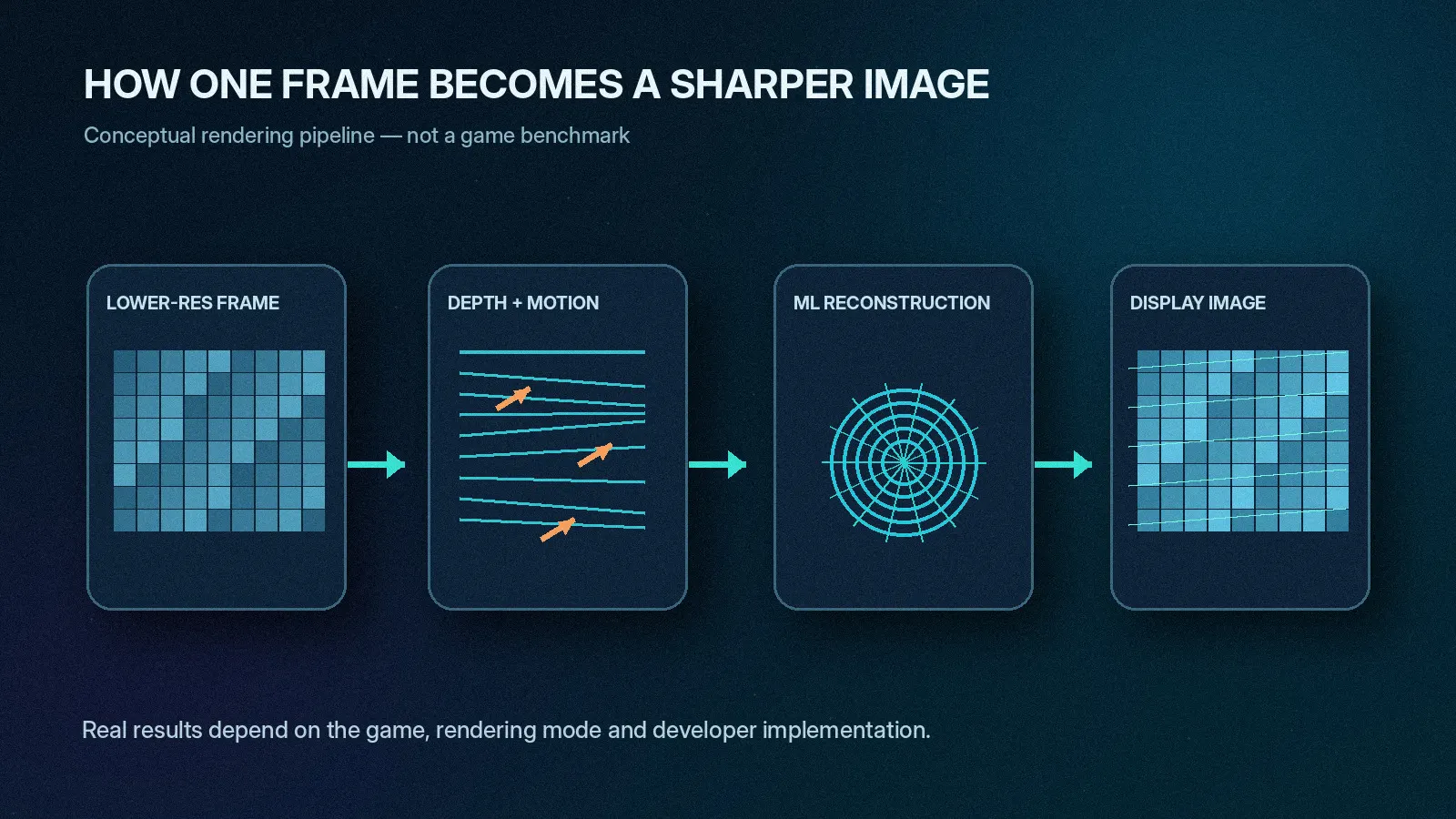
The result is not magically generated detail from nowhere. It is a reconstruction based on real rendering information, prior frames and a model trained to produce plausible high-quality output. Sometimes that can look remarkably close to a higher-resolution render. Sometimes it introduces artifacts of its own.
Why is a machine-learning upscaler arriving on an older GPU?
Xbox Series X and Series S use AMD graphics based on the RDNA 2 architecture. The story behind FSR 4.1.2 is not that someone secretly installed new silicon in every console. AMD and Microsoft adapted the model and its computational cost to hardware that already exists.
The Xbox implementation includes two INT8 options, named Full and Lite. INT8 refers to an eight-bit integer representation used for model calculations. It can help make inference practical under the performance constraints of console hardware, but using a compact model is not a guarantee of identical output quality.
The Lite model is less than half the size of Full, according to AMD. Developers can switch between them in Microsoft’s game-development sample and evaluate what matters to their own game: clarity, stability and the time the GPU spends performing upscaling. Not every title needs the same balance.
This is especially relevant for Series S. A game that already spends almost all of its graphics budget producing one frame has less room for an expensive post-processing pass. A better-looking reconstruction is valuable only when it does not push frame times beyond what the game can tolerate.
The cost of a sharper image, measured in milliseconds
Microsoft published measured GPU times from its sample. These numbers are the cost of the upscaling stage in the test, not a promise that an entire game will become faster or gain a particular number of frames per second.
| Console and output | Lite model | Full model |
|---|---|---|
| Series X at 1440p | 1.29 ms | 1.95 ms |
| Series X at 4K | 2.75 ms | 3.86 ms |
| Series S at 1080p | 1.90 ms | 2.90 ms |
| Series S at 1440p | 3.40 ms | 5.20 ms |
Source: Xbox developer announcement, November 4, 2026. Results refer to Microsoft’s GDK sample; a real title may behave differently.
Why care about a couple of milliseconds? At 60 frames per second, each frame has a total budget of about 16.7 milliseconds. At 30 fps, it has about 33.3 milliseconds. Every extra effect must compete for some of that time.
A 3.86-millisecond reconstruction pass at Series X 4K would consume a meaningful fraction of a hypothetical 60-fps frame budget. But that does not mean FSR makes the overall pipeline slower than native 4K. Rendering fewer pixels in the earlier stages may save more time than the reconstruction consumes. The net result depends on the game, its internal resolution, its engine and which components were limiting performance.
This is why the graphics engineer’s real decision is not simply “Full looks better, so use Full.” It might be “Lite leaves enough time for better shadows” or “Full preserves detail in this slow-moving exploration game.” Those are different ways of spending the same finite GPU budget.
What players might actually notice
There are at least three separate outcomes worth watching for when games eventually adopt this technology.
First is image clarity. Fine foliage, power lines, distant buildings and detailed textures are hard for reconstruction systems because they contain information close to the size of individual pixels. A stronger temporal upscaler may improve their stability—though its effectiveness requires testing on actual titles.
Second is motion behavior. A static screenshot can flatter an upscaler. The more difficult test is a camera moving through a city, a character running in front of a patterned fence or particles appearing and disappearing. Ghosting, shimmer, disocclusion errors and smeared details often become visible only in motion. A fair review needs moving footage, not one dramatic side-by-side frame.
Third is performance headroom. A developer might keep the same frame-rate target and spend savings on image quality, or trade some resolution for a more stable frame rate. An upscaler does not fix every bottleneck, however. A CPU-limited simulation or an overloaded game engine may see little benefit from reducing the GPU’s pixel work.
There is also an essential distinction between upscaling and frame generation. Upscaling reconstructs an image from a lower-resolution render. Frame generation attempts to create intermediate displayed frames. They solve different problems and can affect latency and image artifacts differently. This Xbox announcement concerns FSR Upscaling 4.1.2; it is not a blanket announcement that every game now uses AI frame generation.
Does every Xbox game get FSR 4 automatically?
No. AMD’s GPUOpen release and Microsoft’s developer post are addressed to developers. The required Xbox binaries are available to registered Xbox developers through the Game Development Kit. Studios still have to integrate, test and ship the technology in their own titles.
AMD says the new version uses the same FSR SDK integration approach that developers use on PC and can upgrade DirectX 12 titles already using FSR 3.1 or newer. That reduces some friction, but it does not erase the QA work: menus, cinematic transitions, particles, transparencies, camera cuts, different resolutions and performance modes must all be checked.
There is no evidence here that a universal system update has enabled this effect in every existing game. Nor do the sample timings tell us how a particular game compares with its earlier FSR implementation. Those results need independent game-specific testing.
The surprising part is the life of the console
Traditional console generations make us think in fixed boxes: a machine launches with a certain GPU, a certain amount of memory and a fixed ceiling on performance. That ceiling is real—but software keeps finding different paths toward it.
Some improvements arrive through cleverer engines; others through new rendering methods that reduce work without making the result look proportionally worse. Bringing machine-learning-based upscaling to RDNA 2 is interesting because it shows a technique once associated with newer graphics hardware can sometimes be reshaped for existing devices.
That does not turn a Series S into a high-end PC. It does not conjure ray-tracing performance from nowhere. And until games implement it, the majority of Xbox owners will notice nothing at all.
Yet the principle is powerful: a console’s image quality is not determined only by the number of pixels its hardware can draw. It is also determined by how intelligently the software uses the information those pixels contain.
The next meaningful announcement will not be another model number. It will be a developer showing how a real game looks and runs with FSR 4.1.2 switched on—and giving players the footage and numbers to judge the difference.
Sources and research notes
- Microsoft — AMD FSR Upscaling 4 Is Now Available for Xbox, November 4, 2026. Original GDK announcement and measured sample GPU costs.
- AMD GPUOpen — FSR Upscaling 4.1.2 Comes to Xbox, November 4, 2026. Models, INT8 support, SDK integration and developer scope.
- AMD Developer Community — FSR 4.1.2 on Xbox, November 5, 2026. Developer release confirmation.
Editorial note: This article explains announced developer tooling, not independently tested game performance. The cover and technical illustration are original conceptual artwork, not screenshots from a commercially released title.