
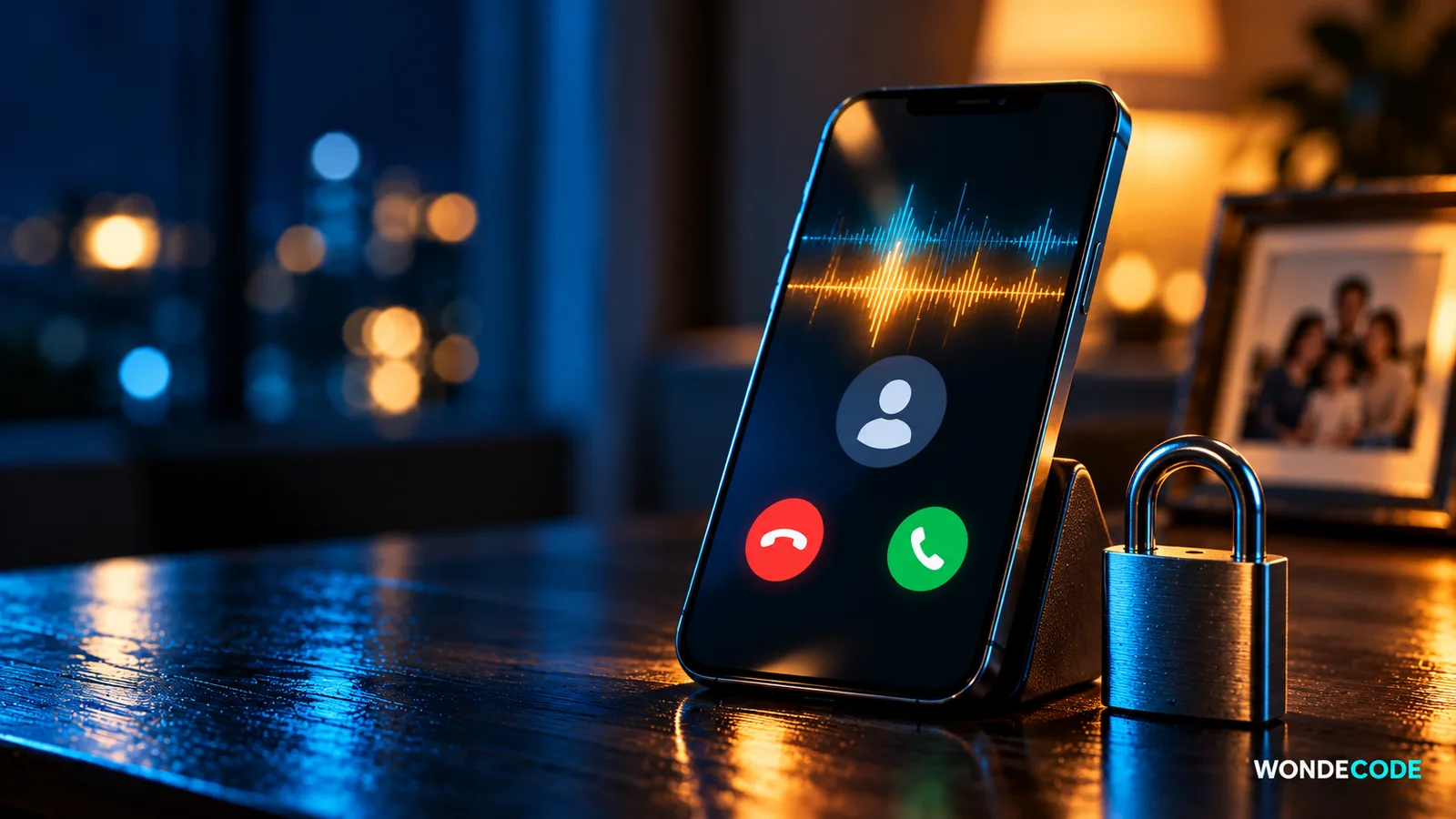
The call comes at 6:40 on a Tuesday. It is your daughter’s voice — crying, breathless. There has been a crash. She needs bail money, and please, please don’t tell Mom. The voice is right. The panic is right. That is exactly what the scammer is counting on.
A cloned voice is no longer a novelty. Consumer guidance from the US Federal Trade Commission describes scammers using a short audio clip — often pulled from something posted online — plus a voice-cloning program to “sound just like your family member,” and warns people not to trust the voice on the line even when it sounds like a relative (FTC, Scammers Use Fake Emergencies To Steal Your Money; FTC consumer alert, 2023).
That leaves families needing a different kind of proof. The cheapest one available costs nothing and takes about five minutes to arrange: a safe word.
Why a familiar voice stopped being proof
Voice cloning works by separating two things our ears normally bundle together: what is being said, and who is saying it.
Modern tools learn the texture of a voice — its pitch, rhythm, accent, the small rises and falls at the end of a sentence — from recordings of that person talking. Once a model has that texture, it can read out new sentences in that voice, including a panicked plea for money. All it needs is audio, and audio of most of us is scattered everywhere: voicemails, birthday videos, story clips, voice notes in group chats.
What a clone cannot do is know what the person knows. Reproducing a sound and reproducing private knowledge are different jobs, and only one of them is easy to fake. That gap is where a safe word lives.
How much audio does it take?
The sources disagree, and the disagreement is worth knowing if you are trying to gauge your own exposure.
Federal Trade Commission guidance says only “a short audio clip.” A family-safety guide from Bitdefender puts it at less than 10 seconds of someone’s voice, pulled from social media, a video, or even a voicemail greeting (Bitdefender, updated 2026). Other figures circulate too — roughly 30 seconds, or as little as 3 to 10 seconds — but these come from secondary sources and vendor write-ups rather than from an authoritative measurement, so treat them as illustration rather than fact.
The honest summary: no one agrees on a number, but every number in circulation is small. One voicemail is plenty.
We are poor judges of voices
Humans do not reliably hear the difference. Researchers at UC Berkeley — Sarah Barrington, Hany Farid and Emily Cooper — tested listeners with real voices and their clones in a study published in Nature Scientific Reports in 2025. Participants identified AI-generated voices correctly only about 60% of the time, against the 50% they would score by guessing. Asked whether two recordings came from the same person, listeners spotted a mismatch only about 20% of the time (Berkeley School of Information, 2025).
Barrington put it plainly: “These things are perceptually realistic enough to fool a human.” The same team argues that the legal standard for identifying a voice in court — a familiar listener saying “that sounds like the same person to me” — is outdated for the same reason.
So “I would know her voice anywhere” is a reasonable thing to feel. It is not a reliable security control.
The tell is behaviour, not audio
Police warnings, including one from Celina, Ohio, list the standard scripts behind these calls: an accident, bail money, being stranded, an arrest. Callers tell you to stay on the line, not to call anyone else, and to keep it quiet. Payment is usually untraceable — a wire transfer, gift cards, cryptocurrency, a payment app (Spectrum News 1, 2026).
Bitdefender’s guidance makes the same point: a cloned voice may sound slightly flat, delayed or emotionally exaggerated, but it can still be convincing — so watch the pressure rather than listening for an audio glitch. Secrecy and speed are the mechanism. Panic is what stops you hanging up and dialling a number you already know.
How to set up a safe word that works
Choose a word or short phrase now, before you need it. Keep it out of anything public: no social media posts, no group chats, no pet names or birthdays anyone could guess. Then make the rule mutual and specific — anyone who calls asking for money gets asked for the word. Ask for it; never volunteer it first. If a caller says “Dad told me the word is…”, that is not verification. That is a claim.
Then accept the limits:
- A safe word only helps if it was agreed in advance. You cannot invent one mid-crisis with a stranger who already knows your daughter’s name.
- It leaks. If it ends up on a fridge whiteboard photographed for Instagram, it is spent.
- It gets forgotten under stress — which is exactly the condition it is designed to survive. Some families store it in a password manager or with their passports, and rehearse it once a year.
- It does not protect anyone who was never told: grandparents, a new partner, a teenager who was half-listening.
The stronger check: hang up and call back
Caller ID can be spoofed, so the number on screen proves less than it used to. Call back on a number already saved in your phone — never a number the caller gives you. If the person claims to be at a hospital or a police station, look up that institution’s number yourself and ring it directly. If the story is real, you have lost thirty seconds and the person will understand.
You can also build in a pause before money can move: real-time transaction alerts from your bank, a lower daily transfer limit, or extra confirmation for large payments (Bitdefender recommends all three). These do not stop the call, but they buy you time.
| Check | Safe word | Callback on a saved number |
|---|---|---|
| What it tests | Whether the caller holds private knowledge | Whether the person is genuinely reachable and in trouble |
| Setup required | Yes — agreed in advance, kept private | Saved numbers for each family member |
| Defeated by | The word leaking | Very little, as a first check |
| Cost during a panic | Seconds | Thirty seconds to a couple of minutes |
| Best role | The first question you ask | The gate before any money moves |
The two work best together, in that order: ask the question, then hang up and verify.
Where this advice breaks down
Real emergencies exist, and they look messy. A frightened teenager in genuine trouble may also beg you not to tell anyone, and a legitimate call can arrive with terrible timing and a bad signal.
You will also see large numbers attached to this scam — headline losses in the hundreds of millions, or claims about how many Americans are targeted. These vary widely between sources, and several appear in security companies’ marketing material. Treat them as atmosphere rather than measurement.
The goal is not to refuse help. It is to verify before money moves — and to say that out loud to your family, so nobody reads the question as an accusation.
What to do this week
- Agree on a safe word tonight, out loud, and pick something unguessable.
- Write it down somewhere private, not somewhere public.
- Adopt one rule: money requests go through a callback on a saved number.
- Tell the people most likely to be targeted, especially grandparents.
- Rehearse once, so the question feels normal rather than suspicious.
A short clip of your daughter’s voice on a video is enough to build a fake version of her. It is not enough to build the one thing that proves it is her: something only your family knows. Agree on the word. Then, whatever the caller says, hang up and call back.
Sources
- Federal Trade Commission. Scammers Use Fake Emergencies To Steal Your Money. Consumer advice, date not stated.
- Federal Trade Commission. Scammers use AI to enhance their family emergency schemes. Consumer alert, 2023.
- Cristina Popov. How to Outsmart AI Voice Scammers Pretending to Be Your Family. Bitdefender, published 3 March 2026, updated 6 April 2026.
- UC Berkeley School of Information. Berkeley Researchers Discover That People Are Poorly Equipped To Detect AI-Powered Voice Clones, Develop New Deepfake Dataset, 29 April 2025, summarising Barrington, Farid and Cooper in Nature Scientific Reports, 2025.
- Madison MacArthur. Celina police warn of AI voice cloning scam. Spectrum News 1, 4 February 2026. Corroborated by WDTN reporting on the same police warning.
- National Cybersecurity Alliance. staysafeonline.org — quoted as giving roughly 30 seconds of audio; publication date not stated.
Sources accessed 11 October 2026.