
A folding phone makes an irresistible promise. Close it and you have something that fits into a pocket. Open it and you have a small tablet. You might expect the contest between foldables to be decided by the crease, the hinge or the thickness of the hardware.
But there is a stranger question hiding inside the glass: when a phone becomes a tablet, does its operating system know what to do with all that extra space?
Apple’s first foldable, the iPhone Duo, went on sale on October 23, 2026. It arrived in a category that Samsung, Google and other Android manufacturers had spent years refining. Its 7.6-inch inner display and specially adapted iOS 27 interface make it a compelling new device, yet the most revealing comparisons are about what happens after you open it.
This is not a laboratory shootout or a declaration that one brand wins. It is a look at the different choices that turn a flexible screen into a useful tool—and why the answer changes depending on whether you’re reading, taking photographs, playing games or juggling several apps.
The screen is bigger. Your tasks are not necessarily easier.
When a conventional phone opens a message, the app usually takes over nearly the whole screen. A foldable has to decide whether to stretch the app, rearrange it, place two apps side by side or offer floating windows. That decision is software design, not merely a display specification.
Apple’s official iPhone Duo announcement describes a 5.4-inch outer display and 7.6-inch folding inner display. Both share an aspect ratio designed to smooth transitions between views, while iOS 27 moves elements such as app navigation and controls to make better use of the larger canvas.
At first glance, this feels like an obvious improvement: more visible content, less scrolling, room for a document alongside messages. But two screens with the same diagonal measurement can behave differently if one operating system imposes a stricter arrangement of windows.
That is why comparing foldables purely by screen size is like comparing desks only by their width. What matters is how much work you can actually arrange on them.
Apple’s answer: make two apps feel simple
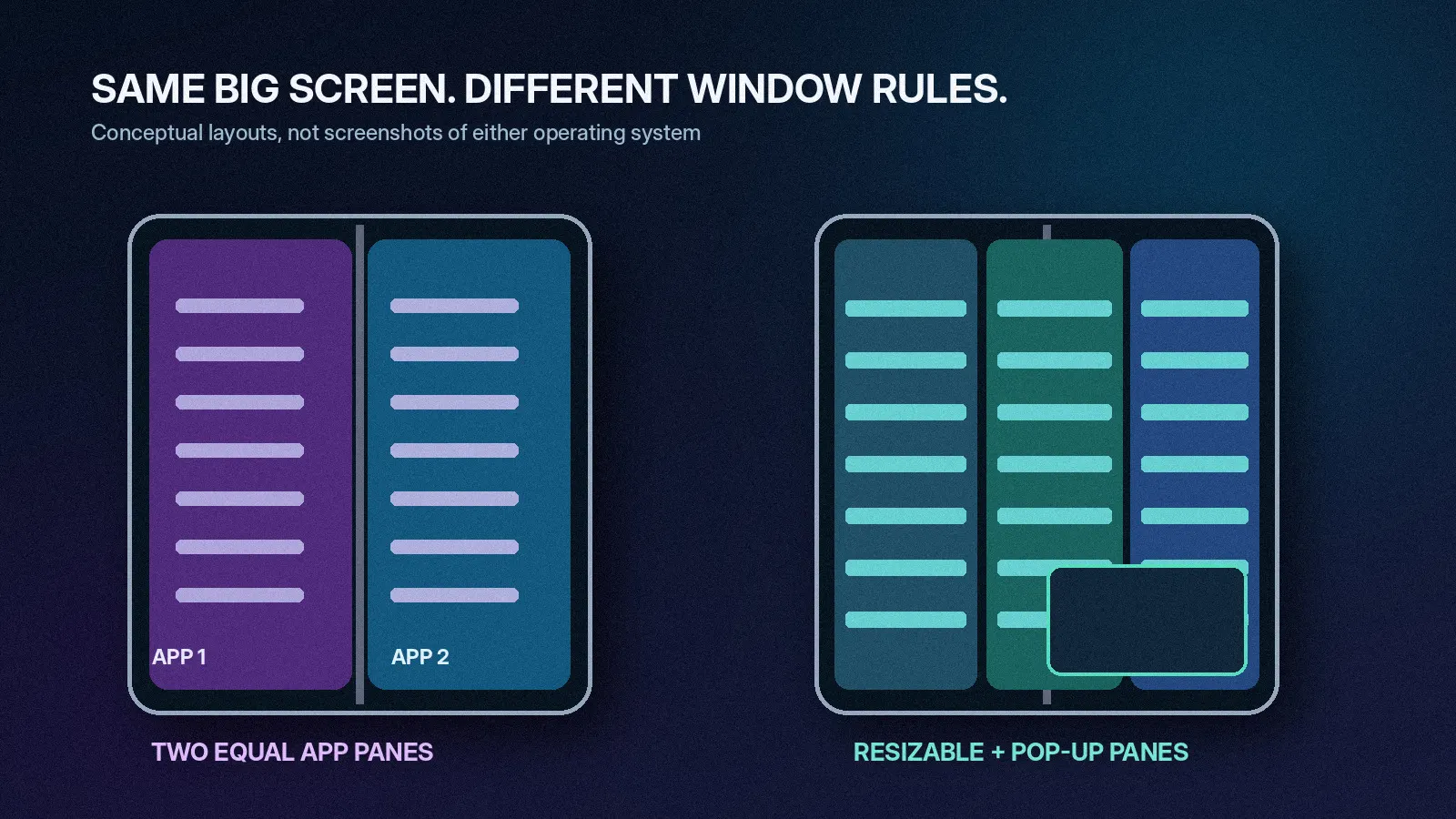
Apple added Split View to the iPhone Duo. Its user guide explains that, when open in landscape, the device can show two apps—or two windows of the same app—side by side. Each occupies an equal share of the screen.
This has a genuine virtue. You can browse a travel page while talking to someone, compare two Safari windows or keep a document beside a conversation without managing a complicated desktop-like interface. Apple also supports saved app pairs, and developers can adapt layouts using the new iPhone Duo interface guidance.
The trade-off is flexibility. In a hands-on comparison published by SamMobile, reviewers found the iPhone Duo’s app divider remained at a 50:50 split, and the two-app arrangement did not preserve the same behavior when the device was rotated. Those observations describe the software available during that review; they are not a guarantee that every future iOS version will behave identically.
For someone who wants two straightforward activities at once, that simplicity can be desirable. For someone who constantly moves information among three or four apps, it can feel restrictive.
Android’s advantage is not the fold. It is the window.
Samsung’s Galaxy Z Fold8 can run multiple apps in split screen, use pop-up windows and provide a taskbar for switching. Samsung’s official multitasking guide also documents DeX, which provides a desktop-style workspace when connected to a compatible external screen.
An independent SamMobile review describes a three-app arrangement with movable dividers, additional floating windows and greater control over window proportions. That is the difference between opening a pair of applications and arranging a miniature workspace.
Think of copying reference material into a note while checking a map and keeping a chat visible. The ability to reposition windows matters more than the abstract number of inches on the display. Android foldables with richer window management have a practical head start here.
But more controls also mean more complexity. A user might never need three apps at once and prefer a predictable split rather than an interface crowded with window handles and launchers. There is no universal law that more multitasking options make every phone better.
It is also important not to treat “Android” as one fixed experience. Galaxy Z Fold8, Pixel 11 Pro Fold and other foldables have different software, update schedules and productivity features. Samsung’s DeX is not automatically a feature of every Android device. The valid comparison is between specific phones and their actual software, not two imaginary perfectly representative operating systems.
Why app optimization matters more than a spectacular hinge
A phone app that simply expands into the middle of a wide display can waste space. Menus may stay cramped, controls drift to awkward corners or large blank bands appear around content. Developers must decide how their app should respond to different window dimensions, folds and orientations.
Apple has provided developer guidance for flexible arrangements and multiple app scenes. This is significant: good folding experiences are partly an ecosystem problem. Third-party apps need time to adopt those tools.
Early reviewers have reported inconsistent optimization. Android Authority’s impressions noted apps that did not yet fully suit the new screen, while The Verge’s November 7 assessment emphasized that the Duo’s sophisticated hardware was ahead of some of its software interactions.
These reports are valuable because they describe actual use. They are also early impressions: app updates can materially change the experience after launch. Anyone comparing devices six months from now should check fresh reviews rather than assuming launch behavior is permanent.
Where the iPhone Duo makes a stronger argument
The conversation is not only about productivity. Apple’s folding design has distinctive uses for photography and video. The outer display can act as a viewfinder for subjects, and the phone can stand partially folded for hands-free shooting or calls. Apple describes features such as Duo Preview and camera workflows built around the device’s two displays in its launch material.
There is also the appeal of consistency. A device that moves smoothly between closed and open states, integrates familiar Apple services and emphasizes straightforward two-app workflows may be more pleasant for some users than one that offers a larger set of controls.
The hardware is ambitious: Apple lists the A20 Pro processor, a nano-texture inner-display finish, a titanium structure and an official starting price of $1,999 in the United States. Those features establish its market position, not its superiority in every task.
A premium device can still have compromises. Early reviewers have raised questions about weight, the practical size of the outer screen and the long-term behavior of first-generation folding hardware. Durability claims should be evaluated through documented testing and real ownership over time, not solely through launch presentations.
The test that matters: what do you do after unfolding it?
If you are deciding between a Duo and a Galaxy Z Fold8, start with five practical scenarios rather than a spec-sheet winner.
Reading and watching: Is the larger display comfortable for the sites, books and video formats you actually use? Some content gains useful space; letterboxing or aspect-ratio differences may waste part of the display.
Working across apps: Do you want two fixed panes, or do you regularly need three apps, movable windows or a desktop-like external-display mode?
Photography: Does the folding stance, outer preview, camera hardware and processing suit your real use? Inspect full-resolution sample photographs, not only promotional crops.
One-handed use: A folded device can feel surprisingly different from a conventional slab. Weight, width and reachable controls matter more in practice than thinness when fully open.
Ownership: Check repair options, availability of parts, warranty conditions, update policies and local price. A hinge and flexible inner display add expensive moving and delicate components; no manufacturer should get a free pass on durability because its product photographs look elegant.
If possible, spend ten minutes using both devices in a shop. Open and close them, rotate them, try two favorite apps and type a paragraph. That brief exercise may tell you more than another page of specifications.
The real story of the first foldable iPhone
The iPhone Duo does not prove that Android foldables were wrong, nor that Apple’s arrival has instantly changed the rules. It demonstrates how much of a foldable’s value is created by software decisions made after the hardware is finished.
For now, Samsung’s established window-management tools make a compelling case for productivity-oriented users. Apple’s tighter approach offers an alternative focused on simplicity, polished transitions and familiar iPhone behavior. The stronger choice depends on what you actually want to do on that large inner screen, and app updates may shift the balance.
A foldable phone is not impressive because its screen bends. It is impressive when opening it changes what you can accomplish. The industry’s next contest may be less about making the crease disappear and more about making the extra space feel indispensable.
Sources and research notes
- Apple Newsroom — Apple unveils iPhone Duo, September 9, 2026. Product specifications, features and availability.
- Apple Support — Open two apps in Split View on iPhone Duo. Official account of the equal split-screen workflow.
- Samsung Support — Multitasking on Galaxy Z Fold8. Multi Window, taskbar and DeX features.
- SamMobile — Galaxy Z Fold 8 vs. iPhone Duo software, October 27, 2026. Hands-on comparison; observations may change with updates.
- Android Authority — Foldables in 2026 and iPhone Duo, November 2026. App-optimization observations.
- The Verge — iPhone Duo versus Android foldables, November 7, 2026. Independent review context.
Editorial note: Wondecode has not independently bench-tested these devices. The cover and explanatory illustration are conceptual artwork, not photographs of Apple or Samsung retail hardware.