
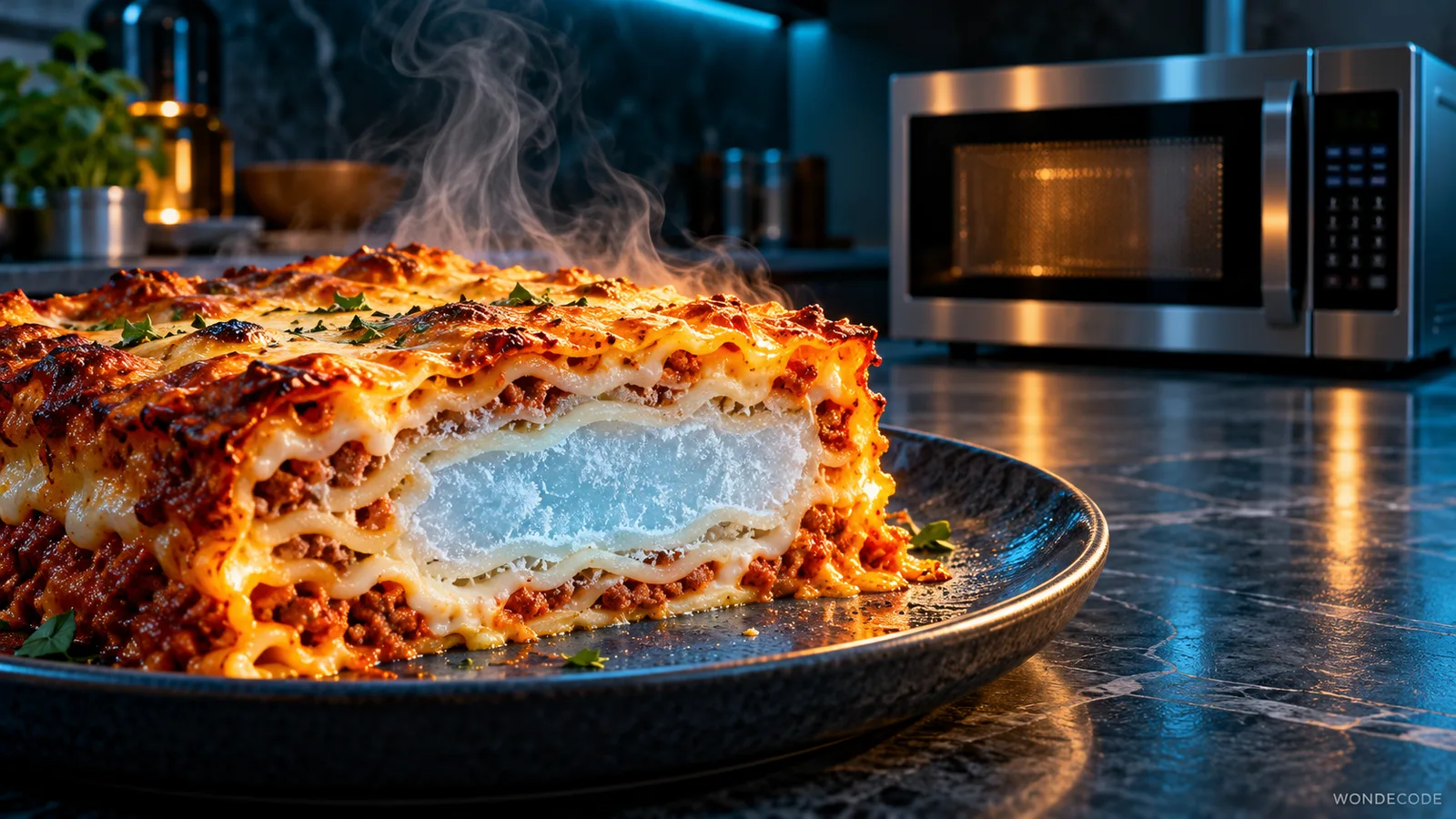
You know the moment: the timer beeps, the cheese bubbles, and dinner looks ready. Then your fork reaches the center. It is barely warm, or still partly frozen. The hot surface gave you only part of the story.
What the microwave actually heats
A microwave oven produces electromagnetic waves that transfer energy to food. Water molecules respond to the changing electric field, and the absorbed energy becomes heat. This is heating within the food, rather than simply warming the oven air around it. FDA: Microwave Ovens
That does not mean every part warms at the same rate. A meal has thickness, layers, and ingredients with different properties. A bubbling corner tells you what is happening at that corner; it cannot tell you the temperature of the whole dish.
Why hot and cold spots appear
Inside the metal cavity, microwaves reflect and overlap. The resulting field has regions that deliver stronger heating and regions that deliver weaker heating. This uneven pattern helps explain why neighboring parts of a meal can end up at different temperatures. TU Delft: Hot spots in the microwave
The pattern is not a universal map with one permanently cold center. Different ovens and food arrangements can produce different results. Think of the problem as uneven energy delivery, rather than a microwave deciding to heat only the edges.
Why the spinning plate cannot fix everything
The turntable moves food through different parts of that field, helping distribute the heating. Rotation improves the result, but it does not make every point receive identical heating. TU Delft
Thickness adds another challenge. Microwave ovens do not generally cook thick food from the inside out. The outer layers absorb microwave energy, while heat must also travel into deeper areas by conduction. That takes time. A thick lasagna can therefore have hot outer layers while the center is still catching up. FDA
What helps in practice
Start with the food’s heating instructions, including the recommended microwave power and standing time. Use a microwave-safe container and cover as directed.
- Stir when the dish allows it. Bring food from the edges toward the center and mix the cooler portions into warmer ones.
- Rearrange or rotate when stirring is impractical. Follow the product instructions for solid pieces or layered meals.
- Allow the full standing time. Heat continues spreading through the food after the microwave stops.
- Check the result throughout. Standing time alone does not guarantee a safe temperature. USDA recommends reheating leftovers to 165°F (74°C), checked with a food thermometer in several places.
These steps follow USDA guidance on microwave cooking. If a checked area is still too cool, continue heating as appropriate, then stir or rearrange, allow the instructed standing time, and check again.
The beep ends a timer, not the temperature check
The useful question is not whether one bite looks hot. It is whether the meal has heated adequately throughout. The microwave supplies energy; your instructions, stirring, standing time, and temperature checks help turn that energy into an evenly heated meal.
What food has given you the biggest hot-outside, cold-inside surprise?