
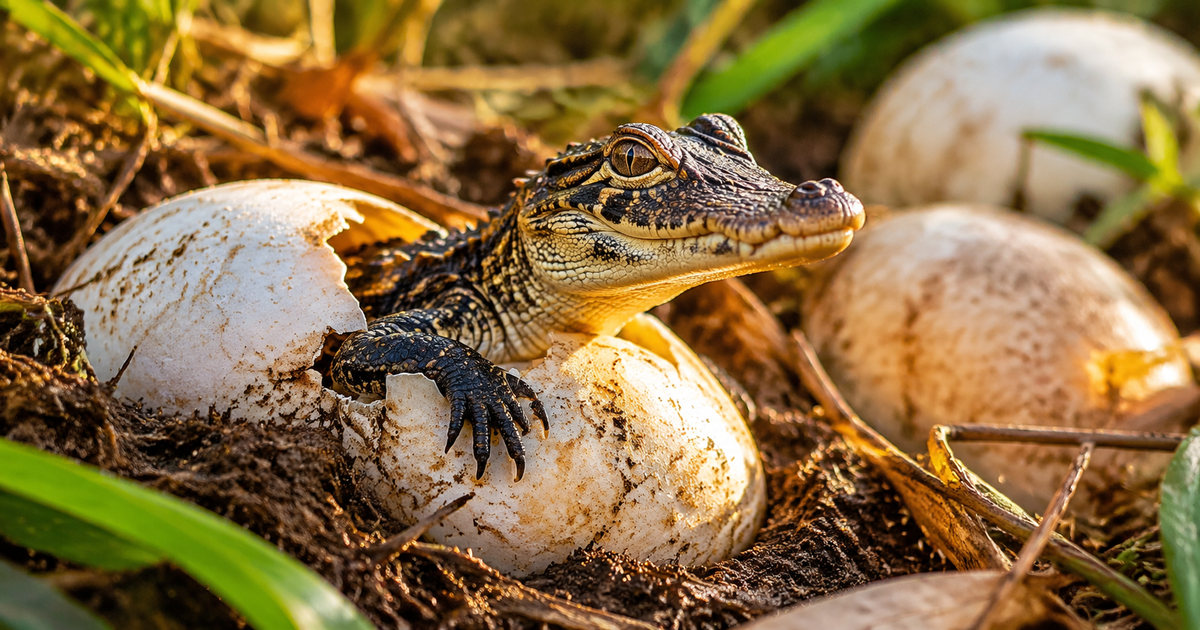
Imagine two American alligator eggs resting in almost identical nests. The embryos have the same species, similar surroundings, and weeks of development ahead. Yet a small difference in the temperatures they experience could tilt their chances of becoming male or female.
For American alligators, that is not science fiction. Unlike humans, whose sex development is usually initiated by sex chromosomes, alligators have temperature-dependent sex determination. The temperature of the egg during a crucial developmental period helps direct the developing reproductive organs. Now, a study published in the Journal of Experimental Biology has challenged how accurately scientists can predict that outcome from laboratory temperature charts. Original study, Ebey and colleagues (2026)
The surprise is not that temperature matters. Scientists have known that for decades. The surprise is how much the daily rise and fall of temperature can change the prediction.
The strange rule inside an alligator egg
In people, we often learn to think of sex determination in terms of X and Y chromosomes. But an American alligator (Alligator mississippiensis) develops under a different system. During a temperature-sensitive window of incubation, conditions inside the nest influence whether its gonads develop along a predominantly male or female pathway.
What makes alligators especially curious is that the relationship is not simply “hot equals male” or “hot equals female.” It follows a broad female–male–female pattern:
| Incubation conditions | Typical sex-ratio tendency |
|---|---|
| Relatively cool | More females |
| Intermediate | More males |
| Relatively hot | More females again |
Historically, controlled experiments suggested that temperatures around 86–88°F (30–31°C) tend to yield females, while approximately 90–92°F (32–33°C) favor males. Very high constant-temperature treatments were also associated with female development, although extreme heat can threaten embryo survival. These are approximate tendencies, not universal thresholds for every nest. University of Georgia, October 2026
That last detail matters. There is no magic setting on an egg that guarantees a single outcome; what biologists estimate is how a particular thermal history affects the proportion of male and female hatchlings.
A real nest does not hold one temperature all day
Think about a thermometer left outdoors. It rises in daylight, falls overnight, and jumps when a heat wave arrives. The same general principle applies to nests insulated by vegetation and soil. Their temperatures change through the day and across the incubation season.
Yet much of the classic research used incubators set to steady temperatures. That is excellent for identifying a basic biological relationship, but an animal developing in a natural nest experiences a sequence of thermal signals, not a single unchanging number.
Earlier field research found that many alligator nests experience both male-promoting and female-promoting conditions during the temperature-sensitive period, sometimes within the same day. That observation made a practical question unavoidable: can a model built on constant temperatures reliably forecast the sex ratio of hatchlings from fluctuating nests? Bock and colleagues, Integrative Organismal Biology (2020)
Scientists tested 146 eggs from seven nests
To investigate, researchers led by Karin Ebey at the University of Georgia collected 146 American alligator eggs from seven nests in South Carolina. The eggs were placed into five incubation treatments designed to mimic the kinds of daily temperature changes a nest might experience.
The treatment averages ranged from about 86°F to 93°F (roughly 30–34°C), rather than staying perfectly constant. The researchers then assessed offspring sex using markers of gene expression in the developing gonads and built models linking the temperature patterns to expected sex ratios. University of Georgia · Peer-reviewed study
At the cooler end, the new model resembled the results of older constant-temperature experiments. But at the warmer end, the predictions diverged substantially. The estimated upper transition between male-producing and female-producing conditions differed from constant-temperature models by up to 1.36°C (about 2.4°F).
That may sound like a tiny discrepancy. Near a biological tipping point, however, it can mean the difference between predicting mostly males and predicting mostly females.
The unexpected result was at the hot end
The university’s account highlights an especially striking contrast. Some earlier models placed the transition back toward female-producing conditions around 97°F (36.1°C). The newer fluctuating-temperature model suggested that female outcomes became more likely starting around 93°F (33.9°C) under the tested regimes.
Brief peaks as high as 96°F (35.6°C) did not cause the kind of harm sometimes seen when embryos endure persistently high temperatures in constant-temperature experiments. Instead, those warm episodes could help shift the predicted sex ratio toward females. University of Georgia
This does not mean every alligator egg switches sex at exactly 93°F. Nor does it mean hotter nests are always safe. Exposure duration, timing, survival, and the full sequence of temperatures all matter. The numbers describe the conditions and models in this research, not a universal biological instruction manual.
How does a temperature become a biological signal?
An egg does not contain a miniature thermometer with a male or female switch. Temperature influences cellular processes that regulate which developmental genes become active and when.
Previous work on American alligator embryos has shown that pathways involving regulators such as JARID2 and KDM6B can respond rapidly to changing temperature conditions. Other genes involved in sexual development, including SOX9 and DMRT1, respond on different timescales. Scientists are still investigating how these molecular signals integrate repeated warming and cooling into a lasting developmental outcome. Bock and colleagues (2020)
The 2026 study was primarily a prediction and temperature-response study. It refined the relationship between fluctuating incubation temperatures and offspring sex; it did not uncover a single new molecular switch that explains everything.
The deeper lesson is that biology often responds not just to how warm something gets, but to when, how long, and how often it gets warm.
Why this discovery matters beyond one nest
Alligators are large predators, but they also shape wetland environments through their movements and the habitats they create. If warming shifts the proportions of male and female hatchlings, those changes could affect population dynamics over time.
Researchers cannot simply look at an increase in average temperature and conclude that a future alligator population will contain more males or more females. The answer depends on where the nests begin on the temperature curve, how their temperatures fluctuate, whether embryos survive, and how other environmental conditions change.
That is precisely why a more realistic model is useful. It can improve conservation forecasts and help scientists ask better questions about other crocodilians. It is not yet a full prediction of what climate change will do to every alligator population. Original study · University of Georgia
There is an evolutionary puzzle here, too. Earlier University of Georgia research found that some male-promoting incubation conditions were associated with better early-life survival in experimental alligators. Scientists are still investigating why temperature-dependent sex determination evolved and how that advantage works in natural habitats. UGA Research, 2023
What the study shows—and what it doesn’t
The evidence supports three clear conclusions:
- Fluctuations matter. Nest-like thermal patterns can produce different sex-ratio predictions from constant laboratory temperatures.
- Small differences can matter greatly near a transition. A change of around one degree Celsius can substantially alter the expected balance of hatchlings under some conditions.
- The hotter transition needs more research. Models based on steady temperatures may misrepresent the conditions most relevant to a warming climate.
The study did not show that a single hot afternoon determines every egg’s sex. It did not demonstrate that climate change will inevitably produce one sex everywhere, or that conservationists can already predict every nest with certainty.
The surprising answer
An alligator’s sex is shaped by its environment before it ever breaks through the shell. But nature does not run on a perfectly steady thermostat. The egg experiences warm afternoons, cooler nights, and changing weather—signals that a developing embryo must somehow integrate.
That is why a difference of about one degree can be scientifically consequential, and why the 2026 findings are more important than a simple hot-versus-cold chart.
If you have ever wondered how an alligator differs from a crocodile, we also explain the anatomy, teeth, snout shapes, and saltwater clues in Alligator vs. Crocodile.
The next time you see a tiny alligator emerging from its egg, remember: the weather in its nest has already helped shape its future.
Sources
- Ebey, Rainwater, Smaga & Parrott (2026) — A sex ratio by incubation temperature reaction norm for the American alligator (Alligator mississippiensis) based on fluctuating thermal regimes, Journal of Experimental Biology
- University of Georgia (29 October 2026) — Is it a boy or a girl? For alligators, it may come down to one degree
- Bock et al. (2020) — Post-Transcriptional Mechanisms Respond Rapidly to Ecologically Relevant Thermal Fluctuations During Temperature-Dependent Sex Determination
- University of Georgia Research (2023) — Temperature-dependent sex determination in alligators linked to survival