
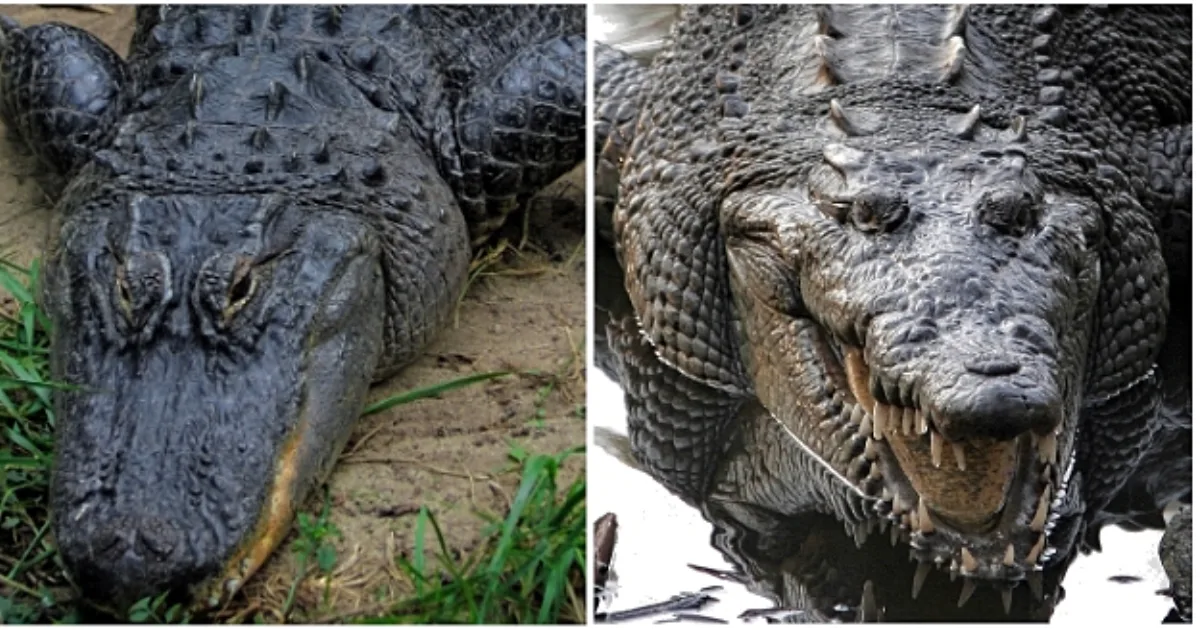
Stand on a boardwalk in southern Florida and a reptile slides into the water below. Is it an alligator or a crocodile? In this one corner of the world, the question is genuinely open. The two American species share the same state, and occasionally the same waterways. Everywhere else, only one of the two lives in the wild.
Three field clues do most of the work: snout, teeth, water. Each has a physiological reason behind it, and each has limits. Here is how to use them — and when to stop trusting them.
Meet the two American reptiles
The animals in question are the American alligator (Alligator mississippiensis) and the American crocodile (Crocodylus acutus). They are not close relatives. They belong to separate biological families — Alligatoridae and Crocodylidae — and molecular work puts their split deep in the Cretaceous, roughly 97–103 million years ago (Roos et al., 2007). That date is not settled: Brochu (2009) cautions that divergence estimates shift with the calibration methods used (Brochu, 2009).
Florida is the only place on Earth where these two species coexist in the wild (FWC). The alligator ranges across the southeastern United States and appears in every Florida county. The American crocodile is a tropical coastal species, found from the Caribbean to the southern Florida coast.
Clue 1: Look at the snout
Start with the head. The American alligator has a broad, rounded snout. The Smithsonian’s National Zoo calls it a “long, rounded snout” with nostrils that face upward (National Zoo). The American crocodile’s snout is narrower and more tapered. Seen from above, an alligator’s head often looks like a wide U; a crocodile’s looks more like a V.
For these two species, the snout is a useful first glance. It is not a universal rule for all crocodilians. Elsewhere in the world, some crocodiles have surprisingly broad snouts, and some caimans have narrow ones. Treat the snout as a starting point, not a verdict.
Clue 2: Check the fourth tooth
The most reliable single field mark is usually the fourth lower tooth. In an alligator, that tooth fits into a socket in the upper jaw and is hidden when the mouth is closed. In a crocodile, the same tooth sits in a constriction in the upper jaw and stays visible even with the jaws shut.
An American alligator may have 74–80 teeth at a time and grow through roughly 3,000 teeth in a lifetime (National Zoo). Crocodiles replace theirs continuously too, but that fourth tooth is the quickest way to separate the two American species at a glance.
Clue 3: Read the water — and the tongue
Habitat is the third clue, and it has a physiological basis. Crocodiles have functional lingual salt glands — glands on the tongue that excrete excess salt. A review of crocodilian osmoregulation by Taplin and colleagues found these glands in the American crocodile (Crocodylus acutus) but not in the American alligator (Alligator mississippiensis) (Taplin, osmoregulation review). As a result, crocodiles can excrete salt at rates many times higher than alligators can.
Alligators osmoregulate more like typical amphibious reptiles: they rely on low skin permeability rather than active salt secretion. So they prefer freshwater. American crocodiles tolerate saltwater far better and often live in brackish coastal habitats, sometimes moving inland through canals (FWC).
Side-by-side comparison
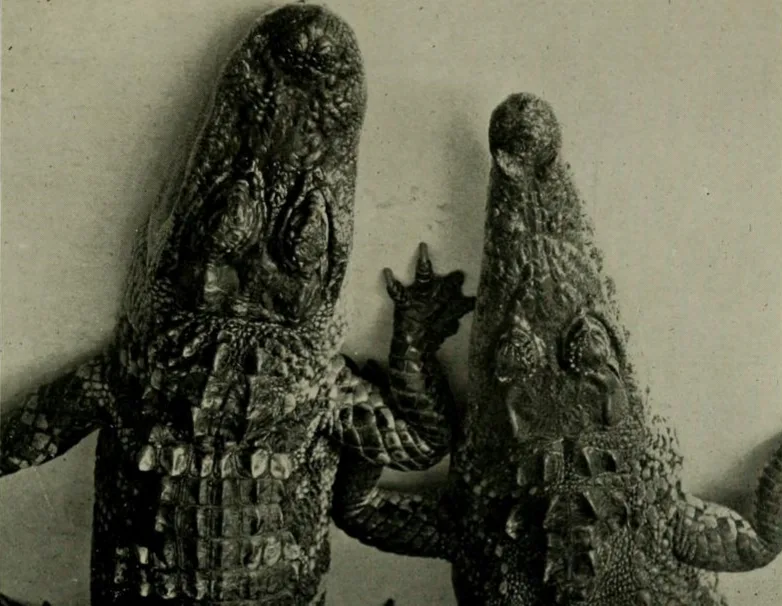
Image: Gator&croc.png — Ditmars, Raymond Lee, 1876-1942. Public domain.


| Feature | American alligator | American crocodile |
|---|---|---|
| Family | Alligatoridae | Crocodylidae |
| Snout shape | Broad, rounded, U-shaped | Narrower, tapered, V-shaped |
| Fourth lower tooth (mouth closed) | Hidden in an upper-jaw socket | Visible in an upper-jaw notch |
| Lingual salt glands | Absent or non-functional | Functional; excrete excess salt |
| Typical habitat | Freshwater; occasionally brackish | Brackish and saltwater; sometimes inland canals |
| U.S. range | Southeastern U.S., including every Florida county | Southern Florida coast and the Caribbean |
Where the simple rules break down
The three clues work well for the two American species. They are less reliable elsewhere. Crocodilian diversity is broad, and documented exceptions exist — the mugger crocodile of South Asia and some caimans do not follow the snout rule. Brochu (2009) also cautions against reading too much evolutionary meaning into osmoregulatory data alone (Brochu, 2009).
Some popular claims are better left out of a field guide. Reports of size and aggression vary widely across sources, and the two species overlap substantially in size. As identifying features, they are unreliable. Stick with the teeth, then the snout and habitat.
One more nuance: alligator salt tolerance is not zero. Adults can tolerate saltwater briefly, and coastal alligators may manage salinity partly through behaviour — retreating to freshwater refuges — rather than through glandular secretion. That makes habitat a strong pattern, not an absolute rule.
The takeaway
Next time you are near a Florida waterway, look first at the closed jaw. If the fourth lower tooth is hidden, you are looking at an alligator. If it protrudes, it is a crocodile. The snout and the water can back up the call — but the tooth is the detail that usually settles it.
Sources
- Roos, J., Aggarwal, R. K., & Janke, A. (2007). Extended mitogenomic phylogenetic analyses yield new insight into crocodylian evolution and their survival of the Cretaceous–Tertiary boundary. Molecular Phylogenetics and Evolution, 45(2), 663–673. PubMed
- Brochu, C. A. (2009). Crocodylians (Crocodylia). In The Timetree of Life. PDF
- Florida Fish and Wildlife Conservation Commission. FWC provides tips on identifying American alligators and crocodiles
- Smithsonian’s National Zoo & Conservation Biology Institute. American alligator
- Taplin, L. E. Osmoregulation in Crocodilians. Scilit
Sources accessed 6 October 2026.