
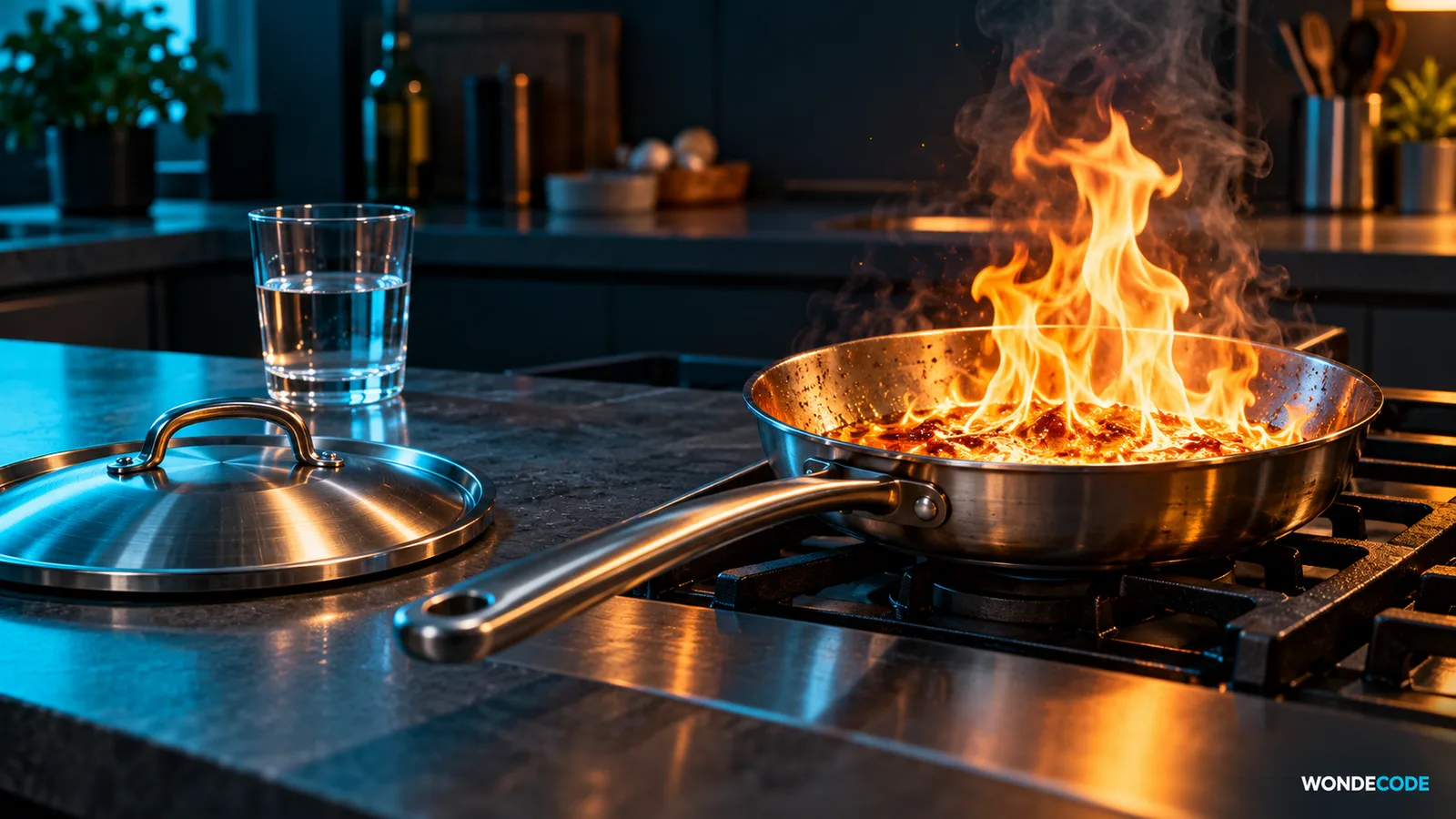
A pan of oil on the hob can sit there quietly for a long time, and then it can’t. A curl of smoke at the rim, a flicker in the middle, and there is a small fire sitting in front of you. Almost everyone reaches for the same thing first: water.
Water is the one thing that makes it dramatically worse.
Three things going wrong at once
Water is heavier than oil. Tip it into the pan and it does not rest on the surface where the flames are. It slides straight through them and settles underneath, at the bottom of the pan.
The oil is far hotter than water’s boiling point. Burning cooking oil or fat sits at several hundred degrees Celsius — far above the 100 °C at which water turns to steam.
Water expands enormously when it boils. One litre of water becomes roughly 1,700 litres of steam. Trapped under a layer of burning oil, that steam has only one way out: up, through the fire.
The result is what German fire services call a Fettbrand — a fat fire — and the eruption that follows when water meets one. The steam blasts the oil above it into the air as a cloud of fine droplets. Each droplet exposes far more surface area to oxygen, the droplets re-ignite, and a quiet pan fire becomes a jet or fireball that can reach the ceiling in seconds.
Why the eruption is worse than the fire
While it stays in the pan, a small oil fire is contained. What follows a splash of water is not. Burning oil is thrown outward and upward, so it can reach kitchen cabinets, curtains and the clothes you are wearing. Fire services warn of severe burns to the hands, face and torso.
It also takes far less water than most people expect. A splash is enough. So is a wet tea towel. So is a frozen item grabbed from the freezer and thrown at the flames — anything that carries water into hot oil starts the same chain.
What to do instead
For a small pan fire, the sequence is short enough to remember under pressure:
- Turn off the burner.
- Slide a metal lid or a baking sheet over the pan from the side. Coming in from the side keeps your hand and forearm clear of the flames.
- Leave it covered until it is cool — and do not move the pan.
The lid works by cutting off oxygen. A cooking-oil fire needs air to keep burning; starve it and the flames die. Moving the pan does the opposite of what you want, because burning oil can spill across the worktop or over you.
Baking soda, in large amounts, can help on a very small fire, but it is a supplement to a lid rather than a replacement for one. Flour, sugar and baking powder should never go near a pan fire: fine powders thrown through a flame can ignite explosively.
| What people try | What actually happens |
|---|---|
| Pouring water | It sinks below the oil, flashes to steam and throws burning oil into the air |
| A wet towel or a frozen item | The same chain — anything wet brings water into the oil |
| Flour, sugar or baking powder | Fine dust can ignite explosively in the flame |
| Carrying the pan outside | Burning oil spills and spreads, and you can be burned |
| Burner off, lid slid on from the side | Oxygen is cut off and the fire goes out |
When the problem is bigger than the pan
If the flames have already spread past the pan — up a wall, into a cupboard, onto a curtain — stop managing it yourself. Get everyone out and call the fire service. Commercial kitchens keep Class K extinguishers, which are designed for cooking-oil fires. Most home kitchens have nothing meant for burning fat.
The one swap worth remembering
This is worth thinking through before it happens, because the wrong response is the intuitive one. Water feels like the answer to a fire in a way that a metal lid never will.
The fix is a single substitution: a lid instead of water, and then hands off. Turn off the burner, slide the lid on from the side, step back and let the fire run out of air.
Sources
- Get Prepared: Cooking — https://secure.in.gov/dhs/get-prepared/fire-safety/cooking-safety/
- Fire Safety Reminder: Cooking and Family Gatherings — https://idahofallsidaho.gov/m/newsflash/home/detail/2864
- Cooking Safety Starts with YOU — https://www.tvfr.gov/m/newsflash/home/detail/752
- Vorsicht Fettbrand! (German) — https://feuerwehr-uelzen.de/buergerinfo/vorsicht-fettbrand/
- How does a grease fire start? — https://www.cws.com/en/fire-safety/news/how-does-grease-fire-start
- Grease Fire: What To Do, What NOT To Do & Why Water Makes It Explode — https://allfirefighter.com/post/safety/grease-fire-what-to-do
No publication dates were supplied for these pages.