
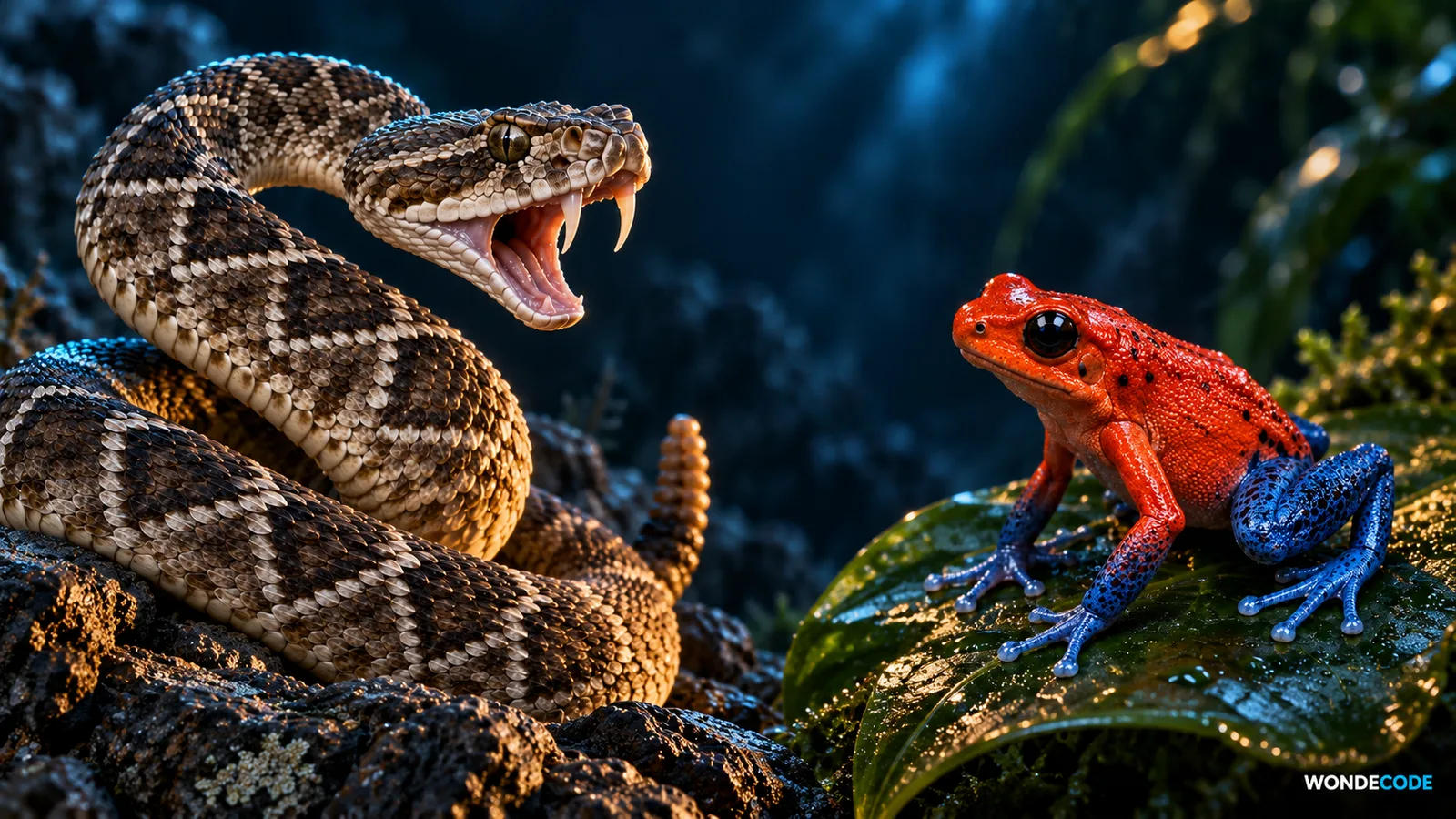
A snake bites. A poison frog doesn’t have to.
That is the whole difference between venom and poison — and it is not about which chemical is deadlier. It is about the route the chemical takes to reach you. Venom has to get inside through a wound. Poison does not need one at all: it can be absorbed through skin, inhaled, or swallowed.
The rule of thumb: wound, or no wound
Ronald Jenner, a venom-evolution researcher at the Natural History Museum in London, offers the version people remember: “If you bite it and you die it’s poison, but if it bites you and you die, that’s venom.”
It is a working rule rather than a law of nature, but it captures the practical split. Venom arrives through fangs, stingers, spines or claws — something that breaks the skin. Poison arrives without a wound.
Jenner’s functional explanation is about size. Poison molecules tend to be small enough to slip across skin. Venom proteins and peptides are usually too large to be absorbed, so they have to be injected. Treat that as a strong tendency rather than a strict law: the exceptions are some of the most interesting animals alive.
Venom: built to be injected
A snake is the classic delivery machine. Venom is stored in glands and pushed under pressure through a channel inside the fang, with its only opening at the tip. The fang works like a sealed hypodermic needle.
That design does more than make a bite efficient. It also helps explain why snakes are not usually harmed by their own secretion: the toxin travels outward, under control, instead of leaking back into the snake’s own tissues.
Poison: carried on the outside
The poison frog runs the same logic in reverse. Its toxins sit in glands in its skin, ready to be transferred on contact or swallowed by whatever grabs it. Dendrobatid frogs are described as “heteroglandular–poisonous”: the glands store, and the delivery is passive.
No bite. No wound. That is the entire point.
The frog’s weapon is borrowed
Here is the twist that makes the frog stranger than the snake: it generally does not manufacture its own toxin. It collects it from what it eats — ants, mites and other small arthropods — and keeps it in its skin.
The evidence is direct. Captive-raised Phyllobates frogs are toxin-free, and arroyo poison frogs acquire pumiliotoxins from their arthropod diet. The frog’s defence is contingent, not innate. It depends on the menu.
A poison frog raised in a laboratory, in other words, is not chemically a poison frog at all. Its armour is something it ate.
A like-for-like comparison
| Question | Venom (for example, a snake) | Poison (for example, a poison frog) |
|---|---|---|
| Where the chemical is stored | Glands connected to a fang | Skin glands |
| How it reaches you | Injected through a wound | Contact, inhalation or swallowing |
| Does it need a wound? | Yes | No |
| Where the animal gets it | Made by the animal itself | Usually taken from its diet |
| The practical rule | Do not get bitten | Do not handle it, and keep your hands away from your face |
Where the labels get messy
The two categories are not mutually exclusive, and nature keeps blurring them. Researchers sometimes separate the field into three: poisons that act on contact, toxungens that are smeared or sprayed onto the outside of a body, and venoms that are injected. It is a useful map, not a set of rigid boxes.
The Asian tiger keelback delivers a venomous bite and also secretes dietary toad toxins from glands in its neck — and it can pass those toxins on to its offspring. It is venomous and poisonous at the same time.
The spitting cobra blurs the line differently. It sprays venom, and if that spray reaches an eye the toxin is absorbed rather than injected. The same animal, releasing the same substance, behaving like poison.
Size is a tendency, not a law either. Tetrodotoxin, the pufferfish toxin, is a small molecule, yet it turns up in animals whose bite is what puts it into the body. The chemistry does not dictate the delivery route.
What to remember
The difference between venom and poison is not how dangerous the chemical is. It is how it gets in — and that route shapes everything else: where the animal stores its defence, how it uses it, and what you should do about it.
For the snake, the aim is distance, so the fangs never reach you. For the frog, the aim is your hands, so the toxin never reaches your skin. The advice sounds similar on the surface, but the biology behind it is entirely different.
Sources
- Natural History Museum. Bite or be bitten: What is the difference between poison and venom? https://www.nhm.ac.uk/discover/bite-or-be-bitten.html
- Daly, J. W. et al. Formicine ants: An arthropod source for the pumiliotoxin alkaloids of dendrobatid poison frogs. PNAS, 2004. https://www.pnas.org/doi/abs/10.1073/pnas.0402365101
- Daly, J. W. An uptake system for dietary alkaloids in poison frogs (Dendrobatidae). Toxicon, 1994. https://pubmed.ncbi.nlm.nih.gov/7940573/
- National Park Service, Cabrillo National Monument. Venomous versus poisonous. Same thing, right? Wrong! https://www.nps.gov/cabr/blogs/venomous-versus-poisonous-same-thing-right-wrong-1.htm
- Washington State University, Ask Dr. Universe. How are animals not affected by their own poison? https://askdruniverse.wsu.edu/2023/01/19/7024/
Sources accessed 13 October 2026.