
A grain of pollen floating in water may seem impossibly far removed from the first moments after the Big Bang. One belongs in a school microscope. The other involves matter so hot that protons and neutrons had not yet settled into their familiar forms. Yet a connection between them has helped physicists discover something strange about how particles move through the most extreme fluid they can study.
In 1905, Albert Einstein explained why tiny particles suspended in liquid appear to jiggle at random. In November 2026, two theorists reported that a familiar mathematical picture of those random nudges misses an important feature when a heavy quark moves close to the speed of light through a hot plasma. Rare, powerful kicks do not follow the simple pattern physicists often use to describe everyday Brownian motion.
The finding, published on November 5 in Physical Review Letters, is a theoretical calculation. It is not the announcement of a newly observed particle, nor proof that Einstein was wrong about pollen. Its significance is subtler: it suggests a new way to read the invisible workings of quark–gluon plasma by watching how a heavy particle would move within it.
Why the early universe can be called a fluid
Ordinary matter is mostly made of atoms, with protons and neutrons packed inside their nuclei. Quarks are constituents of those nuclear particles, held together by interactions involving gluons. Heat matter enough, under suitable extreme conditions, and quarks and gluons can become part of a short-lived collective state called quark–gluon plasma.
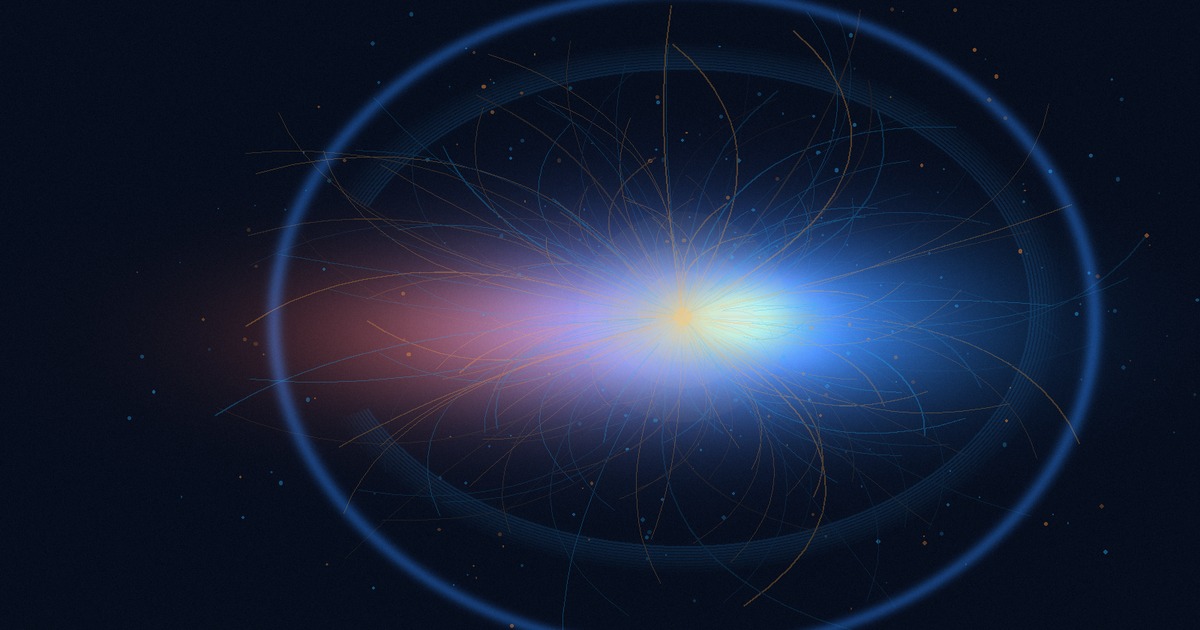
The early universe is thought to have passed through such a state in its first microseconds. Physicists recreate tiny droplets of related plasma by colliding heavy atomic nuclei at enormous energies. These droplets are much too brief and small to be oceans of anything, yet their collective behavior can resemble that of a liquid, not simply a cloud of independent particles.
This distinction is why the word fluid matters. A fluid’s large-scale motion can hide extremely complicated interactions between its constituents. If we could drop an appropriately chosen probe into it, the probe’s motion might tell us something about what we cannot see directly.
A lesson from a particle of pollen
Imagine a speck suspended in otherwise still water. It drifts a little to the left, a little to the right, perhaps pauses and moves again. The water is not truly motionless at microscopic scale. Molecules around the speck continually collide with it, producing numerous small, unpredictable pushes.
Einstein’s mathematical account of this Brownian motion connected two effects: the drag that slows a moving particle and the fluctuations that push it around. In many familiar situations, a broad collection of small, independent nudges produces something like a bell-shaped probability curve. Most changes are modest, while extremely large ones are unusually rare.
That picture is immensely useful. It is not, however, a universal promise that every particle moving through every fluid must receive perfectly symmetric, bell-shaped kicks—especially not when that particle is travelling at relativistic speeds and interacting through the strong nuclear force.
The hidden information in an unlikely shove
Researchers Jean F. Du Plessis of MIT and Bruno Scheihing-Hitschfeld of UC Santa Barbara calculated the momentum changes of a relativistic heavy quark in a weakly interacting plasma of quarks and gluons. Their approach combines contributions from different momentum scales rather than assuming a simple cloud of small nudges tells the entire story.
For small changes, the familiar approximation still has its uses. But the new calculation predicts non-Gaussian tails: large changes occur in a pattern that differs from the ordinary bell curve. Just as importantly, the two sides of the distribution are unequal. A rare strong event that slows the heavy quark is not simply the mirror image of one that makes it speed up.
That asymmetry is a scientific clue. It means the probability of a particularly forceful change depends on the deeper structure of the interactions, not only on a single average measure of friction or diffusion. The research paper’s abstract describes asymmetric exponential tails and explains why these matter for how a particle ultimately approaches equilibrium with its surroundings.
Think of listening to rain on a window. An average volume tells you something about the shower. But if you can distinguish the occasional exceptionally heavy impact from thousands of small taps, you can learn something that the average alone conceals. In the quark problem, the rare events are not literally raindrops; they are mathematical signatures of momentum transfer through the strong interaction.
Why two very different plasmas give a similar clue
The team began with a weakly coupled calculation because it offered a tractable way to analyze the interactions. But they also compared its mathematical structure with earlier work on a strongly coupled, theoretically different plasma. A similar asymmetric pattern appeared there too.
That parallel is intriguing. It suggests that the shape of these rare momentum changes may be more robust than one would expect from any single simplified model. The researchers argue that physical quark–gluon plasma may show the same feature, although connecting the theory to experimental measurements will require further work.
We should be precise about what universal means here. It does not mean the team has measured every plasma or demonstrated an identical response across all conditions. It means a particular mathematical signature persists across the cases they analyzed, making it a promising direction for broader tests.
What particle colliders could look for
Heavy-ion experiments already investigate how energetic probes lose energy and change direction while interacting with a plasma droplet. The new framework suggests that paying closer attention to rare, large momentum changes could provide additional information about the material’s microscopic behavior.
This will not be straightforward. An experiment detects particle products and correlations, not a slow-motion video of an individual quark being tapped by invisible neighbors. Researchers must infer what happened from complex signals while accounting for the plasma’s short lifetime and the processes that take place before particles reach a detector.
The next scientific task is therefore to connect these probability distributions to observables that detectors can distinguish, then ask whether the data support the predicted asymmetry. That is more demanding than drawing an elegant curve, but it is how a theoretical possibility becomes an experimentally useful tool.
Einstein still belongs in the story
There is a temptation to present discoveries like this as a contest between an old genius and a new generation. That misses the point. Einstein’s insight revealed how the motion of a visible particle could expose invisible activity in a fluid. The new work follows that same investigative logic while examining a regime where simpler approximations no longer contain all the information.
The remarkable connection is that the universe’s earliest fluid may be interrogated through the unusual movements of a single kind of particle, just as a grain of pollen once revealed a hidden molecular world.
Sometimes the most important event is not the average bump. It is the rare shove that an old equation taught us to ignore.
Sources
- Du Plessis, J. F., and Scheihing-Hitschfeld, B. (2026). Heavy Quark Transport Is Non-Gaussian beyond Leading Logarithm. Physical Review Letters, 137, 192302. Published November 5, 2026. Primary theoretical research.
- MIT News (November 5, 2026). Pinning down the structure of quark-gluon plasma, the universe’s first fluid. Researcher explanations and context.
- American Physical Society. Journal abstract and publication record. Terminology and limitations of the calculation.