
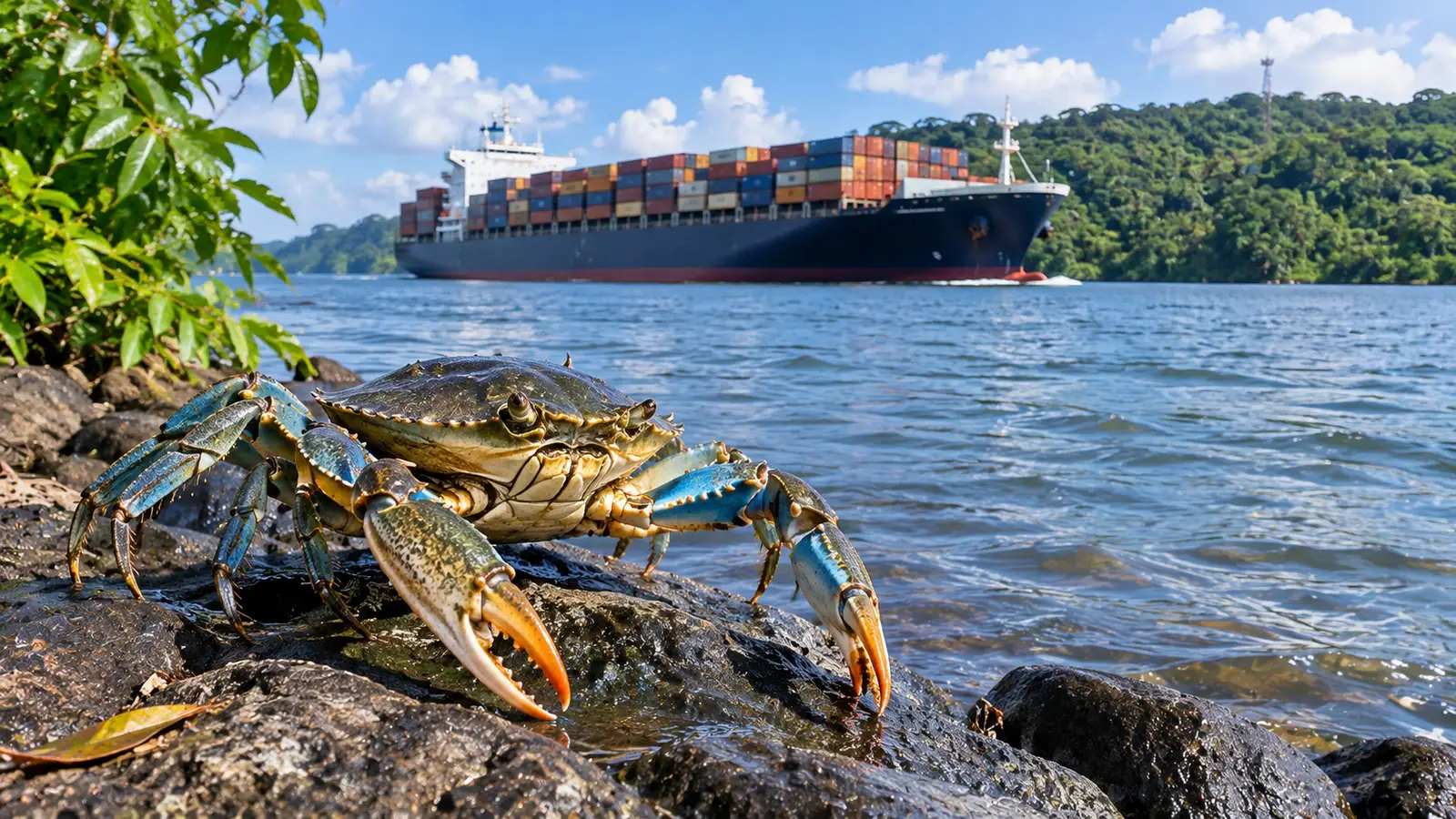
A container ship slides past Panama’s tropical forest on water that looks, at first glance, like an ordinary lake. Beneath its hull, however, a quieter kind of traffic is underway. Fish associated with the sea are increasingly appearing in a reservoir that was built to be freshwater.
That matters because Lake Gatun is not simply another stop along a shipping route. For more than a century, it has helped separate the marine ecosystems of the Atlantic and Pacific. Now scientists are documenting changes that could make that biological divide less effective.
A November 9, 2026, interview published by Smithsonian Magazine brings new attention to the work of the Smithsonian Tropical Research Institute (STRI). The clearest numerical evidence comes from a peer-reviewed study published in Current Biology in 2025: at comparable sampling locations in Lake Gatun, the share of fish biomass made up of marine species rose from about 26% before the canal’s 2016 expansion to 76% afterward.
It is a striking change. But it is also a story with an important scientific distinction: researchers have documented a transformation in fish communities, not proved that a continuous passage for ocean species has already formed between the two seas.
A freshwater barrier between two oceans
The Panama Canal is famous for letting ships avoid a lengthy journey around South America. What is easy to miss is how it does that. Unlike a sea-level channel, the canal lifts ships through locks into Lake Gatun, a large artificial reservoir formed by damming the Chagres River, before lowering them toward the opposite coast.
The lake sits roughly 26 meters above sea level. Its mostly freshwater environment has historically acted as a soft biological barrier: ships can cross, but many saltwater animals cannot easily survive a journey through the lake.
For a fish adapted to marine water, moving from the Caribbean Sea into a freshwater lake is not the equivalent of swimming along an uninterrupted ocean corridor. It involves changes in salinity that can be physiologically demanding, even lethal. That helps explain why the canal did not automatically become a superhighway for marine invasions when it opened in 1914.
The barrier is not perfect, however. Some fish tolerate both saltwater and freshwater, a capacity biologists call euryhalinity. Crabs and other marine-associated organisms can also tolerate brackish conditions. And shipping introduces animals in ways that have nothing to do with swimming.
The fish numbers tell a surprising story
Researchers compared standardized fish surveys collected before the canal expansion, in 2013–2016, with surveys from 2019–2023. By returning to comparable locations and using quantitative methods, they could examine how the catches had changed.
In the pre-expansion sampling, fish biomass was dominated by non-native freshwater species such as peacock bass and Nile tilapia. These accounted for about 57% of the sampled biomass. Marine species made up 26%, and native freshwater fish approximately 17%.
In the comparable post-expansion samples, the balance was different:
- 76% of sampled fish biomass was marine species.
- 13% came from introduced freshwater species.
- 11% came from native freshwater species.
The researchers also surveyed additional lake locations in the later period. Across that broader post-expansion sample, marine fish represented about 74% of biomass.
These are measurements of the weight of fish captured in scientific sampling, not percentages of all fish living in the entire lake, and not measurements of salt concentration. That distinction prevents a tempting but misleading headline: the lake itself has not suddenly become 76% seawater.
The paper identifies southern ladyfish among the important marine species behind the change, and notes an increase in large-bodied marine predators. That could matter for food webs, because predators can alter the populations of smaller fish and other aquatic organisms.
How do ocean animals enter a mostly freshwater canal?
There are at least two different pathways, and they should not be confused.
The first is movement through connected waters. Organisms that tolerate changing salt levels may travel through the locks and into portions of Lake Gatun. In the Smithsonian interview, STRI chief scientist and marine ecologist Mark Torchin says researchers have found some areas of the canal becoming slightly more saline. Pockets with higher salinity can favor animals already comfortable in brackish environments.
The reason for the change is not yet settled. Larger locks, different ship traffic and water-saving systems have all been discussed as possible contributing factors. Torchin explicitly cautions that these explanations are difficult to test. A before-and-after comparison is strong evidence of a changing ecosystem, but it does not by itself prove which aspect of the canal’s expansion caused the shift.
The second pathway is shipping itself. Ships take on ballast water for stability. That water can carry larvae, plankton and sometimes small animals from one coastal environment to another. Other organisms attach to ship hulls or gather in the communities growing on them. Barnacles, mussels and sea squirts can become unwitting passengers; small crabs and fish may shelter among them.
That means species can arrive by being transported, by dispersing on their own, or through some combination of both. Researchers need to distinguish the arrival of a species from its successful establishment and spread.
A blue crab, a bull shark and a changing cast of characters
In the November 9 interview, Torchin describes a canal ecosystem that includes crocodiles, caimans, manatees and Atlantic tarpon, alongside marine crabs, snappers and other fishes. His team has been watching the Maryland blue crab, Callinectes sapidus, appear farther into areas associated with higher salinity. He also mentions a recent report of a bull shark in the canal.
These observations are intriguing, but each comes with its own context. The blue crab’s native range extends into the tropics; a sighting in a particular stretch of canal is not automatically evidence that the species is new to Panama. And a single notable shark record does not establish a resident breeding population.
The broader scientific question is how species that evolved in different ecological communities behave when the canal brings them into new contact. Some arrivals may struggle. Others may exploit new food sources or compete with animals already present.
Even introduced species that appear rare today could become more important if environmental conditions change.
Could a species cross all the way into the other ocean?
That is the question researchers are watching most closely.
The Atlantic and Pacific marine ecosystems on either side of Panama have been separated by land for millions of years. The canal reconnects them for ships, but not equally for every organism. If more marine species can enter and survive within Lake Gatun, the odds of eventual interoceanic introductions could increase.
The 2025 Current Biology study found that some of the fish entering the canal came from the Atlantic and others from the Pacific. In the broader post-expansion dataset, the researchers identified 18 marine fish species entering from the Atlantic and five from the Pacific. That geographic mix makes the canal particularly interesting to invasion biologists.
Still, finding a Pacific-origin fish in the canal is not the same as documenting it establishing a population in the Caribbean—or vice versa. The risk is real enough to study, but a confirmed cross-ocean invasion is a higher evidentiary bar.
Why worry? Because a newly established predator or competitor can reshape the local food web. Its effects may extend to fisheries, smaller fish, bottom-dwelling organisms and the ecological relationships that keep an environment functioning. The outcomes are not predetermined; scientists want long-term observations rather than worst-case predictions presented as facts.
The same water supports ships, wildlife—and people
Lake Gatun has a second importance that makes the story more than a biodiversity curiosity. The canal’s reservoirs are also part of Panama’s freshwater supply. The Smithsonian reports that these water sources serve roughly half the country’s population.
During dry periods, low lake levels can restrict vessel operations and affect water availability. Changes to the surrounding watershed—forest cover, agriculture, soil conditions and rainfall—also influence water quality and how water reaches the lake.
STRI’s Agua Salud research program studies how land-use choices affect water flow and ecosystem services. That is a reminder that the canal is not a closed laboratory. Shipping, drinking water, tropical forests and freshwater wildlife are all connected through the same system.
A strategy that improves navigation could have ecological consequences; a strategy that restores forests could help protect water quality. Those trade-offs need evidence, not a simple assumption that every new marine species is harmful or every engineering change is responsible.
What happens next?
The most useful next steps are continued fish surveys, measurements of salinity at specific locations, and tracking which introduced species survive and reproduce. Scientists also want to understand whether predators and other members of the existing ecosystem limit the success of new arrivals.
The story is therefore both a warning and an opportunity. The canal’s changing fish community is evidence that human infrastructure can transform ecosystems in unexpected ways. But because researchers are observing the transition in real time, they can test mechanisms and advise on how to reduce future risks.
The Wondecode takeaway: The Panama Canal does more than move cargo between oceans. It is quietly changing which animals can occupy the waters in between. The astonishing part is not that a crab can turn up near a giant ship; it is that a reservoir once acting as a biological filter may be becoming easier for marine fish to enter. Whether that leads to lasting cross-ocean invasions is still an open scientific question—and exactly why the canal is worth watching.
Sources
- Smithsonian Magazine (November 9, 2026). The Panama Canal Has an Unusual Ecosystem … New Intruders Pose a Growing Threat. Interview with STRI chief scientist Mark Torchin about salinity, species movement and current research.
- Castellanos-Galindo et al., Current Biology (2025). New fish migrations into the Panama Canal increase likelihood of interoceanic invasions in the Americas. Peer-reviewed before-and-after fish community study.
- North Carolina Sea Grant (March 27, 2026). Where Oceans Connect. Accessible summary of the fish-survey results and ecological implications.
- Smithsonian Tropical Research Institute. Invasion Biology. Research background on biological introductions in Panama.
- Smithsonian Ocean. Researching Invasive Species Near the Panama Canal. Explanation of ballast water and hull fouling as transport pathways.