
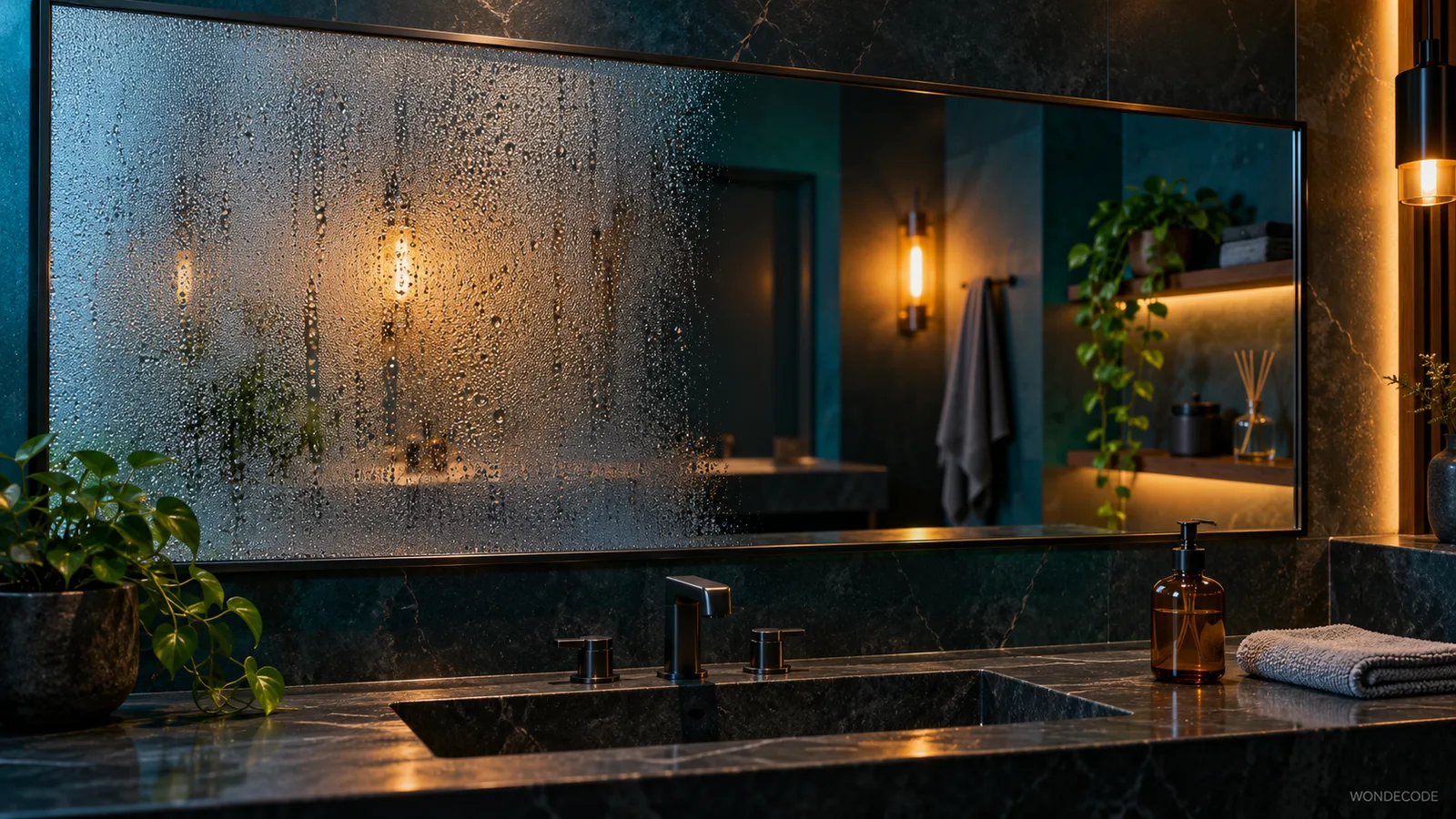
The useful part of this trick is easy to miss: the aim is a film thin enough that the mirror already looks clear before the shower. A visible smear of soap creates its own problem.
What makes the mirror foggy?
Warm, humid bathroom air reaches a cooler mirror, and water vapor condenses into liquid on its surface. Many tiny droplets appear. Their curved surfaces redirect light in different directions, disrupting the image you expect to see in the glass. MIT describes this scattering as the reason condensed droplets make glass look foggy. MIT News: Anti-fog research
That is why a mirror can seem to disappear even though the glass and reflective backing are still there. A layer of droplets is interfering with the light traveling to and from your reflection.
What does soap change?
Soap contains surface-active molecules, or surfactants. They change the way water behaves at a surface, helping it spread rather than remain as separate beads. McGill University’s Office for Science and Society explains that lowering surface tension allows condensed water to form a thin film, and specifically notes that a little soap rubbed onto glass can reduce fogging. McGill University
Water can still be present on the mirror. A smoother layer simply interacts with light differently from a surface covered in many small curved droplets.
How to try a small patch
Use an ordinary bathroom mirror and follow its care instructions, especially if it has a special finish or coating. Start before the shower, while the surface is clean and dry.
- Put a tiny amount of mild liquid soap onto a soft cloth.
- Spread it very thinly over a small test area.
- Buff gently with a clean, dry cloth until the glass looks clear.
- Check the appearance before treating more of the mirror.
This is a practical small-patch adaptation of the surfactant-film principle. A published kitchen-science demonstration by Dave Ansell uses diluted washing-up liquid on part of cold glass, lets it dry, and compares the treated and untreated areas when exposed to humid breath. The Naked Scientists: Stopping fogging
Why more soap can make the view worse
A thick or uneven residue can leave cloudy streaks. If you cannot see clearly through the treated patch before the shower, applying more soap is unlikely to improve that starting point.
Uniformity matters in anti-fog optics. MIT researchers explain that even a continuous water layer can distort an image when its thickness varies substantially. Their work concerns engineered coatings, while illustrating why clarity depends on the quality of the film as well as its presence. MIT News: Cutting through the fog
| What you see | What to check |
|---|---|
| Clear glass before the shower | The film is thin enough for the first test |
| Whitish smears before the shower | Reduce the residue and buff gently |
| Less fog on the treated patch | Compare it with the untreated area |
| No useful difference | Reassess the amount, coverage, and conditions |
Let half the mirror answer
For a simple comparison, leave one half untreated. View both halves during the same shower conditions, before wiping either side. Look at the clarity of a reflected edge, such as a towel rail or shelf, rather than judging only the brightness of the glass.
Treat this as a temporary household experiment. Soap formulations, the surface, and the amount left behind can affect the outcome. There is no fixed number of fog-free showers promised by this method.
The science gives you a useful prediction: a thin, even film may keep the reflection clearer by changing the shape of the condensed water. Your half-mirror test shows whether your application achieves it.
Which side stays clearer after your shower?