
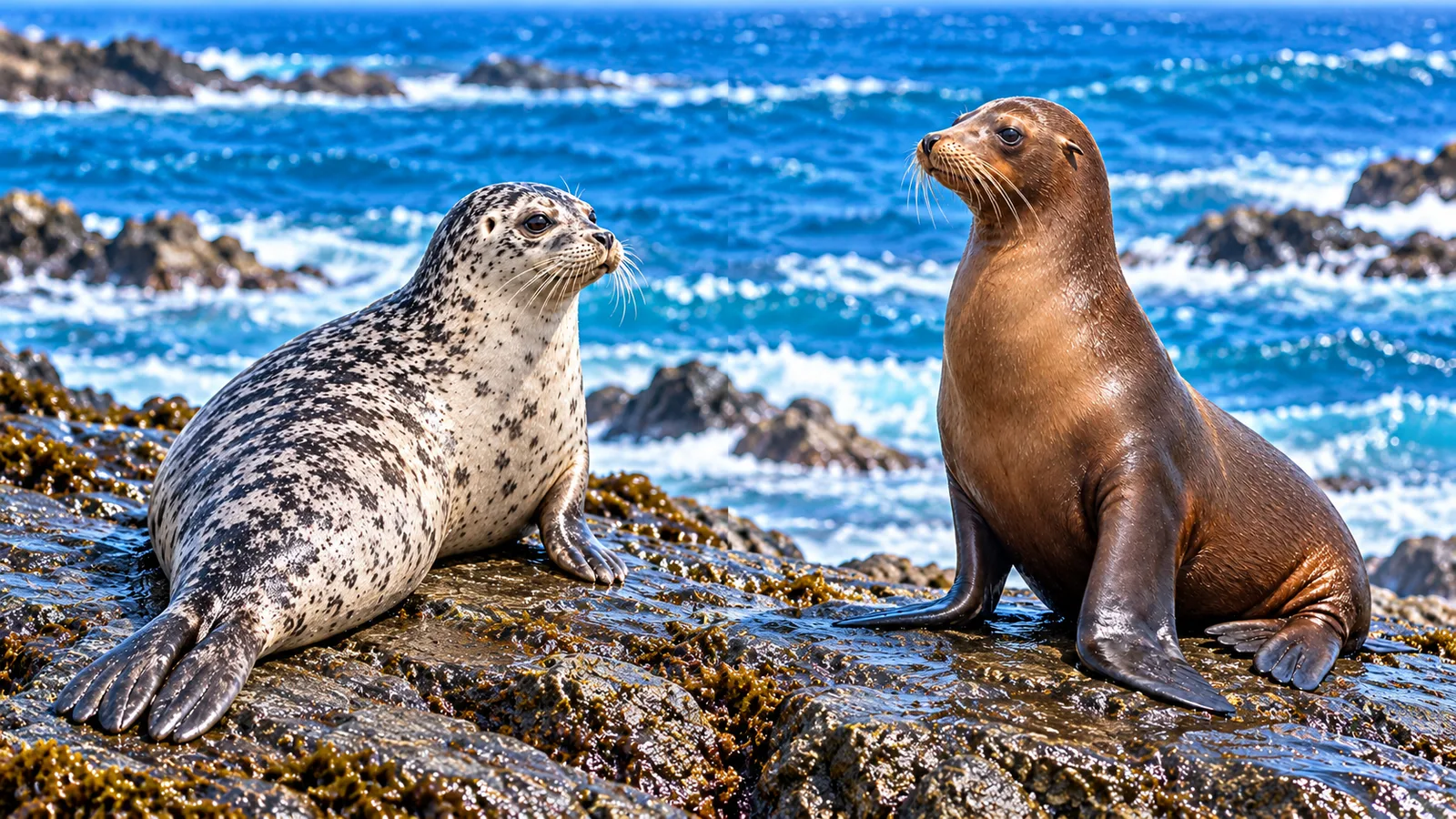
For a specific comparison, meet the harbor seal (Phoca vitulina) and the California sea lion (Zalophus californianus). They are both pinnipeds, a group of marine mammals that also includes walruses, but their equipment works differently on land and in the water. NOAA Fisheries
First, decide what “seal” means
Here, “seal” means a true seal, a member of the family Phocidae. Sea lions belong to Otariidae, the eared-seal family, which also includes fur seals. That naming overlap matters: not every animal with “seal” in its common name has the anatomy of a harbor seal.
The four clues below distinguish our harbor seal from our California sea lion. They are more dependable than simply comparing size, which varies with species, age, and sex. A fur seal would require another step in identification because it shares the external ear flaps of sea lions. NOAA Fisheries
1. Look behind the eye
The harbor seal has an ear opening but no external ear flap. The side of its rounded head looks smooth apart from the small opening. Calling true seals “earless” refers to that missing external flap; it does not mean they have no ears or cannot hear.
The California sea lion has a small visible flap behind the eye. You do not need a large, doglike ear to recognize the difference. A modest projection from the head is the useful feature. When the angle and distance allow a clear view, this can be the quickest clue. Smithsonian Ocean
2. Compare the front flippers
A harbor seal’s front flippers are relatively short, with fur and small claws. A California sea lion’s foreflippers are much longer, giving the animal a noticeably different outline when it props up its chest or extends a limb.
This is more than a difference in appearance. Those long sea-lion foreflippers are important swimming tools. The shorter front flippers of a true seal have a different role in its usual underwater movement. Look at the whole limb and its attachment rather than interpreting one oddly angled photograph as a different species. NOAA Fisheries
3. Watch what happens on land
A sea lion can rotate its hind flippers forward underneath its body. Combined with its front flippers, that lets it support itself and move on all fours. Its shoreward movement can look surprisingly like a walk.
A harbor seal cannot bring its hind flippers underneath itself in the same way. It moves on land using its body and front flippers, producing the familiar wriggling or shuffling motion. Oregon State University’s marine fisheries explanation connects this limitation directly to the seal’s hind-flipper arrangement. Oregon State University Extension
A less graceful appearance on a rock does not mean the seal is poorly adapted. The movement makes more sense once you see the animal in its swimming environment.
4. Underwater, find the main source of thrust
A harbor seal usually generates its main swimming thrust with its hind flippers and the motion of its rear body. Its front flippers mainly help with steering and maneuvering.
A California sea lion relies primarily on powerful strokes of its foreflippers. That sweeping action is why its swimming is sometimes compared with flying underwater. The comparison is a visual analogy: the animal is moving through water with flippers, not using wings. Both animals also steer and adjust posture; the distinction concerns their principal source of propulsion. NOAA Fisheries, Smithsonian Ocean
The comparison at a glance
| Clue | Harbor seal | California sea lion |
|---|---|---|
| External ear flap | Absent; small ear opening | Small visible flap |
| Front flippers | Shorter, fur-covered, with claws | Long, powerful foreflippers |
| Movement on land | Body wiggle or shuffle | Hind flippers rotate underneath for walking |
| Main swimming thrust | Hind flippers and rear-body movement | Foreflipper strokes |
NOAA’s species profiles provide useful context for the animals in this comparison: the harbor seal has a variable spotted coat, while the California sea lion has the recognizable eared-seal build. Coat color helps establish the example, but the anatomical clues do the identification work.
Next time a marine mammal lifts its head on a rock, begin with the ears. Then check the flippers. Two details can turn a vague resemblance into something you can actually recognize.
Sources
- NOAA Fisheries: Seals & Sea Lions.
- NOAA Fisheries: Is It a Seal or a Sea Lion?.
- NOAA Fisheries: Harbor Seal.
- NOAA Fisheries: California Sea Lion.
- Smithsonian Ocean: Pinnipeds: Seals, Sea Lions, and Walruses.
- Oregon State University Extension: How can you tell the difference between seals and sea lions?, revised June 2024.