
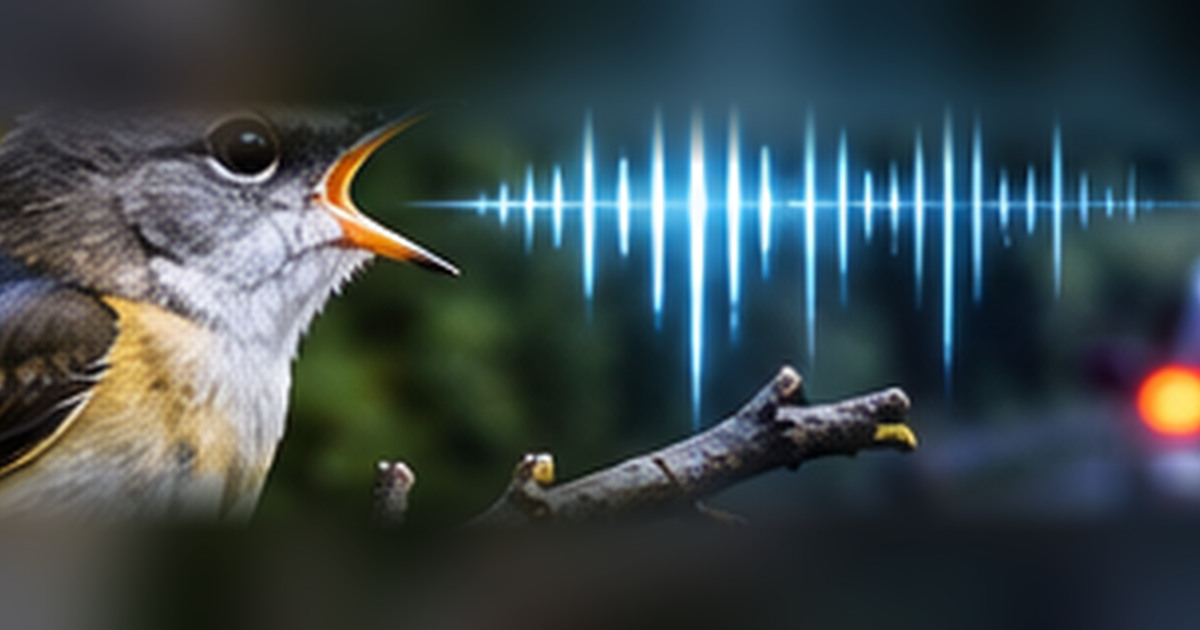
A sparrow can live beside a busy road. A fish can swim beneath a shipping route. An animal may appear perfectly ordinary in a landscape filled with engines, construction, aircraft and human voices. From a distance, we might assume it has simply learned to ignore the noise.
But hearing is not the only thing sound can change.
A large analysis published in Science on November 5, 2026, examined 214 experimental studies involving 177 aquatic and terrestrial species. The researchers found that human-made noise altered at least one measured physiological, developmental or behavioral trait in 80% of the species studied. Across the evidence, they also reported declines in measures of fitness and abundance and changes to predator–prey relationships.
The familiar story is that noise makes animals communicate differently. The more troubling possibility is that it can change how they grow, care for their young, respond to danger and survive.
The most important number needs a warning label
Eighty percent is an arresting figure. It is also easy to misunderstand.
The study does not say that 80% of every animal species on Earth is being harmed by noise. It says that, among the 177 species represented in the experimental evidence analyzed, 80% showed at least one measurable trait response under some noise-exposure conditions.
A change in behavior is not always the same thing as an injury, and one species can respond very differently from another. Some responses may help an animal cope with disturbance; others impose costs that are harder to see until later. A meta-analysis brings disparate experiments together to identify broad patterns, but it does not turn the studied sample into a census of the planet’s wildlife.
That nuance is central to the paper by Hansjoerg Kunc and Rouven Schmidt, titled Echoes of the Anthropocene: Noise pollution as a global threat. Their findings span both water and land, across species whose geographic ranges extend over six continents. The overall result is not that every animal suffers in the same way. It is that noise reaches into biological systems far beyond the ears.
When shelter stops being safe
Picture an animal startled by a predator. The obvious move is to hide: beneath vegetation, inside a crevice, under a ledge. Shelter usually reduces exposure to the outside world.
Sound complicates that calculation.
Noise can be reflected or amplified in enclosed spaces. A hiding place that protects an animal from being seen might expose it to a more intense sound environment. In some experiments summarized by the researchers, noise disrupted predator–prey interactions and pushed animals toward responses that could leave them more vulnerable.
This does not mean every burrow becomes an acoustic trap. It means that an animal’s response to danger depends on more than the presence of a predator. It depends on whether the animal can still detect and interpret what is happening around it—and whether its refuge remains a refuge when sound behaves differently inside.
An animal can be physically safe from a threat yet unable to receive the information it needs to make a good decision.
The effects can begin before adulthood
The Queen’s University Belfast summary of the research describes examples from studies included in the analysis that make the stakes concrete.
House sparrow chicks exposed to traffic noise showed weakened defenses against predators and markers associated with earlier biological ageing. In experiments involving Atlantic cod, noise exposure during early life was associated with slower growth and higher mortality among larvae. These are not merely examples of an animal becoming annoyed or singing at a different pitch: they involve development and survival.
It matters when exposure occurs. Early development is a period when bodies are building organs, regulating stress responses and allocating energy. A disturbance during that window may have consequences unlike the same disturbance in a healthy adult.
But findings from a controlled exposure cannot be translated automatically into a precise prediction for every bird living near a highway or every fish passing a vessel. Real habitats contain many overlapping pressures—temperature, food availability, pollution, predators and changing seasons. Understanding how sound combines with those pressures remains an important challenge.
Parenting under pressure
Among the less intuitive results is a pattern in parental care. Some animals responded to noise by increasing attention to their young; others reduced it.
At first, the contradiction seems to undermine the idea of a common threat. In fact, it may reveal why a single response is such a poor measure of wellbeing.
If a parent spends more time guarding its offspring, that might protect the young, but it could also reduce time spent feeding. If another parent retreats or provides less care, it may be conserving energy or reacting to perceived danger, even when that choice has costs. Different species have evolved different strategies. The same acoustic disturbance can produce opposite visible behaviors.
The question scientists need to ask is not merely Did the animal move or behave differently? It is What did the response accomplish, what did it cost, and what happened afterward?
Those are much harder answers to obtain than a recording of louder birdsong.
A disturbance you cannot always see
The analysis also reported changes in physiology and gene activity. Gene activity describes which biological instructions a cell is using and how strongly; it is not the same thing as a mutation to an organism’s DNA.
That difference is important. Saying ‘noise changes animal DNA’ would be an irresponsible way to summarize this research. The evidence concerns responses in how living systems regulate themselves under different conditions, not proof that traffic sound rewrites the genetic code of wild populations.
Physiological and developmental effects are particularly revealing because they can occur even when an animal has not obviously fled or stopped reproducing. A population may continue to occupy a noisy habitat while individual organisms pay costs that a casual observer cannot detect.
The study’s authors describe sound as a possible selection pressure: a factor that can favor some traits or individuals over others over time. That is a wider ecological hypothesis informed by the measured patterns, not direct proof that a particular species has already evolved in a specific direction because of modern traffic.
Water does not make the problem disappear
It is tempting to imagine the sea as a refuge from human noise. Sound, however, travels efficiently through water, and many marine organisms depend on acoustic information for communication, orientation, foraging or detecting threats.
A ship’s engine, coastal construction or another artificial sound source can therefore alter an environment that looks undisturbed from the surface. Different frequencies, distances, habitats and species create different levels of exposure, and marine sound cannot be assessed by simply applying the same rules used for road traffic.
The distinction between land and water is another reason to avoid turning one striking percentage into a universal rule. The researchers examined both, precisely because the biological pathways and exposure conditions differ.
Can we conserve silence?
Conservation policy typically begins with the visible landscape: protect the forest, maintain the wetland, restore the reef, connect fragmented habitats. Those actions matter enormously. Yet a protected place can still be crossed by aircraft noise, roadside traffic, machinery or vessel sound.
The authors argue for thinking about soundscapes as part of habitat quality. A quieter refuge might allow animals to hear predators, communicate, feed or care for their young with less disturbance. Depending on the setting, approaches could include rerouting particularly noisy activities, managing the timing of construction, reducing unnecessary engine noise or creating genuinely quieter zones.
These are potential management strategies, not interventions shown by this paper to work everywhere. Their effectiveness will depend on the species, the frequencies involved, the geography and how much noise reduction can actually be achieved.
There is a useful lesson here. A park can look green on a map and still be difficult to inhabit acoustically. Protecting an area is not automatically the same as protecting all the conditions that make it livable.
What the research cannot settle
The meta-analysis brings together a large and diverse set of experiments, but it inherits limits from those underlying studies. Noise levels and exposure durations differ. Many experiments run for relatively short periods, and effects demonstrated in a laboratory or playback experiment may play out differently across an animal’s lifetime in the wild.
Species are not equally represented in the available research. Studies that find conspicuous effects may be easier to publish or locate than those with little response. Long-term population consequences, adaptation and the benefits of specific noise-reduction policies require further field evidence.
None of those uncertainties makes the result trivial. They define the next questions worth asking—and keep us from replacing a careful scientific synthesis with a frightening slogan.
We have become accustomed to measuring our impact on nature in things we can see: cleared forests, polluted water, roads cutting through habitat. This study reminds us that another alteration is easy to overlook. A place can remain physically intact while its acoustic environment changes the lives taking place inside it.
Sources and research notes
- Kunc, H. P., & Schmidt, R. (2026). Echoes of the Anthropocene: Noise pollution as a global threat. Science 394, 660–664, published November 5, 2026. Primary meta-analysis of 214 experimental studies and 177 species.
- Queen’s University Belfast (November 5, 2026). Wildlife paying the price for noise pollution, Queen’s study finds. Institutional account with examples involving house sparrows, Atlantic cod, parental care and gene activity.
Statistical note: The 80% figure is the proportion of the studied species showing at least one trait change under experimental noise exposure. It is not a global estimate of species harmed or a uniform effect size. Biological responses range from potentially adaptive changes to documented fitness costs.