
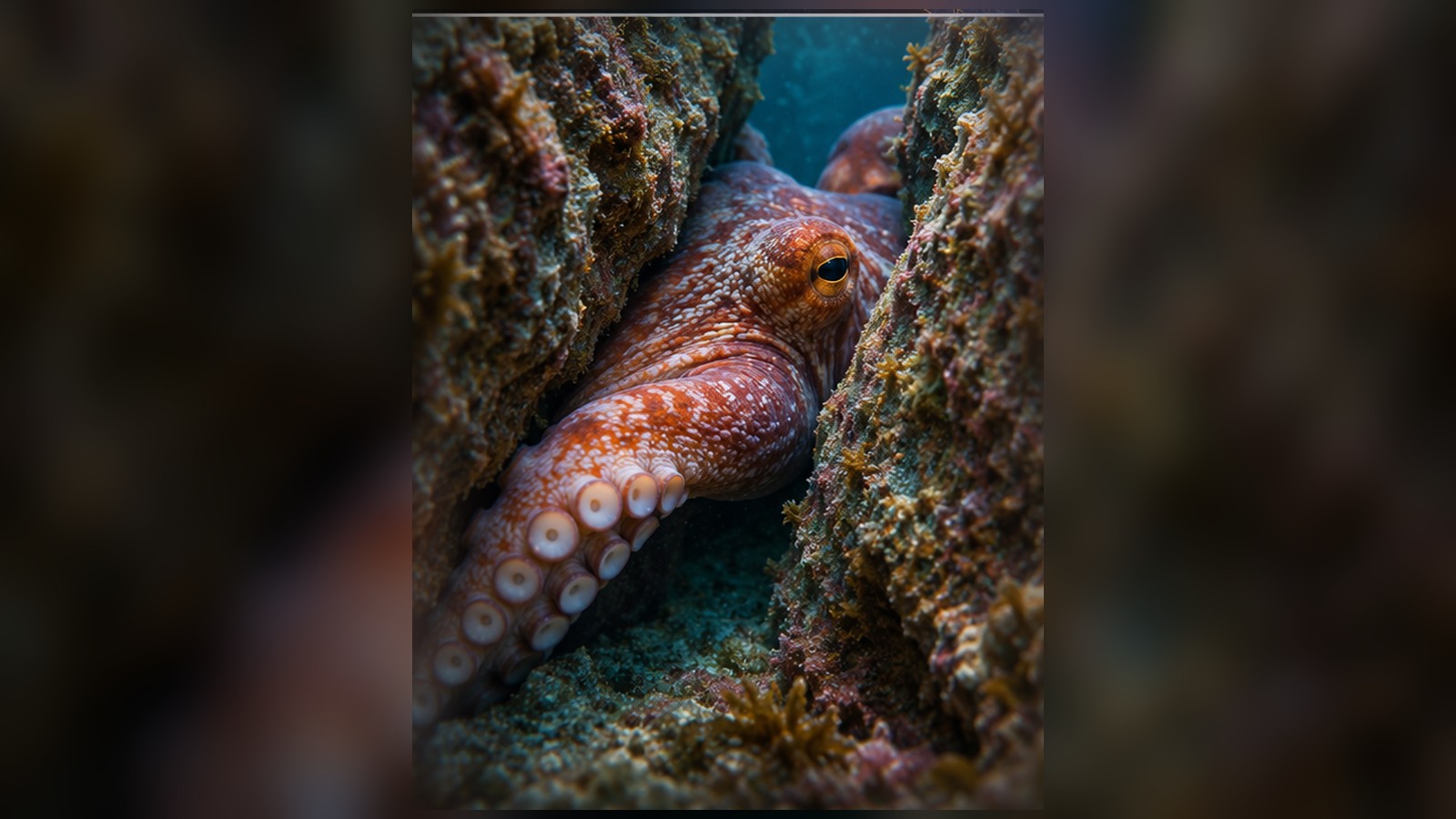
Imagine trying to pass through a doorway narrower than your shoulders. Humans have a limited set of options: turn sideways, squeeze a little, or find another route. An octopus approaches that problem with an entirely different body — and, it turns out, more than one escape plan.
In a study published on November 5, 2026, in the Journal of Experimental Biology, researchers documented how common octopuses move through openings that seem impossibly small. They found a repeatable sequence of three steps for a more generous opening and four steps for a tighter one.
That may sound like a tiny behavioral detail. It is more revealing than it first appears, because it shows how an animal with no rigid skeleton in most of its body reorganizes its movements when space runs out.
The myth of the octopus that fits through anything
Octopuses are famous for their ability to squeeze through gaps smaller than the apparent width of their heads. Their eight arms, flexible tissues and almost fluid changes in shape make the feat look effortless.
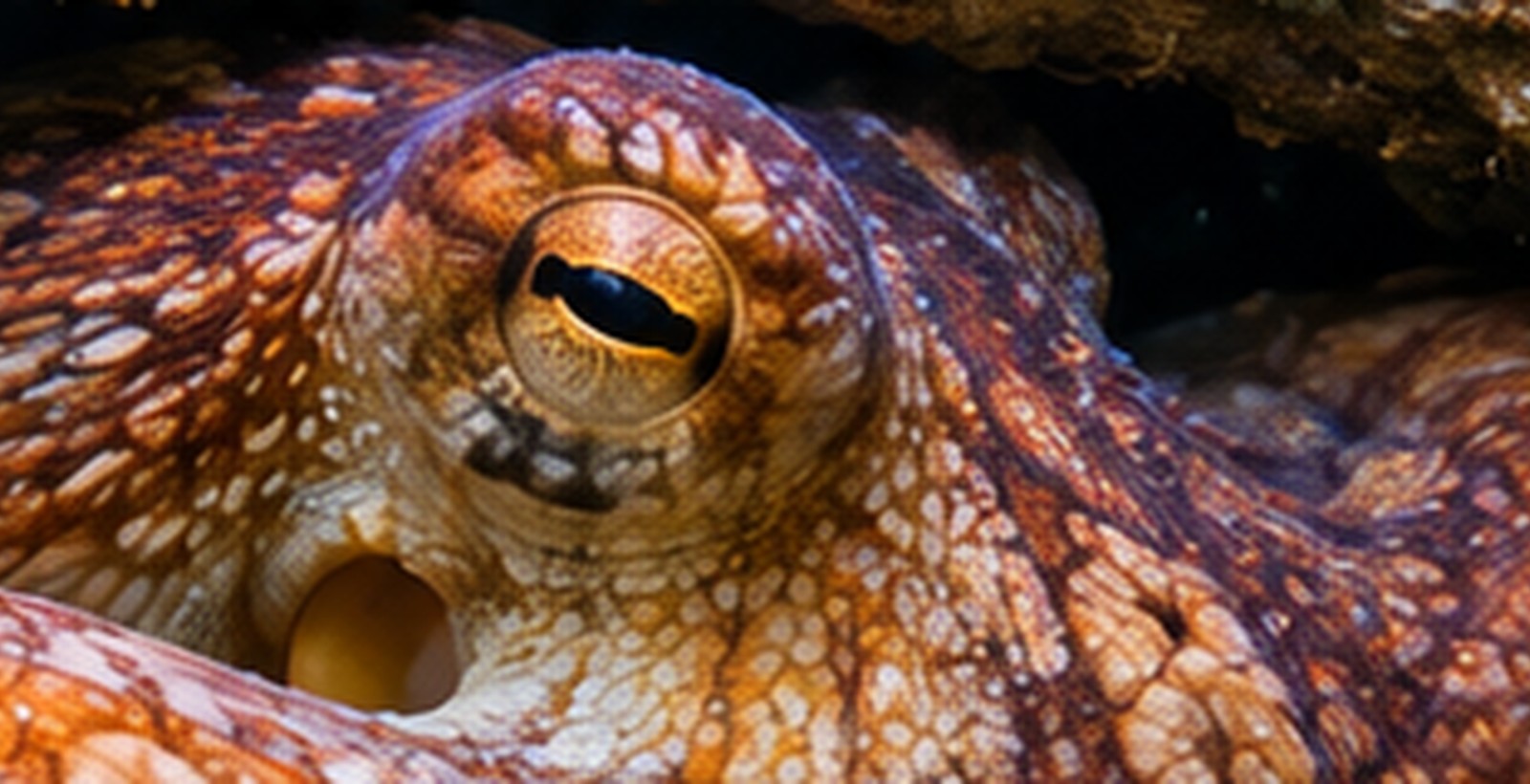
But the animal is not literally boneless in every part. It has a hard beak and relatively rigid structures associated with the brain and eyes. The shape of these parts, together with the arrangement of muscular arms, influences which openings are usable.
A popular rule of thumb says an octopus can fit through anything large enough for its beak. That claim is too simple. Whether an animal can pass depends on the opening, its anatomy and the behavior it uses, not just one hard body part.
To examine the process rather than rely on remarkable escape videos, a team led by Wenci Xin studied how octopuses negotiated holes of different widths.
Three movements for a larger opening
The team observed three common octopuses (Octopus vulgaris) and also studied four Mayan octopuses (Octopus maya) to examine differences between species.
For common octopuses, a hole relatively large compared with the spacing between the eyes tended to prompt a three-part sequence.
First came probing. One or more arms explored the opening and its surroundings, gathering information through movement and touch.
Second came shifting the arms. The octopus fed several arms through the opening, establishing contact with the other side.
Third came squeezing through. The arms already outside could grip the surface with their suckers, providing leverage as the animal moved the remaining arms, head and mantle through the gap.
What looks like an amorphous animal flowing through a hole is therefore an organized series of actions. Its body may be exceptionally flexible, but its behavior is anything but random.
A tighter opening requires a fourth step
When the opening became narrower, the common octopuses did not simply repeat the same movements with more force. The researchers saw them divide the final maneuver into two separate actions.
Instead of bringing the remaining arms and the mantle through together, the animals first repositioned or drew the remaining arms through, then compressed and pulled the mantle through afterward.
That extra movement turned a three-step strategy into a four-step one.
The finding is a reminder that solving a movement problem is not only about what the body can physically do. It is also about the order in which the animal uses that body. In a cramped space, moving two groups of body parts together may be less practical than moving them one after the other.
Not every octopus behaved the same way
The common octopuses were not the whole story. The study also examined Mayan octopuses, which generally did not attempt the narrower openings under the experimental conditions. Offered a choice, they tended to favor a larger route.
That contrast is important because it limits the headline-friendly idea that all octopuses use identical tricks. Their behavior may depend on the species, body proportions, experience and the environments to which they are adapted.
And this was a small experimental sample — three common octopuses and four Mayan octopuses, not a census of all octopus species. It provides a detailed observation of the movements studied, not a universal law of cephalopod escape behavior.
Researchers can now ask whether octopuses use similar sequences in narrow slits, angled tunnels or spaces with rough surfaces. A round opening in a controlled setting is only one kind of obstacle.
What do the suckers have to do with it?
An octopus arm is both a sensor and a tool. Its suckers can contact a surface while the arm changes shape and applies force, allowing the animal to test its surroundings and create purchase.
The arms that have already passed through an opening can therefore help move the rest of the body. They are not passive appendages waiting to be dragged through. They contribute to the mechanical work of the escape.
That is one reason the sequence matters. The animal can use an arm that is already on the far side to assist the parts of its body still on the near side.
In a conventional wheeled robot, the body cannot radically change shape. In a robot inspired by octopus movement, investigators hope coordinated soft components might make navigation through damaged structures and tight spaces more feasible.
The robot connection — promising, but not solved
The researchers suggest the findings could inspire soft robots for exploration and search-and-rescue work. Such machines might need to pass through rubble while carrying cameras, sensors or tools.
But an animal’s ability is not an off-the-shelf engineering solution. Designing a robot that can deform safely, produce enough force to move, maintain control, and protect delicate electronics remains difficult. A robot also has to function reliably in environments very different from an aquarium experiment.
The study supplies something more useful than a flashy promise of an ‘octopus robot’: a description of how body shape, environmental constraints and the sequence of movements interact. Those observations can help engineers formulate and test better designs.
The bigger question
Octopuses are often described as extraordinarily intelligent, and their flexibility is astonishing. Yet the most interesting finding here is not that an octopus can squeeze through an unlikely hole. That much was already familiar.
The discovery is that the animal adapts the choreography of its escape to the width of the gap. One extra step can be the difference between pushing through and having to reorganize the entire maneuver.
Sometimes the natural world’s most useful inventions are not new materials or extraordinary strength. They are surprisingly good instructions for doing familiar things in a different order.
Sources
- Journal of Experimental Biology — Xin et al., ‘Overcoming environmental constraints: octopus uses 3-step or 4-step strategies to squeeze through small holes’ (2026)
- The Company of Biologists — Research press release, November 5, 2026
- Science News — How octopuses squeeze through tiny openings, step by step