
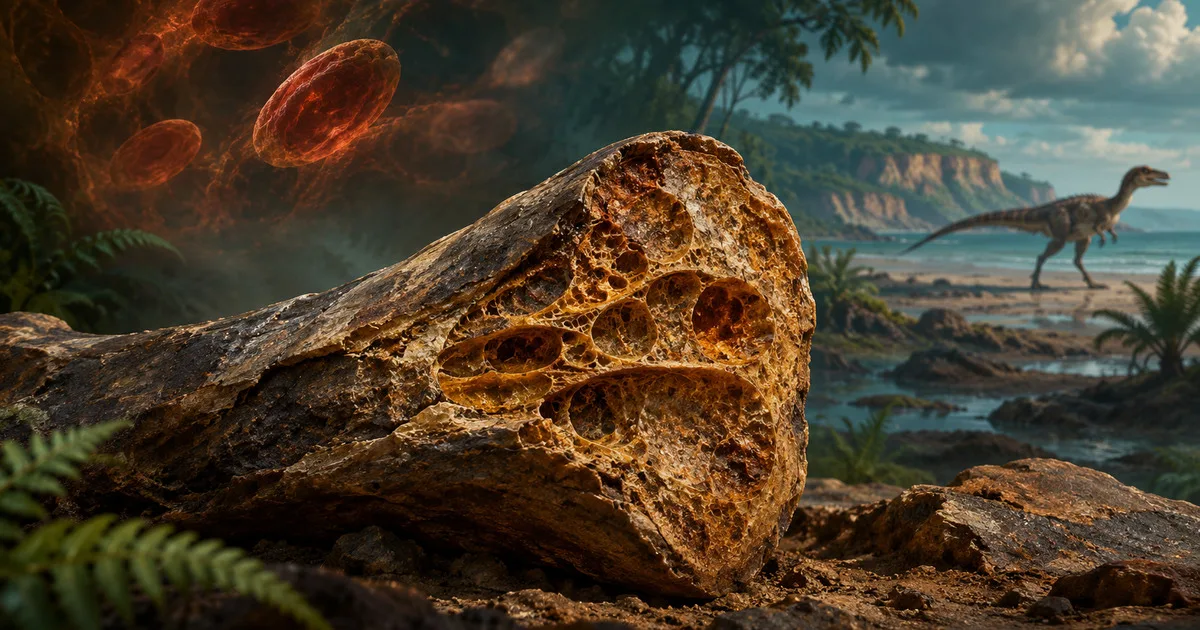
A dinosaur’s leg bone is not the place you would expect to find anything resembling blood. Bone can fossilize; blood normally breaks down, disappears or is replaced as an organism decays. Yet inside a 115-million-year-old fossil from Brazil, scientists report tiny structures in the very passages where blood vessels once ran—and chemical clues linked to heme, a molecule central to oxygen transport.
That does not mean researchers have recovered liquid dinosaur blood. It does not mean they have found a preserved sample of hemoglobin, much less DNA. The striking claim is subtler: some of the microscopic architecture and chemical traces associated with ancient blood may have survived burial, mineralization and more than a hundred million years of geological change.
The findings, published on November 2, 2026, in the Proceedings of the National Academy of Sciences (PNAS), concern a relatively little-known predator called Aratasaurus museunacionali. They also raise a difficult question: how can we tell an authentic biological trace from a mineral or microbial lookalike? The original study offers several converging lines of evidence. Not every independent specialist is convinced that all of them point to fossilized red blood cells.
A surprising discovery in an ordinary-looking leg bone
Aratasaurus museunacionali lived in what is now northeastern Brazil during the Early Cretaceous, approximately 115 million years ago. The fossil was recovered in 2008 from deposits of the Romualdo Formation in Ceará. It represents part of the animal’s right hind limb rather than a complete skeleton.
When paleontologists formally described the species in 2020, they estimated that the juvenile dinosaur measured around 3.1 meters (10 feet) long. Growth marks in its bones suggested at least four growth cycles. It belonged to the coelurosaurs, a broad branch of theropod dinosaurs that also includes the lineage from which birds evolved.
Years later, an international team led by geochemist Kliti Grice of Curtin University examined bone material using a combination of microscopic imaging, mineral analysis and molecular chemistry. What caught their attention was not the outside of the fossil, but its interior.
Bones are living organs in an animal. They contain blood vessels, which deliver oxygen and nutrients to growing tissue. Those vessels travel through small channels in the bone. In the Aratasaurus specimen, some of these vascular canals contain numerous oval or rounded microscopic objects.
Their location matters. Structures inside former blood-vessel channels are more suggestive of blood-cell remnants than similar shapes scattered randomly in surrounding rock. But position alone cannot establish identity: microbes and minerals can also occupy pores and cavities after an animal dies.
The chemical clue: what is heme?
The study’s most consequential result is chemical rather than visual. The researchers detected heme-related molecular signatures in extracts from the fossil bone and associated iron-bearing chemical signals with the cell-like structures. They also compared those findings with the surrounding sediment.
In living vertebrates, heme is an iron-containing component of hemoglobin, the protein inside red blood cells that binds and transports oxygen. Heme has a ring-shaped molecular framework called a porphyrin; its chemistry is one reason scientists can search for ancient blood-derived material even when the original tissue has been profoundly altered.
This distinction is crucial: detecting heme-associated compounds is not the same as recovering intact hemoglobin. A protein is a large, complicated molecule assembled from amino acids. Chemical building blocks, altered fragments and signals characteristic of one part of that protein may outlast the protein itself.
According to the study, molecular measurements identified heme B and a substantially more abundant altered heme-related compound. Elemental analyses linked iron, carbon and nitrogen to the microscopic structures. The researchers also reported amino acids associated with collagen, another important biological component of bone. These findings strengthen the possibility that the fossil retains some information about its original biology, but the amino acids do not amount to an intact collagen protein or a readable genetic sequence.
There is another complication: heme is not exclusive to dinosaurs or red blood cells. Microorganisms also produce heme, and related porphyrin molecules occur in other biological pigments, including chlorophyll. The team therefore compared the fossil’s chemistry with the material surrounding it. The differences supported their interpretation that the heme-related material was associated with the bone, although they acknowledged that a microbial contribution cannot be ruled out completely.
It is the combination of where the structures appear, what they look like and which chemicals are present that makes the result interesting. None of those observations, considered alone, would settle the question.
How could a trace of blood survive 115 million years?
Fossilization is not a process that simply freezes a body in time. Soft tissues usually decay. Minerals can enter spaces once occupied by cells, and the original molecules may break apart, react with surrounding substances or disappear entirely.
The authors propose that the circumstances of the dinosaur’s burial helped preserve an unusually detailed record. The carcass may have been covered by microbial mats—thin, layered communities of microorganisms—in an environment with limited oxygen. Such conditions could have slowed or altered decomposition and promoted early mineral formation.
The cell-like objects were associated with hausmannite, a manganese oxide mineral with the formula Mn₃O₄. The team suggests that early mineralization may have stabilized or replicated delicate biological shapes before they were destroyed. Chemical reactions involving manganese minerals may also have influenced how organic traces changed over time.
Think of the difference between preserving a letter and preserving an impression of its handwriting. The original ink might be gone, but the pattern it left can remain. In the dinosaur bone, the possible equivalent would be a mineralized record of a cell’s shape accompanied by altered chemical traces—not a living cell waiting to be revived.
The burial-and-mineralization explanation is a scientific hypothesis supported by the fossil’s context. Researchers still need experiments and comparisons with other fossils to establish which processes did the most to preserve these particular structures.
Are they really red blood cells? Scientists disagree
This is the most important uncertainty in the story.
The study authors interpret the microscopic objects as mineralized red blood cells. Their case rests on the structures’ abundance and shape, their placement within vascular canals, and the chemical evidence associated with heme.
Other researchers agree the chemistry is intriguing without accepting every part of that interpretation. In an ABC Science report, University of Regina researcher Mauricio Barbi, who was not involved in the work, described the mineralized structures as consistent with red blood cells while emphasizing that their identity still requires interpretation.
Paleontologist Mary Schweitzer, known for her research on ancient tissues and molecules, offered a stronger objection. She considered the chemical evidence significant but questioned whether the objects genuinely match the form of dinosaur red blood cells. Unlike mature human red blood cells, those of living birds and reptiles retain a nucleus, often visible as a bulge. Some of the reported fossil structures appear comparatively small and lack that characteristic shape. Live Science’s reporting explains the morphological concern in detail.
The discrepancy does not automatically disprove the study. Burial and mineral replacement can distort tissues, and nobody has a living Aratasaurus blood sample for comparison. But it does mean the headline “scientists found dinosaur blood cells” is stronger than the evidence currently warrants without qualification.
A more accurate reading is this: the researchers have documented cell-like mineralized structures and heme-related chemical traces in a dinosaur bone. Their interpretation as fossilized red blood cells is plausible and carefully argued, but remains contested.
Does this mean dinosaur DNA could survive too?
No. The work provides no evidence of usable dinosaur DNA, and it does not recover intact blood that could be transferred, cultured or used to recreate the animal.
DNA, proteins, pigments and mineralized cell impressions are different kinds of evidence. They break down through different chemical pathways and are not interchangeable. The presence of a heme-related compound in a fossil cannot be used to infer the survival of chromosomes or a complete genome.
The researchers tested for ancient DNA without obtaining a positive result, according to ABC Science. This discovery therefore offers no realistic shortcut to a Jurassic Park scenario. Its scientific value lies in understanding ancient chemistry and the preservation of biological information, not in reviving extinct animals.
Why this discovery matters beyond one dinosaur
Most dinosaur studies rely on what can be reconstructed from hard parts: the form of bones, the mechanics of joints, the arrangement of teeth, traces left in footprints or information recorded in the rocks around a fossil.
Chemical traces offer a different kind of window. If reliably identified, they could help scientists investigate what molecules persisted during fossilization and how that persistence varies with burial conditions, mineral chemistry and geological age.
There have been earlier reports of blood- or protein-related material in dinosaur fossils. So this is not the first claim ever made about dinosaur soft tissues. Its significance is the attempt to bring microscopic location and multiple chemical tests together in a particularly old specimen.
The next steps are demanding. Researchers will need to test more fossils from different environments, compare them with surrounding sediments, rule out contamination and apply independent techniques that can distinguish original biological molecules from later arrivals. Replication by other laboratories will be especially valuable where the identification of fossil blood cells is disputed.
There is also an appealing possibility: some fossils already sitting in museum collections may hold chemical information nobody knew how to look for when they were excavated. New techniques could reveal that information without requiring a new dinosaur discovery in the field.
A fossil that asks more questions than it answers
The story of Aratasaurus is not that blood has remained fresh for 115 million years. It is that researchers may have found a mineral-and-molecule record of structures once associated with blood, preserved long after the original cells changed beyond recognition.
The heme-related chemistry is important. The cell identification is still under debate. Both statements can be true at once.
If future tests strengthen the interpretation, scientists may have a new way to investigate how traces of living tissue persist across deep time. If the cell shapes turn out to have another explanation, the chemical findings and the questions they raise will still be worth studying.
The extraordinary part is not that we can bring a dinosaur back to life. It is that a bone from a vanished world may still have a few molecular clues left to tell us how that world worked.
Sources
- Grice, K., et al. (2026). Heme signatures in mineralized red blood cells within vascular canals of a 115-million-year-old dinosaur bone. Proceedings of the National Academy of Sciences. Primary study; microscopy, chemical evidence and proposed preservation mechanism.
- Sayão, J. M., et al. (2020). The first theropod dinosaur (Coelurosauria, Theropoda) from the base of the Romualdo Formation (Albian), Araripe Basin, Northeast Brazil. Scientific Reports. Original fossil description, age estimate and anatomical context.
- Muñoz, A. (November 2026). Hallan restos de sangre fosilizada en un dinosaurio brasileño. Agencia SINC. Interviews with the study’s lead researcher and an independent paleontologist.
- de Kruijff, P. (November 3, 2026). Mineralised ‘red blood cells’ detected in 115-million-year-old dinosaur bone. ABC Science. Independent expert assessment and study-author interviews.
- Live Science (November 2, 2026). Traces of ancient blood found in 115 million-year-old dinosaur fossil, new study claims. Independent reporting and discussion of the competing interpretations.