
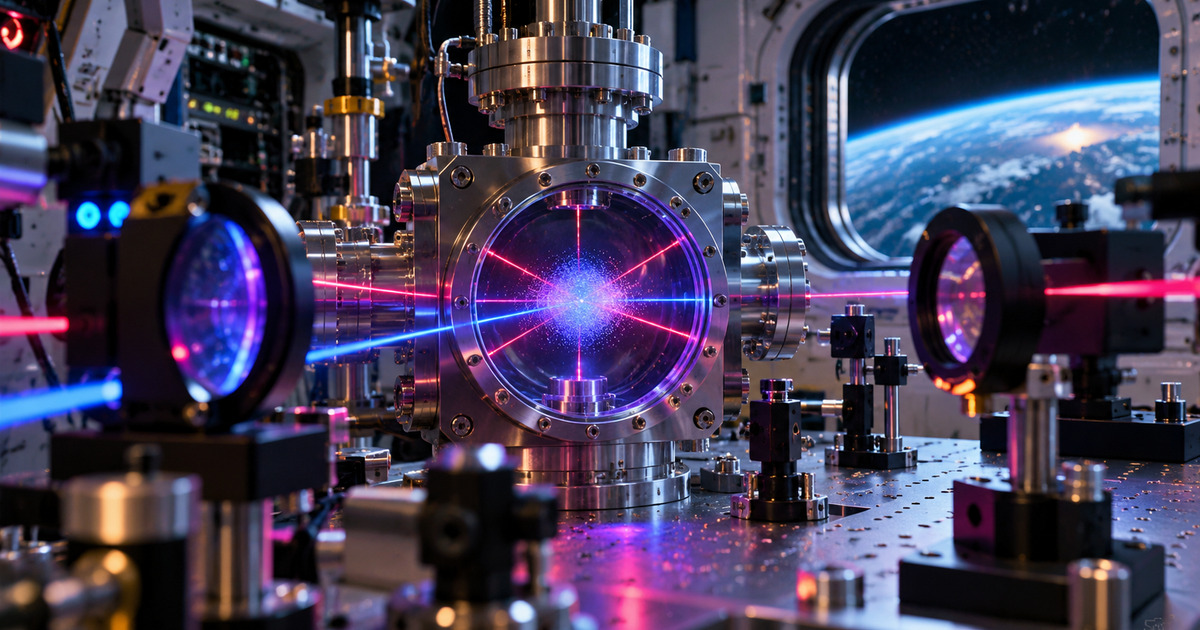
Imagine placing a cloud of atoms in a laboratory, releasing it, and waiting seven seconds to see what happens. On Earth, that sounds trivial. At the temperatures physicists are trying to reach, it is almost absurd: gravity would pull the cloud far below the equipment before the experiment was over.
So a team of researchers took their laboratory into orbit.
Working aboard China’s Tiangong space station, the scientists prepared a gas of about 20,000 rubidium atoms and measured an equivalent temperature of 9.7 picokelvin—9.7 trillionths of a kelvin above absolute zero. Their result, reported in Science on November 5, 2026 (November 6 in Beijing), undercuts a previous 38-picokelvin benchmark. But the temperature is only half the story. The cloud was allowed to expand for seven seconds, turning a fleeting quantum experiment into a remarkably long look at matter moving almost imperceptibly slowly.
The achievement is easier to appreciate once we ask a stranger question: What does it mean to measure the temperature of something that is barely moving at all?
A thermometer would be useless here
If you touched a hot pan, the pan’s atoms would be exchanging energy with your skin. In an everyday gas, temperature tells us about the typical kinetic energy associated with its particles’ random motion. Cooling that gas means reducing that motion—not making the atoms disappear, and not necessarily cooling every object nearby.
At a few trillionths of a kelvin, researchers do not simply insert a thermometer into a container. Instead, they prepare a tiny atomic cloud, switch off its confinement and observe how its distribution spreads. The slower the atoms drift apart, the lower the equivalent temperature inferred from their expansion.
That distinction matters. Headlines describing Tiangong as the ‘coldest place in the universe’ turn a specialized measurement into a misleading picture. The space station is not chilled to nearly absolute zero. Its walls, instruments and astronauts inhabit an entirely different thermal world. The record belongs to the motion of a carefully prepared quantum gas, not to the room around it.
The team reported the result in Quantum gases below 10 picokelvin in space, a peer-reviewed paper involving researchers at Peking University and the Chinese Academy of Sciences.
Why a cold gas needs a space station
On Earth, gravity is an invisible deadline. Release an atomic cloud and it falls. A freely falling object would travel roughly 240 metres in seven seconds under Earth’s surface gravity, far beyond the size of a typical laboratory vacuum chamber. Researchers can reproduce short periods of weightlessness in drop towers, but those runs end when the apparatus reaches the bottom.
Tiangong does not escape Earth’s gravity. Like other spacecraft in low Earth orbit, it and everything inside it are continuously falling around the planet. This shared free fall produces microgravity, allowing experiments that would otherwise be disrupted by the downward motion of the atoms.
The advantage is subtle. A gas held tightly in a trap can be easier to contain, but the confinement itself affects how far scientists can reduce its energy. Loosen the trap on Earth and gravity begins to win. In orbit, experimenters can use exceptionally weak confinement and give the particles more time to reveal their behavior.
The previous benchmark cited by the researchers was 38 picokelvin with two seconds of free expansion. Tiangong’s experiment extended that window to seven seconds. It did not merely repeat a brief measurement with a slightly smaller number: it established a different operating range for preparing and observing ultracold matter.
First, teach the atoms to act together
The researchers did not cool a familiar puff of air. They worked with rubidium atoms and created a Bose–Einstein condensate, a remarkable state in which many atoms occupy the same quantum state. Instead of behaving solely like a loose collection of separate particles, the ensemble shows collective wave-like properties.
To reach that regime, atoms must first be captured and cooled. In the Tiangong experiment, laser light supplied the main trapping geometry. An optical dipole trap holds atoms using interactions between the atoms and the electric fields of light. The team then used cooling stages that reduce the energy of the cloud, including evaporative cooling, in which higher-energy atoms are preferentially removed.
The all-optical approach is important. Magnetic traps have already produced extremely cold gases in microgravity, but optical trapping provides different experimental flexibility, including access to atoms and configurations that are less convenient for purely magnetic methods. Here it proved possible to prepare a condensate and then measure an extraordinarily slow expansion after release.
No one should picture the atoms as tiny ice cubes frozen in place. Quantum physics does not let all motion and uncertainty simply vanish. The achievement is that the distribution of velocities associated with the released cloud is extraordinarily narrow.
Seven seconds can be more valuable than a record
When physicists make an atom interferometer, they exploit the fact that matter behaves as a wave. Under carefully controlled conditions, an atomic wave can be split along different paths and recombined. Differences between those paths produce a measurable interference signal, potentially revealing tiny accelerations or gravitational effects.
This is where the extra observation time becomes valuable. Depending on the interferometer design, sensitivity to acceleration can improve strongly with the duration between interactions. The Chinese Academy of Sciences’ account of the experiment explains why researchers see long free-evolution times as an important resource.
A precise instrument in orbit could ultimately help study Earth’s gravity field, test the principle that different bodies respond equally to gravity, or search for subtle signatures associated with proposed dark-matter models. Those are possible research directions, not discoveries made by this experiment. No dark matter was detected, no law of gravity was overturned, and the seven-second expansion is not the same as demonstrating a functioning seven-second interferometer.
The distinction might sound cautious. It is what makes the result genuinely impressive: this experiment has expanded what a future measuring instrument might be able to do.
How cold is 9.7 picokelvin, really?
One picokelvin is one trillionth of a kelvin. Room temperature is around 300 kelvin. The cosmic microwave background, the faint radiation filling the universe, is about 2.7 kelvin—hundreds of billions of times warmer than this atomic cloud in the specific sense of equivalent temperature.
That comparison offers perspective, but it is not an invitation to declare a patch of the space station colder than every natural object. Physicists carefully specify what is being measured, because temperature means different things for different systems, particularly when particles are far from ordinary thermal equilibrium.
The result also illustrates a less obvious trade-off: to measure extraordinarily small effects, scientists often need not only more sensitive detectors but also more time before the experiment is disturbed. Seven seconds is a blink for a person; for a released cloud of quantum gas, it is a huge opportunity.
What remains unproven
The result describes a particular system prepared and measured in orbit. Future teams will need to reproduce and extend the performance, assess different atom species, and establish whether the improvements survive inside practical precision instruments. The optical controls, vibrations and stability demands of an operating space station remain engineering challenges.
There is also no single permanent ‘coldest’ title in experimental physics: new records depend on techniques, definitions and measurement conditions, and someone may surpass this one.
Still, a spacecraft built to house people has done something no ordinary refrigerator can do. It gave a quantum gas enough freedom to spread almost imperceptibly, and enough time for scientists to watch. The startling number is 9.7 picokelvin. The deeper achievement is that the experiment had seven seconds to mean something.
Sources and research notes
- Xiong, W., et al. (2026). Quantum gases below 10 picokelvin in space. Science, published online November 5, 2026 (November 6 in Beijing). Primary peer-reviewed paper; reports the all-optical condensate, approximately 20,000 atoms, 9.7 pK equivalent temperature and seven-second expansion.
- Chinese Academy of Sciences (November 6, 2026). China’s Space Station Sets New Atomic Cooling Record. Institutional explanation of the measurement and possible research uses.
- Peking University (November 6, 2026). Research-team announcement. Technical development and publication chronology (Chinese-language source).
- Science News (November 6, 2026). Record-low temperature created on China’s space station. Independent science reporting and comparison with earlier ultracold-gas experiments.
Interpretation note: Equivalent temperature is inferred from cloud expansion, not measured as the ambient temperature of Tiangong. Proposed interferometry and dark-matter experiments are future applications, not outcomes reported in this study.