
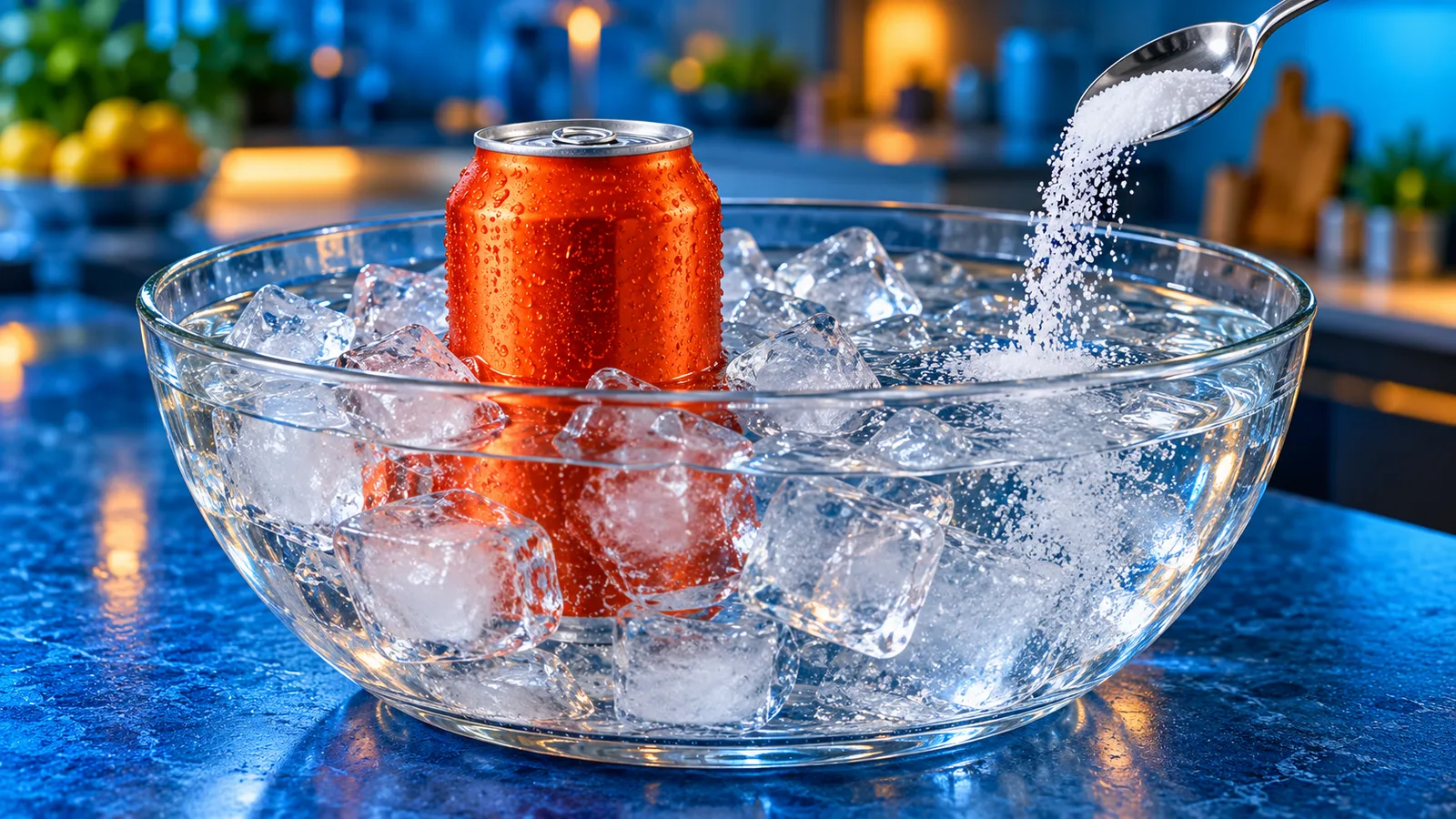
Keep the drink sealed. The salt belongs outside the can, where it changes the freezing behavior of the surrounding water. An ice-and-salt bath can become colder than an ordinary melting-ice bath, helping heat leave the drink more quickly. The Museum of Science demonstrates this practical use of freezing-point depression in its drink-cooling experiment. Museum of Science, Boston
Build a cold bath around the can
Use a bowl or small cooler that gives the can room to sit among plenty of ice. Add cold water to fill the gaps and surround most of the can. Keep its closed top above the bath when practical, then mix ordinary table salt into the water around it.
Stir the bath gently rather than shaking the carbonated drink. Check the can regularly, remove it when it is cold enough, and rinse and dry the top before opening. These are practical handling steps for keeping salty water away from the opening.
There is no universal amount of salt for every bowl: the size of the bath, the quantity of ice, and how much water you add all change the mixture. As a teaching example, Australian National University uses half a cup of table salt mixed through a container of ice. Treat that as an example setup, rather than a precise recipe for any container. Australian National University
Why adding water helps
Ice cubes piled around a curved can touch it at scattered points. The spaces between them contain air, so the whole surface does not have the same contact with something cold. Liquid water fills those spaces and surrounds much more of the metal.
Heat travels from the warmer drink, through the can wall, into the colder surroundings. Moving the bath gently brings water past the can instead of leaving the same small region next to it. The can itself can stay still; the useful motion is in the cooling bath.
Water is doing a different job from salt. It improves contact, while salt changes how cold the liquid portion of the ice bath can remain. Simply pouring lots of room-temperature water over a small handful of cubes would also bring extra heat into the system. Start with plenty of ice and cold water.
What the salt changes
At ordinary pressure, pure water freezes at about 0°C, or 32°F. Dissolved salt lowers that freezing point. Water with salt in it can therefore remain liquid at temperatures where pure water would freeze.
That is the core idea behind freezing-point depression. The American Physical Society describes how adding salt changes the freezing and melting behavior of water, rather than giving the water a mysterious new cooling power. American Physical Society
In a bath containing ice and salty water, ice can melt while the mixture is below 0°C. Melting requires energy, which comes from the bath and its surroundings, including the warmer can. The result can be a colder liquid bath and a larger temperature difference driving heat out of the drink. ANU identifies that larger difference as a reason for faster cooling. Australian National University
A University of Washington demonstration makes the effect especially clear: salt is added to an ice-water mixture initially at 0°C, and its temperature drops. The changing temperature is measurable; it is not a claim that every household bowl instantly reaches the same temperature. University of Washington
Faster does not mean a fixed number of seconds
A small can and a large bottle do not start with the same amount of liquid to cool. Starting temperature, container material, salt concentration, bath temperature, and movement all matter. Check the result instead of relying on a universal countdown.
The same principle is used to make ice cream in a bag: the food stays sealed while an outer ice-and-salt mixture becomes cold enough to remove heat from it. NOAA’s classroom activity compares different salt quantities and explicitly notes that freezing times vary. NOAA
For a warm drink, remember the division of labor: ice supplies the cold reservoir, water improves contact, and dissolved salt lets the icy bath operate at a lower temperature. The drink stays sealed, and the useful change happens around it.
Sources
- Museum of Science, Boston: How to Cool Your Drinks Fast!, May 11, 2023.
- Australian National University: Chill drinks faster.
- American Physical Society: Getting Salty, PhysicsQuest 2019 teaching resource.
- University of Washington, Department of Chemistry: Freezing Point Depression.
- NOAA: Learning Lesson: We all Scream for Ice Cream.