
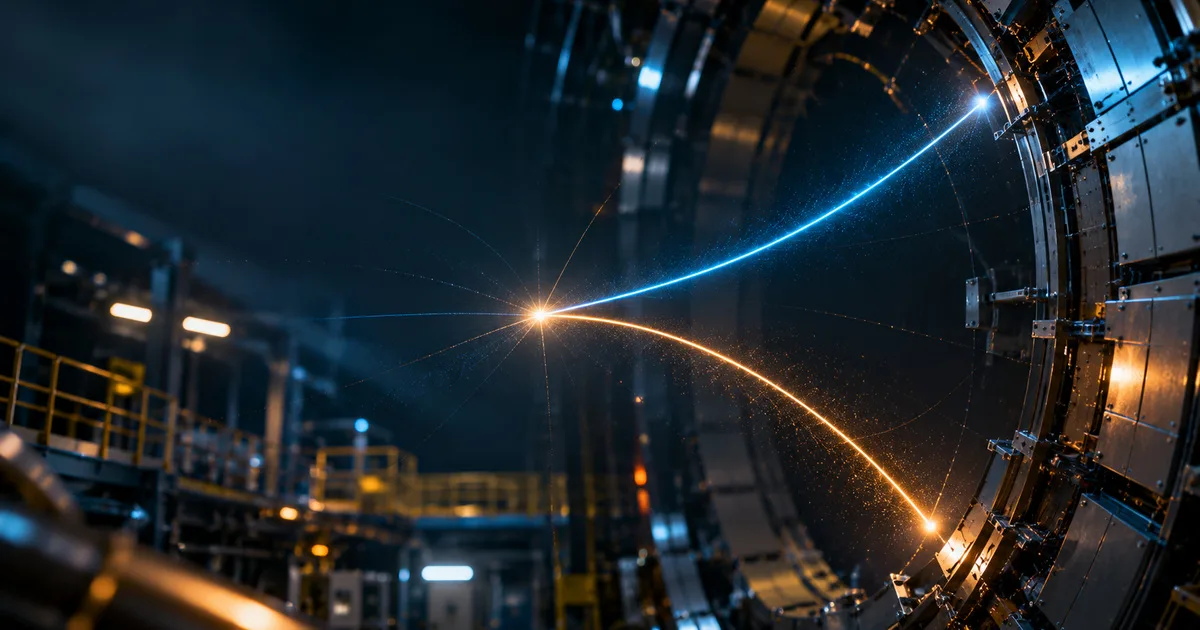
Imagine sorting through ten billion identical-looking envelopes to find a single message. Now imagine that most of the envelopes cannot even be opened directly: you must infer their contents from the marks they leave behind. Physicists at CERN have spent decades pursuing a challenge with a similarly daunting signal-to-noise ratio.
On November 3, 2026, the LHCb collaboration announced the first evidence from a single experiment for an exceptionally rare transformation of a particle called a neutral B meson. In the process, written B⁰ → μ⁺μ⁻, the meson decays into a muon and an antimuon. According to the Standard Model of particle physics, this happens roughly once in every ten billion B⁰ decays.
The result is an important milestone, not a confirmed discovery. It reaches 3.2 sigma when the newest measurements are combined with earlier LHCb data, below the conventional five-sigma threshold for an observation. It also agrees with the existing theory rather than contradicting it.
So why spend more than 40 years looking for something scientists already expected to exist? Because a process this rare can become an exceptionally sensitive way to detect the influence of particles we have never seen.
The tiny event behind the enormous headline
The particle at the heart of the story is a B⁰ meson, also called a neutral beauty meson. Mesons are short-lived particles made from a quark and an antiquark. A B⁰ contains a beauty (or bottom) quark and a down-type antiquark, or the corresponding charge-conjugate combination. Its lifetime is only about a trillionth of a second before it transforms into other particles.
The particular transformation investigated at CERN produces exactly two charged particles: a muon and an antimuon. A muon belongs to the same family as an electron. It has the same magnitude of electric charge but is much heavier. Its antiparticle has the opposite charge.
The striking part is what does not appear among the final particles. Most ways a B meson can decay are far more common. In contrast, the route to just two muons is heavily suppressed by the rules governing the weak interaction and by the way quarks can change type. In the Standard Model, it can happen through subtle higher-order quantum processes, often illustrated with virtual-particle loops in Feynman diagrams.
The researchers did not watch a single B meson break apart with a microscopic camera. Subatomic decays are reconstructed statistically from the detectable particles they leave in instruments. This distinction is central to understanding both the breakthrough and its limits.
The LHCb research paper gives the Standard Model prediction for the probability, called the branching fraction, as (1.03 ± 0.05) × 10⁻¹⁰. Expressed in ordinary language, that is approximately one such decay per 9.7 billion B⁰ meson decays. The familiar “one in ten billion” is a useful rounded description—not a probability that every ten billion proton collisions produces exactly one such event.
How do you find a signal that rare?
The work took place at LHCb, one of the experiments at CERN’s Large Hadron Collider. The accelerator collides beams of protons at extremely high energies. These collisions can produce particles containing beauty quarks, which then decay almost immediately.
LHCb is designed to measure the paths, momenta, and identities of many of the particles emerging from these events. Its tracking detectors reconstruct trajectories, and its muon-identification systems help distinguish muons from other particles. The challenge is that countless processes can produce two muon-like tracks or combinations that imitate the sought-after signature.
Finding the signal requires several steps:
- Identify promising events. The detector and its data-processing systems retain collisions consistent with interesting particle decays.
- Reconstruct two muon tracks. Analysts select oppositely charged muon candidates with properties compatible with a B-meson decay.
- Reject look-alikes. Particle-identification measurements and statistical selection methods reduce backgrounds from other decays and random track combinations.
- Measure their combined mass. By reconstructing the pair’s invariant mass, researchers look for a small excess near the known B⁰ mass.
- Fit the full data distribution. The strength of the possible signal is estimated against models of both genuine signal events and competing backgrounds.
The word signal therefore refers to a statistically meaningful excess in a distribution, not a bright spot that announces itself as a newly found particle.
The upgraded LHCb detector made the search substantially more effective. The new analysis used 18 inverse femtobarns of proton-collision data collected in 2024 and 2025 at a center-of-mass energy of 13.6 teraelectronvolts. An inverse femtobarn measures the integrated exposure to collisions; it is not a count of individual B mesons. The detector’s upgrade improved how much data could be collected and how reliably different particles could be identified.
Researchers also used machine-learning classification, including boosted decision trees, to suppress misleading combinations. Machine learning did not invent the result or replace the physics: it helped sift large amounts of measured data so the statistical analysis could isolate the rare process more cleanly. The team then tested the fitted significance using simulated pseudoexperiments. These methodological details appear in the original study.
What did the numbers actually show?
The data from 2024–2025 alone yielded evidence at approximately 3.0 sigma. When LHCb combined that sample with its earlier measurements from 2011–2018, the significance increased to 3.2 sigma.
The combined analysis reported a B⁰ → μ⁺μ⁻ branching fraction of approximately 1.14 × 10⁻¹⁰, with substantial statistical uncertainty. That central estimate corresponds to about one decay per 8.8 billion B⁰ meson decays, but the uncertainty is large enough that rounding the phenomenon to “one in ten billion” remains appropriate.
Importantly, the measured value is compatible with the Standard Model expectation of 1.03 × 10⁻¹⁰. Physicists have therefore identified evidence for an exceptionally elusive predicted process—not an unexpected departure from known physics.
For readers wanting the technical details, the combined branching-fraction result is (1.14 +0.42/−0.39 [statistical] +0.06/−0.05 [systematic]) × 10⁻¹⁰, as reported by the LHCb collaboration. The statistical uncertainty reflects finite sample size; the systematic uncertainty covers sources such as modeling and measurement calibration.
The same work also sharpened measurements of a related, previously established decay, Bₛ⁰ → μ⁺μ⁻. The Bₛ⁰ meson contains a strange quark rather than a down quark, and its two-muon decay is predicted to happen about 30 times more often. LHCb obtained a branching fraction of around 3.25 × 10⁻⁹ and a measured effective lifetime of 1.60 ± 0.16 ± 0.01 picoseconds. These measurements, too, are consistent with the Standard Model.
What does “3.2 sigma” mean—and why isn’t this a discovery yet?
In particle physics, a measurement can look compelling yet still be a statistical fluctuation or the product of an imperfectly understood background. That is why researchers use a demanding vocabulary.
A result at roughly three sigma is commonly described as evidence. A result at five sigma is the conventional benchmark for claiming an observation or discovery, provided systematic checks and the underlying analysis also stand up to scrutiny. The difference matters: an interesting pattern can weaken or disappear when a larger or better-understood dataset becomes available.
“Sigma” describes how incompatible the observed data are with a specified background-only statistical model. It is not the probability that the physicists are wrong, nor a statement that the phenomenon has a 99.9% chance of being real. The interpretation also depends on the assumptions of the analysis and on how alternative signals and backgrounds were considered.
There is a useful historical warning in this very story. In 2015, a combined analysis involving LHCb and CMS reported evidence for the B⁰ two-muon channel while firmly observing its more common Bₛ⁰ counterpart. Later analyses did not confirm the B⁰ hint. That history is one reason to distinguish today’s single-experiment evidence from a definitive observation.
The current result is stronger in a specific sense: a single collaboration has now obtained evidence above the three-sigma threshold, using its upgraded detector and its own combined datasets. But confirmation with additional data is still the next goal. It is also important that the new manuscript was posted to arXiv on October 30, 2026 and was not yet peer-reviewed when CERN announced the result on November 3.
Why a predicted decay could still reveal new physics
If the decay is behaving as expected, where is the excitement?
Think of the Standard Model as an extraordinarily precise set of instructions for what nature should do. For some processes, it predicts not only whether an event can happen but almost exactly how often it should happen. Rare decays are especially valuable because their ordinary contributions are strongly suppressed. A tiny extra contribution from an unknown particle could therefore have a comparatively noticeable effect on the measured rate.
Quantum mechanics allows particles that cannot be directly produced in a collision to influence the probabilities of other processes through higher-order interactions. Some proposed extensions of the Standard Model contain new Higgs-like particles, heavier force carriers sometimes called Z′ bosons, or hypothetical particles known as leptoquarks. The present analysis does not detect any of them. Instead, it tightens the range of possible ways such particles could affect known interactions.
That approach is complementary to building ever-more-powerful accelerators. A detector can search directly for new particles, but precision measurements can sometimes probe the effects of physics at energy scales beyond the collider’s direct production reach. The LHCb paper discusses the sensitivity of these measurements to new-physics contributions at much higher scales under particular theoretical assumptions.
Researchers can ask more than one question, too. They can measure the frequency of the B⁰ decay, compare it with the Bₛ⁰ process, and study how long the latter particles effectively survive before decaying into two muons. Different extensions of the Standard Model can influence these observables in different ways. Agreement in one measurement does not eliminate every possibility of new physics; it narrows the space in which new effects can hide.
In this case, the central message is not that the Standard Model has failed. It is that scientists have gained a sharper instrument with which to test where it might eventually fail.
Four decades of looking for the same rare event
The search reaches back to the CLEO experiment in 1984, when researchers could set limits on how frequently B⁰ mesons decayed into two muons but could not isolate the signal. As colliders improved, so did experimental sensitivity.
The progress came in stages. The related Bₛ⁰ → μ⁺μ⁻ decay was observed through a joint LHCb–CMS analysis published in 2015. A tentative B⁰ signal in that era did not survive subsequent scrutiny. Later LHCb upgrades made it possible to collect much larger datasets and distinguish background particles more reliably.
On November 3, 2026, after more than forty years of searching, CERN announced evidence for the B⁰ channel from a single experiment. This is a milestone precisely because previous claims had been inconclusive, and because the collaboration has now measured the incredibly small rate close to the value predicted by theory.
The new result will be assessed by other physicists through peer review, independent scrutiny of analysis methods, and future measurements. Researchers hope to reach the five-sigma observation standard with more data. CERN also points to the High-Luminosity LHC era and a proposed further LHCb upgrade in the 2030s as opportunities to improve the sensitivity of these rare-decay tests.
What this result is—and is not
A dramatic headline can leave the impression that scientists discovered a mysterious new particle. They did not. Here is the accurate summary:
- What was found: First single-experiment statistical evidence for the exceptionally rare B⁰ → μ⁺μ⁻ decay.
- How strong: 3.2 sigma when new and earlier LHCb data are combined; more evidence is required for a formal observation.
- How rare: A branching fraction around 10⁻¹⁰—roughly one in ten billion B⁰ meson decays.
- What it tells us: The observed rate is consistent with the Standard Model and further limits some theories involving unknown particles.
- What it does not tell us: It does not establish a new particle, prove a new force exists, or settle the mysteries of dark matter or the matter–antimatter imbalance.
Science often advances by testing very small predictions over very long periods. In this case, the remarkable achievement is not that the universe has behaved strangely. It is that researchers have finally become sensitive enough to detect a process that the universe performs almost never—and to begin measuring it carefully.
If a particle can leave a measurable trace only once in ten billion opportunities, what other hidden effects might become visible when our instruments grow still more precise?
Sources
- LHCb Collaboration (2026). Evidence for the decay B⁰ → μ⁺μ⁻ and improved measurements of the decay Bₛ⁰ → μ⁺μ⁻. Preprint, submitted to Physical Review X; arXiv:2611.00230, first posted October 30, 2026. Primary evidence for measured rates, significance, and experimental methods. Full HTML.
- CERN (November 3, 2026). LHCb finds evidence of one-in-ten-billion particle decay. Official announcement and explanation of the milestone.
- LHCb Outreach (November 3, 2026). Evidence for the decay B⁰ → μ⁺μ⁻ and improved measurements of Bₛ⁰ → μ⁺μ⁻. Experiment’s technical context and combined lifetime measurement.
- University of Cambridge (November 3, 2026). Physicists knock at the door of the zeptoverse. Explanation of the collaboration’s objectives and why the result is preliminary.
- CERN. Terms of Use for CERN Audiovisual Media. Conditions governing reuse of official detector photographs; included for editorial image verification.