
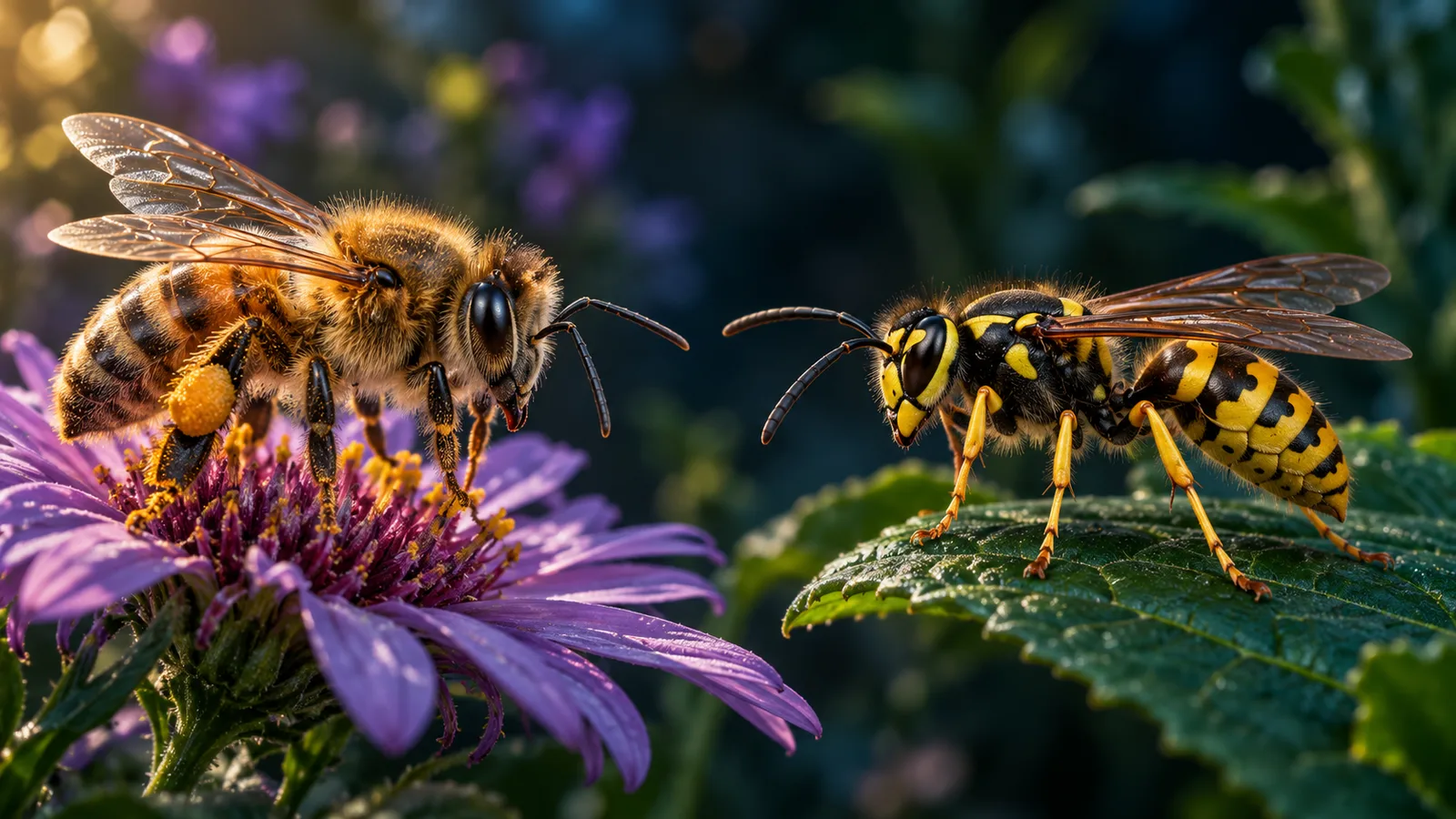
This comparison focuses on the western honey bee, Apis mellifera, and yellowjacket wasps in the genus Vespula. It is not a universal identification key for every bee and wasp. Both groups contain a wide variety of insects, and some flies imitate their appearance. University of Minnesota: Basic Bee ID
1. Look at the body, especially the thorax
A honey bee often looks golden brown, with a noticeably fuzzy thorax and darker bands on the abdomen. Many of its hairs are branched, helping pollen cling to its body as it moves among flowers.
A yellowjacket usually presents a brighter yellow-and-black pattern on a shinier surface. It still has hairs, but far fewer than the conspicuous coat of a honey bee. Think of the contrast as fuzzy versus glossy, rather than hairy versus completely hairless. University of California IPM
2. Check the hind legs for a pollen load
Worker honey bees have specialized pollen baskets, or corbiculae, on their hind legs. These are areas of the legs bordered by hairs, not separate containers. A forager can pack pollen into a compact load that appears as a yellow or orange lump against each hind leg.
Yellowjackets do not have these pollen baskets. A visible load is therefore a useful clue in this particular comparison. However, a honey bee may return with nectar rather than pollen, so empty legs do not automatically make an insect a wasp. University of Florida: Welcome to the Apiary
3. Notice how the wings rest
When a honey bee is resting, its wings lie flat and unfolded over its back. A resting yellowjacket folds its forewings along their length, making them look like narrow strips.
Watch an insect that has settled rather than trying to judge a blur in flight. Both insects have two pairs of wings; the difference here is their resting posture, not the number of wings. University of Minnesota: Wasps and bees
4. Ask what it is collecting for the colony
Honey bees collect nectar and pollen. Nectar provides carbohydrates, while pollen supplies protein and fats used in feeding the colony, including developing young. Food is processed and shared within the hive.
Yellowjacket workers collect animal protein for their larvae, by hunting insects or, in some species, scavenging other material. A wasp handling a caterpillar is doing useful ecological work, not simply causing trouble. Penn State Extension
Adult wasps also seek sugary food, including nectar. That is why seeing an insect on a flower does not settle its identity. Wasps can transfer pollen between flowers, too. Natural History Museum: What do wasps do?
Put the clues together
| Feature | Honey bee worker | Yellowjacket worker |
|---|---|---|
| Body | Fuzzy thorax; often golden brown | Shinier yellow-and-black surface |
| Hind legs | Pollen baskets; sometimes visibly loaded | No pollen baskets |
| Wings at rest | Flat and unfolded | Forewings folded lengthwise |
| Colony food | Collects nectar and pollen | Collects animal protein for larvae; adults seek sugar |
Several matching clues are more convincing than one color pattern. Observe from a distance and use a photograph if you want a closer look. Neither an attractive flower visitor nor a confident identification is a reason to handle the insect or disturb its nest.
Shiny body, narrow folded wings and no pollen baskets: in this comparison, that points to the yellowjacket. Which detail will you notice first next time?
Sources
- University of Minnesota Extension — Wasps and bees
- University of Minnesota Extension — Basic Bee ID (PDF)
- University of Florida IFAS — Welcome to the Apiary!
- University of California IPM — Yellowjackets and Other Social Wasps
- Penn State Extension — Common Social Bees and Wasps of Pennsylvania
- Natural History Museum — What do wasps do?
Images are AI-generated educational illustrations, not photographs documenting identified specimens. The panels are not a calibrated size comparison.